

Sidebar 3: Measurements
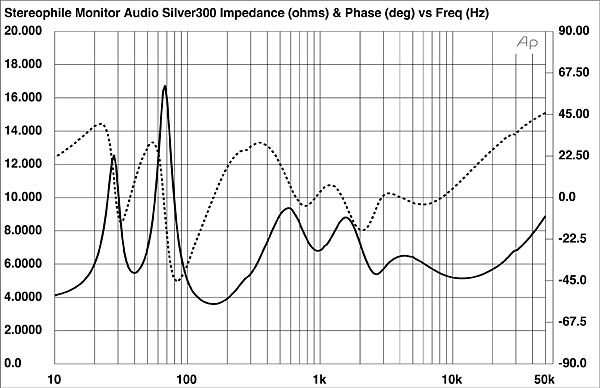
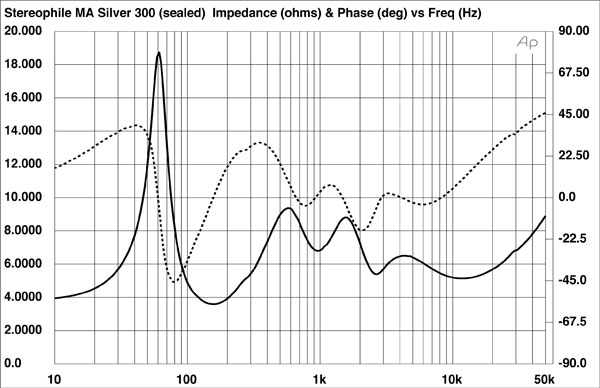
I used DRA Labs' MLSSA system and a calibrated DPA 4006 microphone to measure the Monitor Audio Silver 300's frequency response in the farfield, and an Earthworks QTC-40 for the nearfield responses. My estimate of the Silver 300's sensitivity was 88.8dB(B)/2.83V/m, which is close to the specified 90dB. The Silver 300's nominal impedance is specified as 8 ohms, and its impedance magnitude (fig.1, solid trace) remains between 5 and 9 ohms through almost the entire audioband. Although the minimum magnitude is 3.6 ohms between 150 and 170Hz and there is a combination of 5.4 ohms and –39° at 97Hz, this speaker won't tax the amplifiers with which it is used. With the ports blocked (fig.2) there is a single peak in the bass, centered on 61Hz.
 The top panel and the sides adjacent to the midrange unit were relatively dead to the knuckle-rap test, though lower on the sidewalls there was a strong mode at 449Hz (fig.3). However, as Kal Rubinson didn't mention any midrange congestions that might stem from this resonance, I assume it measures worse than it sounds. (The audibility of a cabinet resonance depends on how large the afflicted area is, its frequency, and the Q or Quality factor).
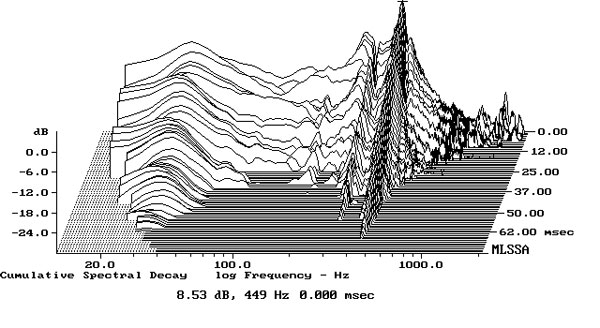


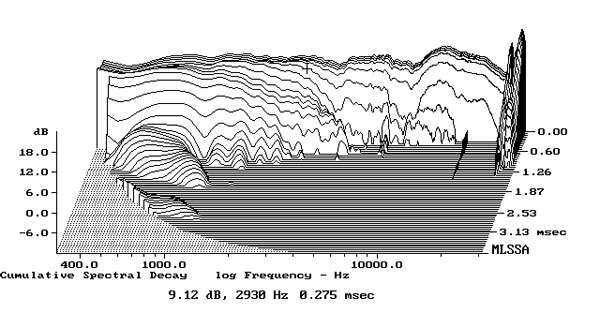
Fig.1 Monitor Audio Silver 300, electrical impedance (solid) and phase (dashed) with ports open (2 ohms/vertical div.).
Fig.2 Monitor Audio Silver 300, electrical impedance (solid) and phase (dashed) with ports blocked (2 ohms/vertical div.).
Fig.3 Monitor Audio Silver 300, cumulative spectral-decay plot calculated from output of accelerometer fastened to center of sidewall level with the midpoint of the two woofers (MLS driving voltage to speaker, 7.55V; measurement bandwidth, 2kHz).
The woofers have identical responses, and the sum of their outputs with the ports blocked is shown as the red trace in fig.4. Their response rolls off with a second-order slope below 70Hz, and the apparent rise in the upper bass in this graph is an artifact of the nearfield measurement technique, which assumes a 2pi acoustic environment; ie, a baffle that extends to infinity in both planes. With the ports open (green trace), the minimum-motion notch at 38Hz suggests that this is the tuning frequency of each of the two ports, and the sum of the port outputs does indeed peak between 25 and 60Hz. The ports behave identically below 200Hz, but the lower port has some low-level output present in the midrange, which can be seen in this graph. The woofers are crossed over to the midrange unit at 715Hz rather than the specified 570Hz, with what appear to be relatively gentle, second-order filter slopes. Two sharp mid-treble peaks can be seen in the woofers' output, but these are well suppressed by the crossover. The response covered by the Silver 300's midrange unit and tweeter (black trace) is impressively flat. (The measurements were taken without the grilles.)
Fig.4 Monitor Audio Silver 300, acoustic crossover on tweeter axis at 50", corrected for microphone response, with nearfield responses of midrange unit (black), woofers with ports blocked (red), woofers with ports open (green), and ports (blue), respectively plotted in the ratios of the square roots of their radiating areas below 450Hz, 312Hz, 350Hz, and 1050Hz.
Fig.5 shows how these individual outputs sum across a 30° horizontal window centered on the tweeter axis. The Silver 300's farfield response is evenly balanced, with only small variations in output and useful low-frequency extension, the bass not rolling off until below 40Hz. The lateral dispersion (fig.6) is wide and even through the midrange to the mid-treble, though the speaker does become increasingly directional above 9kHz. In the vertical plane (not shown), the Monitor speaker maintains its even response over a wide (±10°) angle centered on the tweeter axis, which is 37.5" above the floor.
Fig.5 Monitor Audio Silver 300, anechoic response on tweeter axis at 50", averaged across 30° horizontal window and corrected for microphone response, with complex sum of nearfield midrange, woofer, and port responses plotted below 300Hz.
Fig.6 Monitor Audio Silver 300, lateral response family at 50", normalized to response on tweeter axis, from back to front: differences in response 90–5° off axis, reference response, differences in response 5–90° off axis.
The Silver 300's step response on the tweeter axis (fig.7)—and taking into account the different distance from the microphone of each unit's acoustic center on the flat front baffle—reveals that the tweeter and midrange unit are connected in inverted acoustic polarity and the woofers in positive polarity, but that the decay of each unit's step blends smoothly with the step of the driver next lower in frequency, indicating optimal crossover design. The cumulative spectral-decay plot (fig.8) features superbly clean decay, especially in the midrange, and the tweeter dome resonance just below a high 30kHz can be seen at the far right of this graph.
Fig.7 Monitor Audio Silver 300, step response on tweeter axis at 50" (5ms time window, 30kHz bandwidth).
Fig.8 Monitor Audio Silver 300, cumulative spectral-decay plot on tweeter axis at 50" (0.15ms risetime).
Its measured performance indicates that the Monitor Audio Silver 300, like its predecessor, is a well-engineered design.—John Atkinson















