

Sidebar 3: Measurements
I measured the Monitor Audio Silver 8's farfield frequency response using DRA Labs' MLSSA system and a calibrated DPA 4006 microphone. I used an Earthworks QTC-40 microphone for the nearfield responses, its small, ¼"-diameter capsule offering no significant barrier to the free flow of air through the speaker's ports. The Silver 8 is specified as having a sensitivity of 90dB/W/m; my estimate of its voltage sensitivity was 88.5dB(B)/2.83V/m, which is slightly lower. Though the Silver 8's impedance is specified as 4 ohms, its measured impedance magnitude (fig.1, solid trace) remains at or above 5 ohms for the entire audioband other than the region between 100 and 300Hz, where it reaches a minimum value of 3.5 ohms at 165Hz. The electrical phase angle is generally benign, though there is a combination of –34° and 4.5 ohms at 100Hz, a frequency where music can have high energy. A 4 ohm–rated amplifier or receiver will have no problems driving this speaker to high levels.

 The solid trace in fig.1 indicates that the twin ports are tuned to 48Hz, which is relatively high considering the Silver 8's fairly large cabinet. However, each woofer is loaded with its own chamber and port, and nearfield analysis of the woofer and port outputs reveals that the two bass drivers behave identically below 500Hz, with the top woofer offering a little more output between 500 and 800Hz. The red trace in fig.3 is a composite showing the summed nearfield woofer outputs below 350Hz and their farfield response on the tweeter axis above that frequency. The minimum-motion notch in the woofers' response occurs, as expected, at 48Hz, and the sum of the port outputs (blue trace) peaks broadly between 30 and 80Hz. Though there is a peak in the ports' output in the midrange, this is well down in level. The woofers appear to be crossed over to the midrange unit (green trace) at around 650Hz (higher than the specified 500Hz), with a steep rolloff above that frequency. Though sharply defined resonant peaks are visible at 5.5kHz and 7kHz, these are well suppressed by the crossover. The tweeter's output appears from fig.3 to be balanced 2–3dB higher than that of the midrange driver, but the sharply defined peak due to its fundamental dome resonance occurs at a commendably high 29kHz.


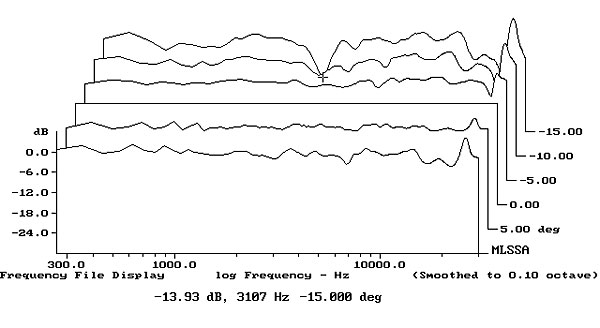


Fig.1 Monitor Audio Silver 8, electrical impedance (solid) and phase (dashed) (2 ohms/vertical div.).
A significant discontinuity just below 300Hz in the impedance traces suggests some sort of cabinet-resonance problem at that frequency. I did find a strong resonant mode at 301Hz on the top and rear panels (fig.2), and another strong mode at 410Hz on the side panels, level with the midrange unit. Lower, and level with the woofers, the side panels were relatively inert; as Kalman Rubinson commented that "male voices . . . didn't sound overripe," it's probable that these resonances measure worse than they sound.
Fig.2 Monitor Audio Silver 8, cumulative spectral-decay plot calculated from output of accelerometer fastened to center of rear panel midway between ports (MLS driving voltage to speaker, 7.55V; measurement bandwidth, 2kHz).
Fig.3 Monitor Audio Silver 8, acoustic crossover on tweeter axis at 50", with nearfield responses of: midrange unit (green), woofers (red), ports (blue), respectively plotted below 500Hz, 350Hz, 650Hz.
Fig.4 shows the Silver 8's overall response on its tweeter axis at 50", averaged across a 30° horizontal window and spliced at 300Hz to the complex sum of the individual nearfield responses. Other than the slight excess of energy in the tweeter's passband, the response is impressively even and flat. The small rise in the upper bass will be entirely due to the nearfield measurement technique, and the speaker's low frequencies extend to 40Hz, –6dB. KR did describe the speaker's low end as being "in good balance," and wrote that the louder he pushed the twin 6" woofers, "the more power and impact the Silver 8s delivered, without boom."
Fig.4 Monitor Audio Silver 8, anechoic response on tweeter axis at 50", averaged across 30° horizontal window and corrected for microphone response, with complex sum of nearfield responses plotted below 300Hz.
The Silver 8's plot of lateral dispersion, normalized to the tweeter-axis response (fig.5), has a textbook appearance below 8kHz, with smooth, even contour lines. The speaker becomes more directional above that frequency, which will tend to compensate for the excess on-axis energy in the same region. In the vertical plane (fig.6), the smooth tweeter-axis response is maintained over a wide angle of ±10°. Only at 15° above the tweeter axis does a suckout appear at the upper crossover frequency, 3.1kHz (rather than the specified 2.7kHz).
Fig.5 Monitor Audio Silver 8, lateral response family at 50", normalized to response on tweeter axis, from back to front: differences in response 90–5° off axis, reference response, differences in response 5–90° off axis.
Fig.6 Monitor Audio Silver 8, vertical response family at 50", normalized to response on tweeter axis, from back to front: differences in response 15–5° above axis, reference response, differences in response 5–10° below axis.
The Silver 8's step response on its tweeter axis (fig.7) shows that the tweeter and midrange unit are connected in inverted acoustic polarity, the woofers in positive polarity. More important than the polarities (see "Letters," November 2014, p.11) is the fact that the decay of each unit's step smoothly blends with the start of the decay of the next step lower in frequency, which suggests optimal crossover design. The cumulative spectral-decay plot on the tweeter axis (fig.8) is superbly clean other than a small degree of delayed energy at 7kHz, this most likely from the metal-cone woofers.
Fig.7 Monitor Audio Silver 8, step response on tweeter axis at 50" (5ms time window, 30kHz bandwidth).
Fig.8 Monitor Audio Silver 8, cumulative spectral-decay plot on tweeter axis at 50" (0.15ms risetime).
The Monitor Audio Silver 8 offers superb measured performance at a very competitive price. I am not surprised that KR liked this speaker as much as he did.—John Atkinson















