

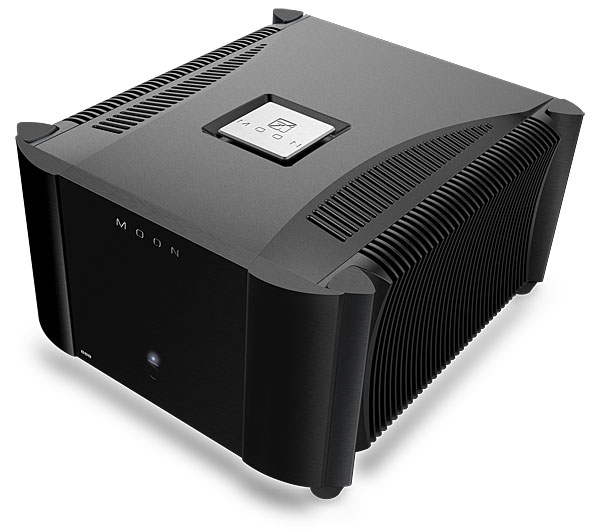
Although the class-AB Moon 888 consumes a relatively low 50W at idle, its prodigious power output and linear power supply mean that it won't be the most energy-efficient device in your home. It has two standby modes: Low Power and Default. Though Low Power powers down all but the logic circuit, Simaudio recommends using Default mode, in which the gain stages remain active. This maintains the 888's ideal operating temperature: it's always ready to play, without warmup. Whether your concern is environmental or financial—the latter is unlikely, if you're dropping $118,888—you're covered.
Sound
The Moon by Simaudio 888s arrived while the EgglestonWorks Viginti speakers were still in my system. I'd spent a few weeks listening to the Vigintis as driven by the darTZeel NHB-458 monoblocks and taken lots of notes. Within a few minutes of listening to Vigintis driven by the Moon 888s, I realized that all of my notes had to be tossed out. For whatever reason(s), the darTZeels weren't able to effectively control or grip the Vigintis' woofers. My notes turned out to be more about the interaction of the darTZeels and EgglestonWorks than about the sound of the speakers themselves. This was yet another reminder that any equipment review, published in Stereophile or elsewhere, should be read only as a rough sketch, not a detailed roadmap—even if the reviewer is a navel-gazer intent on telling you just how discerning and particular his listening abilities are. (And don't get me started about seemingly molecular-level reports from hi-fi shows at which demo systems are set up in hotel rooms.) Don't ever forget: Any equipment review is built only on the shaky foundation of the review sample's interactions with the system's other components.
 The Moon 888s' grip on the Vigintis' woofers produced a seismic shift in the speakers' sound. I'd been about to write that the EgglestonWorks had somewhat sloppy, underdamped bass. Now, with what was clearly the right amplification, they were producing a far more enjoyable and reasonably well-controlled visceral wallop. But if you prefer tight, polite bass that stays in the box, look elsewhere.
I listened to the Moon 888s driving the Vigintis, my reference Wilson Audio Alexxes, and Sonus Faber's Aidas (review in the works). For whatever reason(s), the Moon 888s sounded most different from the darTZeel NHB-458s with the EgglestonWorks Vigintis. And both amps sounded different, in different ways, from Boulder Amplifiers' big 2150 monoblocks ($99,000/pair), which I reviewed in February 2017.
The Moon 888 dispelled the myth that high-powered amplifiers are lumbering giants that can't possibly match the nimbleness of lower-powered ones, and that it's best to match the amp to the speakers so that you don't "overpower" them and thus lose speed and resolution of detail.
The Moon 888 nimbly drove all three speakers, including the Sonus Faber Aida, which is specified as having a sensitivity of 92dB and a nominal impedance of 4 ohms. In other words, it could pump a couple of thousand watts into the Aida—a speaker that in my room needs, on average, probably less than 20W! Yet the Moon 888 drove the Aidas with agility. It was comfortable just loafing along, putting out a few class-A watts.
For much of the time the Moon 888s were in my system, I forgot they were there and went on, listening to music and to other components I was reviewing. Believe me—had the 888s produced homogenized sonic boredom or committed obvious aural sins such as grain, etch, smear, or glare, I'd have heard them. If that's not a strong endorsement of the 888's lack of a sonic signature of any sort, I'm not sure what is. Those who think that a powerhouse amp operating at such low ebb might lose focus would be mistaken.
When my attention at last returned to the Moon 888s, I noted, with familiar recordings, their obvious bottom-end grip. It never sounded mechanical or overdamped, though bass was somewhat tighter than through the darTZeels, which sound more relaxed on the bottom. I also noted the Simaudios' solid, vividly three-dimensional imaging and their ability to produce a big soundstage when the recording contained that information.
The Moon 888s' grip on the Vigintis' woofers produced a seismic shift in the speakers' sound. I'd been about to write that the EgglestonWorks had somewhat sloppy, underdamped bass. Now, with what was clearly the right amplification, they were producing a far more enjoyable and reasonably well-controlled visceral wallop. But if you prefer tight, polite bass that stays in the box, look elsewhere.
I listened to the Moon 888s driving the Vigintis, my reference Wilson Audio Alexxes, and Sonus Faber's Aidas (review in the works). For whatever reason(s), the Moon 888s sounded most different from the darTZeel NHB-458s with the EgglestonWorks Vigintis. And both amps sounded different, in different ways, from Boulder Amplifiers' big 2150 monoblocks ($99,000/pair), which I reviewed in February 2017.
The Moon 888 dispelled the myth that high-powered amplifiers are lumbering giants that can't possibly match the nimbleness of lower-powered ones, and that it's best to match the amp to the speakers so that you don't "overpower" them and thus lose speed and resolution of detail.
The Moon 888 nimbly drove all three speakers, including the Sonus Faber Aida, which is specified as having a sensitivity of 92dB and a nominal impedance of 4 ohms. In other words, it could pump a couple of thousand watts into the Aida—a speaker that in my room needs, on average, probably less than 20W! Yet the Moon 888 drove the Aidas with agility. It was comfortable just loafing along, putting out a few class-A watts.
For much of the time the Moon 888s were in my system, I forgot they were there and went on, listening to music and to other components I was reviewing. Believe me—had the 888s produced homogenized sonic boredom or committed obvious aural sins such as grain, etch, smear, or glare, I'd have heard them. If that's not a strong endorsement of the 888's lack of a sonic signature of any sort, I'm not sure what is. Those who think that a powerhouse amp operating at such low ebb might lose focus would be mistaken.
When my attention at last returned to the Moon 888s, I noted, with familiar recordings, their obvious bottom-end grip. It never sounded mechanical or overdamped, though bass was somewhat tighter than through the darTZeels, which sound more relaxed on the bottom. I also noted the Simaudios' solid, vividly three-dimensional imaging and their ability to produce a big soundstage when the recording contained that information.
 4AD Records recently reissued, from high-resolution digital files, the Cocteau Twins' Head Over Heels (LP, 4AD/Beggars Banquet CAD 3709), of which I also have an original 1983 UK pressing. This Scottish duo of Elizabeth Fraser (vocals) and Robin Guthrie (guitar, bass, drum machine) produced an unusual sound that paved the way for the later shoegazer genre. Other than the deep, explosive bass that begins the album, and other bass accents and effects, Head Over Heels sounds as if the mixing engineer used the "echo return" from the board and forgot to include the actual recording—it's bright, jangly, and echoey. A solid-state amp with a hard or rough-edged sound might produce a homogenized glaze instead of separating and defining the individual bright, airy elements, as well as fail to reproduce this recording's prodigious artificial depth and spacey three-dimensionality. But the Moon 888s delivered a pristine rendering, preserving and detailing all of the recording's crystalline threads without smear or glaze. The reissue has deeper, more powerful bass than my 1983 LP, but if all of the original's top-end ice and shimmer was intended, the reissue loses it, while also managing to homogenize and flatten the original's spaciousness.
When I reinserted the darTZeel monoblocks in my system, I could still hear these differences, but not as dramatically. The Moon 888s unmasked everything on top without adding high-frequency and/or transient glaze or smear. High-frequency transients were icy when called for, as in Head Over Heels—they were cleanly rendered and free of smear and/or grit. And the 888s naturally and convincingly delivered the pluck and warmth of nylon guitar strings, such as those on Leonard Cohen's Songs of Leonard Cohen (LP, Columbia CS 9533) or on your favorite Charlie Byrd album—mine is Bossa Nova Pelos Passaros (LP, Riverside RM436/RS9436).
Someone should reissue Clarinet Summit, by clarinetists Alvin Batiste, John Carter, Jimmy Hamilton, and David Murray, recorded live at the Public Theater in 1984 (LP, India Navigation IN-1062). Sadly, all but Murray are now gone. This beautiful recording nails the clarinet's tone and texture, and reveals an amplifier's midrange soul—or the lack thereof. The darTZeels nail it, and, somewhat to my surprise, so did the Moon 888s, though the Simaudios traded some of the clarinet's warm yet reedy roundness and body for a more effective reproduction of this live recording's air and space.
In the superb The Concert Sinatra, Frank Sinatra is accompanied by Nelson Riddle conducting his own arrangements for large orchestra, recorded live to 35mm tape on the Samuel Goldwyn Studios' Soundstage 7 (LP, Reprise RS-1009/Mobile Fidelity Sound Lab MFSL 1-345). The Moon 888s' reproduction of this record produced a vivid, warm, 3D Sinatra hovering in space between the speakers on a cushion of air, with a sense of the voluminous stage behind. If you enjoy 3D sound, the Moon 888s delivered it.
4AD Records recently reissued, from high-resolution digital files, the Cocteau Twins' Head Over Heels (LP, 4AD/Beggars Banquet CAD 3709), of which I also have an original 1983 UK pressing. This Scottish duo of Elizabeth Fraser (vocals) and Robin Guthrie (guitar, bass, drum machine) produced an unusual sound that paved the way for the later shoegazer genre. Other than the deep, explosive bass that begins the album, and other bass accents and effects, Head Over Heels sounds as if the mixing engineer used the "echo return" from the board and forgot to include the actual recording—it's bright, jangly, and echoey. A solid-state amp with a hard or rough-edged sound might produce a homogenized glaze instead of separating and defining the individual bright, airy elements, as well as fail to reproduce this recording's prodigious artificial depth and spacey three-dimensionality. But the Moon 888s delivered a pristine rendering, preserving and detailing all of the recording's crystalline threads without smear or glaze. The reissue has deeper, more powerful bass than my 1983 LP, but if all of the original's top-end ice and shimmer was intended, the reissue loses it, while also managing to homogenize and flatten the original's spaciousness.
When I reinserted the darTZeel monoblocks in my system, I could still hear these differences, but not as dramatically. The Moon 888s unmasked everything on top without adding high-frequency and/or transient glaze or smear. High-frequency transients were icy when called for, as in Head Over Heels—they were cleanly rendered and free of smear and/or grit. And the 888s naturally and convincingly delivered the pluck and warmth of nylon guitar strings, such as those on Leonard Cohen's Songs of Leonard Cohen (LP, Columbia CS 9533) or on your favorite Charlie Byrd album—mine is Bossa Nova Pelos Passaros (LP, Riverside RM436/RS9436).
Someone should reissue Clarinet Summit, by clarinetists Alvin Batiste, John Carter, Jimmy Hamilton, and David Murray, recorded live at the Public Theater in 1984 (LP, India Navigation IN-1062). Sadly, all but Murray are now gone. This beautiful recording nails the clarinet's tone and texture, and reveals an amplifier's midrange soul—or the lack thereof. The darTZeels nail it, and, somewhat to my surprise, so did the Moon 888s, though the Simaudios traded some of the clarinet's warm yet reedy roundness and body for a more effective reproduction of this live recording's air and space.
In the superb The Concert Sinatra, Frank Sinatra is accompanied by Nelson Riddle conducting his own arrangements for large orchestra, recorded live to 35mm tape on the Samuel Goldwyn Studios' Soundstage 7 (LP, Reprise RS-1009/Mobile Fidelity Sound Lab MFSL 1-345). The Moon 888s' reproduction of this record produced a vivid, warm, 3D Sinatra hovering in space between the speakers on a cushion of air, with a sense of the voluminous stage behind. If you enjoy 3D sound, the Moon 888s delivered it.
 Compared to my reference darTZeels, which do a damn good job of it, too, the Moon 888s produced "blacker" backgrounds and more air, without in any way sacrificing the rich sheen of Riddle's massed strings. There was nothing boring and/or homogenized about the 888s' sound—and nothing that sounded analytical or mechanical.
I've concentrated on the Moon 888's reproductions of the midrange and high frequencies in part because, when I first heard them in January 2017, at the Consumer Electronics Show, the sound in the room, for whatever reason(s), was unpleasantly icy, and audiophiles who don't appreciate solid-state amplifiers often call attention to this area. In my system, it was where the Moon 888 was most impressive.
Conclusions
Compared to my reference darTZeels, which do a damn good job of it, too, the Moon 888s produced "blacker" backgrounds and more air, without in any way sacrificing the rich sheen of Riddle's massed strings. There was nothing boring and/or homogenized about the 888s' sound—and nothing that sounded analytical or mechanical.
I've concentrated on the Moon 888's reproductions of the midrange and high frequencies in part because, when I first heard them in January 2017, at the Consumer Electronics Show, the sound in the room, for whatever reason(s), was unpleasantly icy, and audiophiles who don't appreciate solid-state amplifiers often call attention to this area. In my system, it was where the Moon 888 was most impressive.
Conclusions
Not having heard Simaudio's less costly Moon 880M monoblock, which was reviewed by Brian Damkroger in June 2013, I can't be sure, but I'd bet the Moon 888 sounds similar, albeit with greater nuance, grace, and finesse, especially in the upper octaves, and greater transparency overall. Of course, if the recording is poor, you're going to hear that poorness in all its awful glory—but that's not the amplifier's fault. However, with the best recordings, regardless of genre or whether it was on LP, CD, or hi-rez file, the Moon 888s produced the highest level of sound quality in my system, passing along warmth or chills, transparency or sludge, grain or greatness, as dictated not by the electronics but by the recording itself. To say that the Moon 888s delivered what I'd expect and demand for $118,888/pair is not to say that it will necessarily meet the expectations of every audiophile, especially those who prefer warmth and, perhaps, a more fleshed-out harmonic presentation even if it's not on the recording. But they sure met mine. Given a choice between the Moon by Simaudio 888, the Boulder 2150, and the very different-sounding Ypsilon Hyperion, which would I choose? That's my business. Which you'd choose is yours. I'm sticking with the darTZeel NHB-458s. They're not perfect, nor are any of the three mentioned above, including the Moon by Simaudio 888—to some degree, they all "sound." But based on what I've heard, clearing out Simaudio's skunkworks closet has paid off. Hopefully, the sonic gains made at the top of the Moon line will eventually trickle down to more affordable models at the middle and bottom.
The Moon by Simaudio 888s arrived while the EgglestonWorks Viginti speakers were still in my system. I'd spent a few weeks listening to the Vigintis as driven by the darTZeel NHB-458 monoblocks and taken lots of notes. Within a few minutes of listening to Vigintis driven by the Moon 888s, I realized that all of my notes had to be tossed out. For whatever reason(s), the darTZeels weren't able to effectively control or grip the Vigintis' woofers. My notes turned out to be more about the interaction of the darTZeels and EgglestonWorks than about the sound of the speakers themselves. This was yet another reminder that any equipment review, published in Stereophile or elsewhere, should be read only as a rough sketch, not a detailed roadmap—even if the reviewer is a navel-gazer intent on telling you just how discerning and particular his listening abilities are. (And don't get me started about seemingly molecular-level reports from hi-fi shows at which demo systems are set up in hotel rooms.) Don't ever forget: Any equipment review is built only on the shaky foundation of the review sample's interactions with the system's other components.
The Moon 888s' grip on the Vigintis' woofers produced a seismic shift in the speakers' sound. I'd been about to write that the EgglestonWorks had somewhat sloppy, underdamped bass. Now, with what was clearly the right amplification, they were producing a far more enjoyable and reasonably well-controlled visceral wallop. But if you prefer tight, polite bass that stays in the box, look elsewhere.
I listened to the Moon 888s driving the Vigintis, my reference Wilson Audio Alexxes, and Sonus Faber's Aidas (review in the works). For whatever reason(s), the Moon 888s sounded most different from the darTZeel NHB-458s with the EgglestonWorks Vigintis. And both amps sounded different, in different ways, from Boulder Amplifiers' big 2150 monoblocks ($99,000/pair), which I reviewed in February 2017.
The Moon 888 dispelled the myth that high-powered amplifiers are lumbering giants that can't possibly match the nimbleness of lower-powered ones, and that it's best to match the amp to the speakers so that you don't "overpower" them and thus lose speed and resolution of detail.
4AD Records recently reissued, from high-resolution digital files, the Cocteau Twins' Head Over Heels (LP, 4AD/Beggars Banquet CAD 3709), of which I also have an original 1983 UK pressing. This Scottish duo of Elizabeth Fraser (vocals) and Robin Guthrie (guitar, bass, drum machine) produced an unusual sound that paved the way for the later shoegazer genre. Other than the deep, explosive bass that begins the album, and other bass accents and effects, Head Over Heels sounds as if the mixing engineer used the "echo return" from the board and forgot to include the actual recording—it's bright, jangly, and echoey. A solid-state amp with a hard or rough-edged sound might produce a homogenized glaze instead of separating and defining the individual bright, airy elements, as well as fail to reproduce this recording's prodigious artificial depth and spacey three-dimensionality. But the Moon 888s delivered a pristine rendering, preserving and detailing all of the recording's crystalline threads without smear or glaze. The reissue has deeper, more powerful bass than my 1983 LP, but if all of the original's top-end ice and shimmer was intended, the reissue loses it, while also managing to homogenize and flatten the original's spaciousness.
When I reinserted the darTZeel monoblocks in my system, I could still hear these differences, but not as dramatically. The Moon 888s unmasked everything on top without adding high-frequency and/or transient glaze or smear. High-frequency transients were icy when called for, as in Head Over Heels—they were cleanly rendered and free of smear and/or grit. And the 888s naturally and convincingly delivered the pluck and warmth of nylon guitar strings, such as those on Leonard Cohen's Songs of Leonard Cohen (LP, Columbia CS 9533) or on your favorite Charlie Byrd album—mine is Bossa Nova Pelos Passaros (LP, Riverside RM436/RS9436).
Someone should reissue Clarinet Summit, by clarinetists Alvin Batiste, John Carter, Jimmy Hamilton, and David Murray, recorded live at the Public Theater in 1984 (LP, India Navigation IN-1062). Sadly, all but Murray are now gone. This beautiful recording nails the clarinet's tone and texture, and reveals an amplifier's midrange soul—or the lack thereof. The darTZeels nail it, and, somewhat to my surprise, so did the Moon 888s, though the Simaudios traded some of the clarinet's warm yet reedy roundness and body for a more effective reproduction of this live recording's air and space.
Compared to my reference darTZeels, which do a damn good job of it, too, the Moon 888s produced "blacker" backgrounds and more air, without in any way sacrificing the rich sheen of Riddle's massed strings. There was nothing boring and/or homogenized about the 888s' sound—and nothing that sounded analytical or mechanical.
I've concentrated on the Moon 888's reproductions of the midrange and high frequencies in part because, when I first heard them in January 2017, at the Consumer Electronics Show, the sound in the room, for whatever reason(s), was unpleasantly icy, and audiophiles who don't appreciate solid-state amplifiers often call attention to this area. In my system, it was where the Moon 888 was most impressive.
Not having heard Simaudio's less costly Moon 880M monoblock, which was reviewed by Brian Damkroger in June 2013, I can't be sure, but I'd bet the Moon 888 sounds similar, albeit with greater nuance, grace, and finesse, especially in the upper octaves, and greater transparency overall. Of course, if the recording is poor, you're going to hear that poorness in all its awful glory—but that's not the amplifier's fault. However, with the best recordings, regardless of genre or whether it was on LP, CD, or hi-rez file, the Moon 888s produced the highest level of sound quality in my system, passing along warmth or chills, transparency or sludge, grain or greatness, as dictated not by the electronics but by the recording itself. To say that the Moon 888s delivered what I'd expect and demand for $118,888/pair is not to say that it will necessarily meet the expectations of every audiophile, especially those who prefer warmth and, perhaps, a more fleshed-out harmonic presentation even if it's not on the recording. But they sure met mine. Given a choice between the Moon by Simaudio 888, the Boulder 2150, and the very different-sounding Ypsilon Hyperion, which would I choose? That's my business. Which you'd choose is yours. I'm sticking with the darTZeel NHB-458s. They're not perfect, nor are any of the three mentioned above, including the Moon by Simaudio 888—to some degree, they all "sound." But based on what I've heard, clearing out Simaudio's skunkworks closet has paid off. Hopefully, the sonic gains made at the top of the Moon line will eventually trickle down to more affordable models at the middle and bottom.















