

Sidebar 3: Measurements
When I received the sample of the Moonriver 404 Reference that Jason Victor Serinus had auditioned, serial number DK201002153RE, it rattled when I unpacked it. I removed the top cover and saw that the amplifier had incurred damage during its transcontinental journey. The heavy toroidal power transformer is mounted on one side of the large printed circuit board that occupies almost all the amplifier's internal space, with two aluminum straps connecting the board to the central internal heatsink to provide the necessary support. The box must have been dropped on its top during the journey, as the two aluminum straps had fractured, with one loose inside the chassis. When I connected the amplifier to my Audio Precision SYS2722 system (see the January 2008 "As We See It"), the left channel was dead, though I was able to perform a complete set of tests on the right channel using the line-level inputs.
I let Editor Jim Austin and Moonriver's US distributor, Philip O'Hanlon of On a Higher Note, know about the situation. O'Hanlon told me that there would be a running change in production to provide more support for the transformer, and he arranged for Moonriver to ship a second sample to me directly from Sweden.
This sample, serial number DK201120164RE, arrived without shipping damage, and I resumed testing. Although the internal heatsink doesn't look substantial, it is connected to the bottom panel with thermally conductive grease so that the entire chassis can dissipate heat. I preconditioned the amplifier by following the IHF's recommendation of operating it at one-third the specified power into 8 ohms for an hour. At the end of that time, the temperature of the chassis was 100.1°F (37.8°C). The 404 Reference has sufficient heatsink capacity for its rated power.
I looked first at the new sample's behavior via its line inputs. The maximum gain at the loudspeaker outputs was 46dB, which is a little higher than usual for an integrated amplifier. At the preamplifier output, the maximum gain measured 16dB. The 404 Reference preserved absolute polarity (ie, was noninverting) at both its loudspeaker and preamplifier outputs.
The 404 Reference's line input impedance was an appropriately high 24k ohms at 20Hz and 1kHz, dropping to a sufficiently high 17.1k ohms at 20kHz. The manual says that the preamplifier output impedance is "a few ohms." I measured 96 ohms at high and middle frequencies and a higher 1426 ohms at the bottom of the audioband. However, I had problems measuring the behavior of the 404 Reference's preamplifier output due to the presence of high levels of ultrasonic noise (footnote 1). I believe this noise, which had a center frequency around 1.7MHz, was confusing the input of the Audio Precision SYS2722. This noise was present with both samples of the amplifier, and could be the cause of a "buzz" Jason Serinus told me he experienced with the preamplifier output.
The amplifier's output impedance was moderately low, at 0.23 ohms at 20Hz and 1kHz, rising slightly to 0.33 ohms at 20kHz. The modulation of the amplifier's frequency response, due to the Ohm's law interaction between this source impedance and the impedance of our standard simulated loudspeaker, was therefore small, at ±0.25dB (fig.1, gray trace). This graph was taken with the volume control set to its maximum, and the right channel output (red, magenta, and gray traces) was 0.25dB higher than the left (blue and cyan traces). The channel balance improved at lower settings of the volume control, in the range at which it will most often be used. The amplifier rolls off slightly at the top of the audioband, the response reaching –0.4dB at 20kHz and –3dB at 50kHz. This results in a slight lengthening of the waveform's leading edges with the Moonriver's reproduction of a 10kHz squarewave (fig.2). The waveform is free from overshoot and ringing, however.


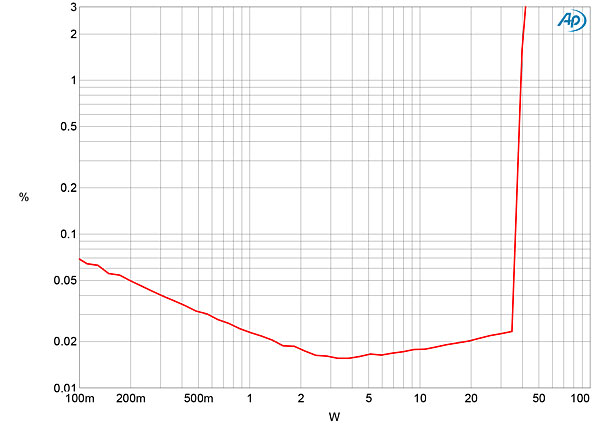
 Fig.4 plots the percentage of THD+noise in the 404 Reference's speaker output vs power into 8 ohms. Though the 404 Reference's maximum power is specified as 50W into 8 ohms (17dBW), using our definition of clipping, which is when the output's percentage of THD+noise reaches 1%, fig.4 indicates that the amplifier clipped at 39.5Wpc into 8 ohms (14dBW). The Moonriver clipped at 60W into 4 ohms (14.8dBW, fig.5). (Both graphs were taken with both channels driven. The first sample's right channel behaved identically.)



 The first sample included the optional USB digital module. I didn't test this, however, as it uses an AKM DAC chip that is no longer available due to a disastrous fire at the Japanese factory in late October 2020. (Moonriver is redesigning this module to use a chip from another manufacturer.) The digital module wasn't installed in the second sample of the amplifier. The 404 Reference's phono input offers moving magnet and moving coil modes, these selectable with internal DIP switches; however, the second sample of the 404 Reference had not been fitted with the phono module: This input behaved identically to the line inputs.
The Moonriver 404 Reference's measured performance had some good points: the low level of power-supply spuriae and the distortion signature, which is primarily the subjectively benign second harmonic without this being accompanied by excessive levels of intermodulation distortion. However, the amplifier does not meet its specified powers. I was also bothered by the high level of ultrasonic noise from the preamplifier outputs.—John Atkinson
The first sample included the optional USB digital module. I didn't test this, however, as it uses an AKM DAC chip that is no longer available due to a disastrous fire at the Japanese factory in late October 2020. (Moonriver is redesigning this module to use a chip from another manufacturer.) The digital module wasn't installed in the second sample of the amplifier. The 404 Reference's phono input offers moving magnet and moving coil modes, these selectable with internal DIP switches; however, the second sample of the 404 Reference had not been fitted with the phono module: This input behaved identically to the line inputs.
The Moonriver 404 Reference's measured performance had some good points: the low level of power-supply spuriae and the distortion signature, which is primarily the subjectively benign second harmonic without this being accompanied by excessive levels of intermodulation distortion. However, the amplifier does not meet its specified powers. I was also bothered by the high level of ultrasonic noise from the preamplifier outputs.—John Atkinson
Footnote 1: The level of this noise was not reduced when I floated the Audio Precision's signal generator ground nor when I connected the grounding terminal on the amplifier's rear panel to the analyzer ground.
Fig.1 Moonriver 404 Reference, frequency response at 2.83V into: simulated loudspeaker load (gray), 8 ohms (left channel blue, right red), 4 ohms (left cyan, right magenta), 2 ohms (green) (1dB/vertical div.).
Fig.02 Moonriver 404 Reference, small-signal 10kHz squarewave into 8 ohms.
Channel separation via the line inputs (not shown) was okay, at 72dB in both directions below 2kHz, decreasing to 48dB, L–R, and 56dB, R–L, at 20kHz. The level of the Moonriver's noise floor dropped at lower settings of the volume control, but even with the control at its maximum, which is the setting I use for noise-floor analysis, supply-related spuriae at 60Hz and its harmonics remained at or below –90dB ref. 1W into 8 ohms (fig.3). The higher-order supply harmonics were around 10dB lower in level in the right channel (red trace) than the left (blue). The wideband, unweighted S/N ratio, taken with the input shorted to ground and the volume control set to its maximum, was 54.7dB, left, and 49.9dB, right, ref. 2.83V output into 8 ohms. Restricting the measurement bandwidth to the audible range improved the ratios to 75.3dB and 74.8dB, respectively, while switching an A-weighting filter into circuit improved the ratio in both channels to 77.8dB.
Fig.3 Moonriver 404 Reference, spectrum of 1kHz sinewave, DC–1kHz, at 1W into 8 ohms with volume control set to its maximum (left channel blue, right red) and "–12.0" (left green, right gray, linear frequency scale).
Fig.4 Moonriver 404 Reference, distortion (%) vs 1kHz continuous output power into 8 ohms.
Fig.5 Moonriver 404 Reference, distortion (%) vs 1kHz continuous output power into 4 ohms.
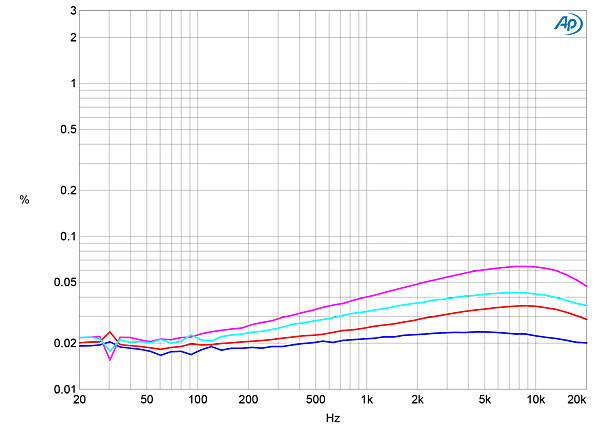
I measured how the 404 Reference's distortion changed with frequency at 12.67V output, which is equivalent to 20W into 8 ohms and 40W into 4 ohms. The THD+N percentage was low in the midrange and bass into both loads (fig.6) but rose in the top audio octaves, more in the right channel (red, magenta traces) than the left (blue, cyan). The distortion is predominantly the subjectively innocuous second harmonic (fig.7) with the third and higher harmonics lower in level, even into 4 ohms (fig.8). Even with the rise in distortion at the top of the audioband, intermodulation distortion was low (fig.9), the difference product at 1kHz resulting from equal-level tones at 19kHz and 20kHz at high power into 4 ohms lying just below –80dB (0.01%).
Fig.6 Moonriver 404 Reference, THD+N (%) vs frequency at 12.67V into: 8 ohms (left blue, right red) and 4 ohms (left cyan, right magenta).
Fig.7 Moonriver 404 Reference, 1kHz waveform at 20W into 8 ohms, 0.02% THD+N (top); distortion and noise waveform with fundamental notched out (bottom, not to scale).
Fig.8 Moonriver 404 Reference, spectrum of 50Hz sinewave, DC–1kHz, at 40W into 4 ohms (left channel blue, right red, linear frequency scale).
Fig.9 Moonriver 404 Reference, HF intermodulation spectrum, DC–30kHz, 19+20kHz at 40W peak into 4 ohms (linear frequency scale).
Footnote 1: The level of this noise was not reduced when I floated the Audio Precision's signal generator ground nor when I connected the grounding terminal on the amplifier's rear panel to the analyzer ground.















