

Sidebar 1: Improved MQA Encoding
In "Into the Fold," my article on MQA in the February 2018 Stereophile, I presented measurements of a particular MQA file (2L 2L-078) showing that MQA encoding caused the MQA file to differ radically from the unencoded DXD (24/352.8) version, adding significant noise even within the audioband—although, as I noted, I found that difference inaudible. In his "Manufacturer's Comment" in that issue, Bob Stuart said that the file in question "was one of the first to be encoded to MQA (in December 2015)," and "one of a dozen albums that used the early Sphynx2 converters; many of these were scheduled to be remastered this winter, and should be available from 2L by the time this issue is available."
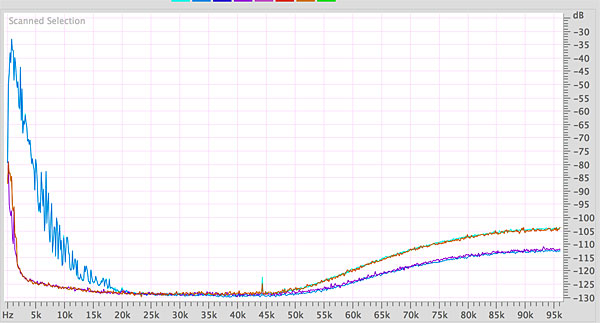
Fig.1 Spectral analysis, 0Hz–96kHz, Prolog for soprano and piano, orange and cyan traces are MQA (music data and noise data, respectively); red and blue are DXD (music and noise, respectively).
After confirming with 2L's Morten Lindberg that the re-encoding had been done and that the new files had been uploaded to 2L's online store, I downloaded the new MQA version. I made the same measurements I made before—and confirmed that the added noise that had been present in the original MQA version was absent from the new MQA version. Shown above is the new MQA version, compared with the DXD version from which it was encoded.— Jim Austin















