For some months now, I've lived mostly without music. To survive the dust and grit of the renovation of our Manhattan apartment, all electronics had to be covered with heavy plastic, the speakers encapsulated in large green lawn bags, and the listening room partitioned off with a temporary wall. We could listen to music with our little 3.1-channel TV system in the den (eh) or through headphones (not!), or we could decamp to our house in Connecticut, which we did as much as possible. I felt deprived. Now that it's all over, I'm grateful to have it back—and grateful for the improvements in the main system, some of them direct byproducts of the renovation.
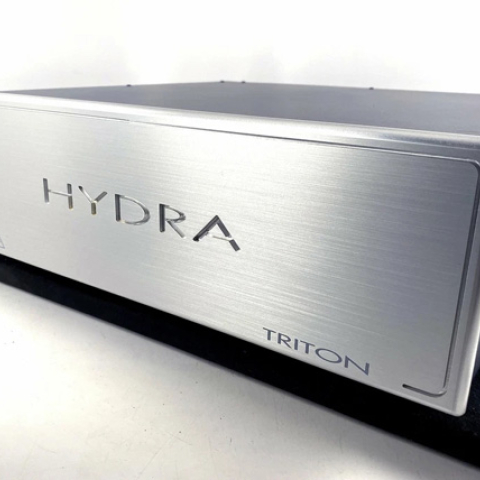
First, we replaced the circuit-breaker box, to increase the current and add circuits. The main rack components retain their dedicated 20A circuit, which feeds them through an AudioQuest Niagara 5000 power conditioner. Now, the power amps and subs at the other end of the room also have their own dedicated circuit. Second, we improved the networking that connects our network-attached storage (NAS) with the music room by installing both copper CAT6A and fiber-optic links between the two rooms in place of MoCA (Multimedia over CoAxial) links. Third, we installed an updated Baetis Prodigy X server.
As for the Prodigy X: In the past, the Baetis servers, with their Intel Core i7 processors, did a bang-up job with every stereo and multichannel music file, including many that had overwhelmed proprietary server hardware based on lesser processors. The Baetises even handled the additional tasks of on-the-fly file conversion, downsampling, upsampling, convolutions, room equalization, and output via Signalyst's HQPlayer app. The trouble was that applying all these operations to the highest-resolution multichannel files—DSD256 and 24-bit/352.8kHz PCM (DXD)—was still just beyond my system's grasp: playback of the whole enchilada, including all apps, was often plagued by infuriating interruptions for buffering.
Baetis's new, fully kitted-out Prodigy X, with i7-7700K at 4.2GHz CPU, 512GB RAM, 1TB SSD drive, SOtM tX-USBhubIN output, and HD-Plex linear power supply, is now running the latest versions of Roon and JRiver Media Center (respectively v1.3/build 247 and v23.0.36), and indeed it did eliminate those occasional hiccups when processing and playing multichannel DSD256—a relief and a pleasure, as I have a lot of those files. Unfortunately, it didn't make much of a difference with my dozen or so DXD files, but why? After all, DXDs are really PCM files of equivalent data density to DSD64, and obviously don't have to be converted to PCM, thereby eliminating a process needed for DSD256. The solution lies elsewhere.
My apartment is part of a Manhattan fortress of concrete and steel. That means I haven't been able to tunnel an Ethernet cable from my modem and router in the room containing my NAS drives directly to the room where my music system lives. The solution, at first, was a pair of Ethernet Powerline adapters—devices that enable the transmission of data through household AC wiring—which I later replaced with much faster and more reliable MoCA adapters, which operate over the coaxial cables already installed for TV by the cable company. With the latter, the LAN speed from NAS to server was a respectable 350Mbs, which served me well—until the processing of DSD256 and DXD files revealed the limits of the setup. I tried playing them from a local, directly connected USB drive, but that didn't help, probably because I was then using a less potent server than the Prodigy X.
The main motivation for the renovation was to install a washer and dryer, which required running new AC lines from a new breaker box (near the music system) to the new laundry (close to the modem/router and NAS). The contractor was willing to run my CAT6a and fiber-optic cables as part of that job.
Hooray! It's had an immediate and substantive effect. Now, every file I can lay hands on plays flawlessly, and the overall result is a perceptible stability and purity of playback of all formats, even with the same DAC, preamp, power amps, and speakers. Inspired by the announcement of Merging Technologies' ZMan—an accessory circuit board, compatible with the audio-specific Ravenna protocol, that the company plans to offer to their OEM partners—I still dream of building my own silent superPC based on a CPU with eight or more cores and communicating via my LAN directly with DACs, amps, and powered speakers that support their own streaming services and DSP processing for decoding or room EQ. That may come, but for now there's nothing to do but enjoy the ride.
Oppo Digital UDP-205 universal disc player
The first Oppo product to be reviewed in Stereophile was the DV-970HD universal DVD player, by Wes Phillips, in the May 2007 issue. A high-value SACD and multichannel player, it sold for $149 and weighed less than 5 lbs. Ever since, Oppo players have been at the leading edge, introducing new features while also improving sound quality, and have become the darlings of value-conscious audiophiles. The latest and, perhaps, greatest Oppo is the new UDP-205 universal Blu-ray player, which weighs a considerable 22 lbs and costs an equally considerable $1299 (footnote 1). From its cutting-edge DACs to its substantial housing, the UDP-205, unlike early Oppos, isn't merely a high-quality, low-cost disc player. The universal encrypted in the prefix UDP means that the UDP-205 can play any commonly available 45/8" silver disc (except HD DVD), and decode and/or output all audio and/or video content. Oppo's packaging has always been exemplary, but now it's fully justified. As I slipped the UDP-205 from its velvet sheath, it was apparent that this player is intended to appeal to senses other than auditory. Its beautiful reinforced case contains a toroidal transformer in its power supply, and enough strategically placed heatsinks to eliminate the need of a ventilating fan.
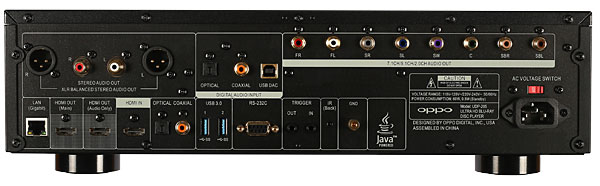 The UDP-205 offers myriad combinations of inputs and outputs. The analog audio output benefits from the use of dual ESS ES9038PRO Sabre Pro DACs, and one of its two HDMI audio outputs features a high-stability, high-precision clock and a special audio jitter-reduction circuit. In both my New York and Connecticut systems, I used the Oppo to play discs, access music files, and as a bridge (footnote 2) or renderer with my servers.
Setup was the same process familiar to users of earlier Oppos, but the menus and screens have been updated to a cleaner appearance. Of course, that's aided by Oppo's complete elimination of the array of external apps featured in those earlier players—no longer are there home-page links to Netflix, YouTube, Tidal, etc. Notable among the new additions are options for digital audio filters. However, the UDP-205 and its stablemate, the UDP-203 ($549), can't be used to rip SACDs, as their predecessors can.
I played mostly SACDs and BDs; the UDP-205 was fast, silent, and deadly effective. Discs loaded briskly, and track changes seemed quicker than with previous Oppos, especially with BDs and streaming.
One of the UDP-205's two HDMI outputs is labeled Audio Only. For that output, the standard video clock is replaced with a dedicated, high-stability, ultra-low-jitter, 148.5MHz master clock, based on an SAW oscillator, that uses a pattern-generator chip to create full black content. This is intended to eliminate the multiplicity of phase-locked loops (PLLs) to provide the clock frequencies for different video formats, and to eliminate the influence of different video formats on the audio, which is embedded in the video blanking interval.
Sound quality via either HDMI output—labeled Main and Audio Only—to my Marantz AV-8802a preamplifier-processor was excellent, but comparing them was difficult. Connecting the Audio Only HDMI output mutes the audio from the Main output, making it impossible to conduct A/B comparisons by using two connections to a pre-pro or A/V receiver. This probably reflects the Oppo's inability to use different clocks for audio over each of the two HDMI outputs simultaneously. And because there is no video from the Audio Only HDMI output, video users who can't bypass their pre-pros for video won't benefit from the Audio Only output's low jitter. This means that you: 1) can't get the superior audio with any video; and 2) can't choose between A/V and superior audio with the pre-pro's input selector.
The UDP-205 offers myriad combinations of inputs and outputs. The analog audio output benefits from the use of dual ESS ES9038PRO Sabre Pro DACs, and one of its two HDMI audio outputs features a high-stability, high-precision clock and a special audio jitter-reduction circuit. In both my New York and Connecticut systems, I used the Oppo to play discs, access music files, and as a bridge (footnote 2) or renderer with my servers.
Setup was the same process familiar to users of earlier Oppos, but the menus and screens have been updated to a cleaner appearance. Of course, that's aided by Oppo's complete elimination of the array of external apps featured in those earlier players—no longer are there home-page links to Netflix, YouTube, Tidal, etc. Notable among the new additions are options for digital audio filters. However, the UDP-205 and its stablemate, the UDP-203 ($549), can't be used to rip SACDs, as their predecessors can.
I played mostly SACDs and BDs; the UDP-205 was fast, silent, and deadly effective. Discs loaded briskly, and track changes seemed quicker than with previous Oppos, especially with BDs and streaming.
One of the UDP-205's two HDMI outputs is labeled Audio Only. For that output, the standard video clock is replaced with a dedicated, high-stability, ultra-low-jitter, 148.5MHz master clock, based on an SAW oscillator, that uses a pattern-generator chip to create full black content. This is intended to eliminate the multiplicity of phase-locked loops (PLLs) to provide the clock frequencies for different video formats, and to eliminate the influence of different video formats on the audio, which is embedded in the video blanking interval.
Sound quality via either HDMI output—labeled Main and Audio Only—to my Marantz AV-8802a preamplifier-processor was excellent, but comparing them was difficult. Connecting the Audio Only HDMI output mutes the audio from the Main output, making it impossible to conduct A/B comparisons by using two connections to a pre-pro or A/V receiver. This probably reflects the Oppo's inability to use different clocks for audio over each of the two HDMI outputs simultaneously. And because there is no video from the Audio Only HDMI output, video users who can't bypass their pre-pros for video won't benefit from the Audio Only output's low jitter. This means that you: 1) can't get the superior audio with any video; and 2) can't choose between A/V and superior audio with the pre-pro's input selector.
Footnote 1: Oppo Digital, Inc., 162 Constitution Drive, Menlo Park, CA 94025. Tel: (650) 961-1118. Web: www.oppodigital.com. Footnote 2: The Oppo UDP-205 can function as a network bridge by receiving multichannel digital input from a server via Ethernet, wired or wireless, and conveying it to a local DAC via its HDMI Audio Only output. It can also do this with two-channel signals via its TosLink or S/PDIF output.
The first Oppo product to be reviewed in Stereophile was the DV-970HD universal DVD player, by Wes Phillips, in the May 2007 issue. A high-value SACD and multichannel player, it sold for $149 and weighed less than 5 lbs. Ever since, Oppo players have been at the leading edge, introducing new features while also improving sound quality, and have become the darlings of value-conscious audiophiles. The latest and, perhaps, greatest Oppo is the new UDP-205 universal Blu-ray player, which weighs a considerable 22 lbs and costs an equally considerable $1299 (footnote 1). From its cutting-edge DACs to its substantial housing, the UDP-205, unlike early Oppos, isn't merely a high-quality, low-cost disc player. The universal encrypted in the prefix UDP means that the UDP-205 can play any commonly available 45/8" silver disc (except HD DVD), and decode and/or output all audio and/or video content. Oppo's packaging has always been exemplary, but now it's fully justified. As I slipped the UDP-205 from its velvet sheath, it was apparent that this player is intended to appeal to senses other than auditory. Its beautiful reinforced case contains a toroidal transformer in its power supply, and enough strategically placed heatsinks to eliminate the need of a ventilating fan.
The UDP-205 offers myriad combinations of inputs and outputs. The analog audio output benefits from the use of dual ESS ES9038PRO Sabre Pro DACs, and one of its two HDMI audio outputs features a high-stability, high-precision clock and a special audio jitter-reduction circuit. In both my New York and Connecticut systems, I used the Oppo to play discs, access music files, and as a bridge (footnote 2) or renderer with my servers.
Setup was the same process familiar to users of earlier Oppos, but the menus and screens have been updated to a cleaner appearance. Of course, that's aided by Oppo's complete elimination of the array of external apps featured in those earlier players—no longer are there home-page links to Netflix, YouTube, Tidal, etc. Notable among the new additions are options for digital audio filters. However, the UDP-205 and its stablemate, the UDP-203 ($549), can't be used to rip SACDs, as their predecessors can.
I played mostly SACDs and BDs; the UDP-205 was fast, silent, and deadly effective. Discs loaded briskly, and track changes seemed quicker than with previous Oppos, especially with BDs and streaming.
Footnote 1: Oppo Digital, Inc., 162 Constitution Drive, Menlo Park, CA 94025. Tel: (650) 961-1118. Web: www.oppodigital.com. Footnote 2: The Oppo UDP-205 can function as a network bridge by receiving multichannel digital input from a server via Ethernet, wired or wireless, and conveying it to a local DAC via its HDMI Audio Only output. It can also do this with two-channel signals via its TosLink or S/PDIF output.