

 "I'm back from Europe, I'm listening to the system, everything is sounding great, then all of a sudden I hear a loud pop," Levy explained. "I see smoke coming out of my AMC CD player! I knew that was going to be the next thing to go, but I'd hoped it wouldn't be in such a flamboyant manor. Anyway, I found an Audiolab 6000CDT transport on eBay for about $450 new in box. Wow, I just wanted something to spin CDs, but holy s*** it really upped the game tremendously which I wasn't expecting at all. Pretty much in stereo nirvana over here!"
 The Music Hall MMF-5 with Goldring 1042 MM cartridge is a solid, entry-level analog machine. "The 1042 is Goldring's top-of-the-line moving magnet cartridge," Levy said. "The beauty of the Goldring cartridge is you can replace the stylus when it's time, just slide it out. I wasn't sure I was going to hear much of a difference between the two analog rigs, but I was pleasantly surprised. I'm not sure if it's because of the moving coil cartridge on the Ariston versus the moving magnet on the Music Hall, but the Ariston brings out much more detail and it's warmer and fuller sounding. The Ariston is a fully suspended turntable, which makes a big difference. It sings like an instrument much more.
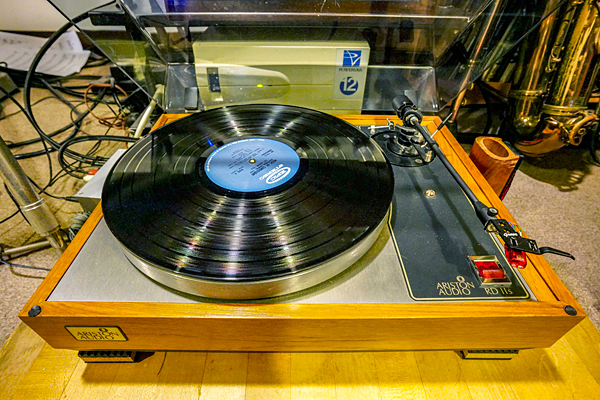 "The Ariston is from the 70s. It's basically a Linn Sondek LP12," Levy continued. "I wasn't sure how technology had improved on analog, but the Ariston sounds great."
 During my first visit to Levy's listening crib, the Audio Research / Aronov combo powered his Spendor / ProAc speakers. My return visit found a used Rogue Audio Cronus Magnum integrated amplifier in their place.
 "The Audio Research/Aronov combo was very good, and it wasn't replaced because I thought the Cronus was better," Levy said. "The Aronov blew a resistor and possibly a tube and I was looking around for a repair shop. ... Between the two, the Audio Research and the Aronov have a bit more detail and are more refined, but not by much. I went from 60 watts a side with the Aronov to 100 watts per channel with the Cronus. The ProAcs love that power, while 60 watts was plenty for the Spendors.
 Perhaps the oddest element in Levy's chain is the power conditioner. "It's a Powervar power conditioner, made for hospital diagnostic equipment," Levy explained. "It's got a giant toroid inside, about 30 pounds of toroidal transformer. Because it's not part of the audio world It cost nothing, like 30 bucks."
 On The Road
When not spinning black discs, rehearsing tunes, or practicing downstairs, Levy maintains a busy performance schedule. The Robson-Levy group toured Europe not long after our first interview, followed by stateside dates at New York City's Birdland (with Robson, drummer Clarence Penn, and bassist Peter Slavov). There's an engagement at Smalls Jazz Club in Greenwich Village August 23 and 24. The Robson-Levy group will play the Bay area in September. On the horizon, there's a tour of Italy in November ,with Levy and drummer Jason Brown joining two Italian musicians for a week of performances and workshops. In August, Levy will perform in the Chicago/Milwaukee area with his old friend, pianist, Jeremy Kahn, including a weekend (August 9 and 10) at Winter's in Chicago. Levy is also working in Peter Leitch's New Life Orchestra, featuring the leader's arrangements of Levy's original material and jazz standards.
 Jazz musicians never have it easy, but Levy counts his blessings. "There are still jazz clubs in the states, but it's hard to weave gigs together because the distance is so great," Levy noted. "And in the states, they don't understand that they need to pay for transportation to get musicians to the date. But the clubs in Europe understand, so it's built into the budget. I don't look at music in a corporate way, my business sense has never been great. I just want to play good music, and I'm fortunate enough to do that. I'm grateful."















