Sidebar 3: Measurements
Other than "+" appended to the name on the amplifier's top and bottom plates, the Brooklyn AMP+ appears identical to the original Brooklyn AMP that was reviewed in the September 2018 issue. I summed up the earlier amplifier's behavior on the test bench by writing "Mytek's Brooklyn AMP is a tiny powerhouse offering respectable measured performance." I used my Audio Precision SYS2722 system (see the January 2008 "As We See It") to test the Brooklyn AMP+. Like its predecessor, the AMP+ has an output stage operating in class-D, so I inserted Audio Precision's auxiliary AUX-0025 passive low-pass filter between the test load and the analyzer. This filter eliminates RF noise that could drive the SYS2722's input circuitry into slew-rate limiting, and I used it for all the tests other than frequency response.
The Brooklyn AMP+ is specified as having a voltage gain of 23 or 29dB, selectable with one of the rear-panel DIP switches. (Setting DIP switch #1 to On allows the amplifier's settings to be adjusted with the switches; otherwise, it is controlled with the Mytek Control app via the rear-panel USB port. I tried both methods.) The voltage gain into 8 ohms measured very close to the specification at 22.9dB and 28.9dB for both balanced and unbalanced inputs. In Bridged mode, the gain was 6dB higher in both gain settings, as expected.
Both sets of inputs preserved absolute polarity (ie, were noninvert-ing) in Normal mode, and the Bridged mode was noninverting when the positive output was taken from the left channel's positive output terminal. The input impedance was 19.8k ohms from 20Hz to 20kHz for the balanced inputs, and 17k ohms at 20Hz and 1kHz for the unbalanced inputs, the latter dropping slightly at 20kHz, to 15k ohms. The output impedance in Normal mode, including a 6', spaced-pair speaker cable, was very low at 0.085 ohms at 20Hz and 1kHz, but rose to 0.3 ohms at 20kHz. As a result, the modulation of the Brooklyn AMP+'s frequency response with our standard simulated loudspeaker was very small in the audioband (fig.1, gray trace). Into 8 ohms (blue and red traces), the response peaked by +0.9dB between 40kHz and 50kHz, before rapidly rolling off to reach –3dB at 80kHz. (The original Brooklyn AMP rolled above 25kHz.) The ultrasonic peak, which is due to the passive low-pass filter that follows the amplifier's class-D output stage, was absent into 4 ohms (cyan and magenta traces) and 2 ohms (green trace). The response into 2 ohms was down by 0.7dB at 20kHz.


 Mytek's website specifies the amplifier's maximum power as 250Wpc into 8 ohms (24dBW), 300Wpc into 4 ohms (21.7dBW), and 400Wpc into 2 ohms (20dBW). Defining clipping as when the THD+noise in the output reaches 1%, I measured the clipping power with both channels driven into 8 ohms as 265W (24.23dBW, fig.4). However, when I tried to measure the clipping power into 4 ohms, the Mytek went into protection mode at 210.4Wpc into 4 ohms (20.2dBW, fig.5). Similarly, the AMP+ went into protection mode at 103.7W into 2 ohms (14.14dBW, not shown). In both cases, the amplifier turned itself on again as soon as I reduced the level of the input signal.


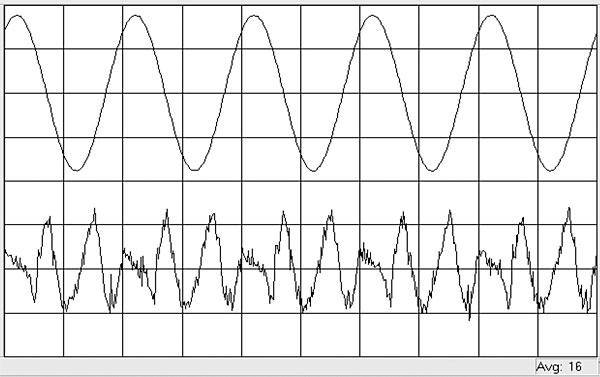
 The THD+N waveform at 50Wpc into 8 ohms (fig.7) suggests that the distortion signature is primarily third harmonic in nature. This was confirmed by spectral analysis of the amplifier's output while it drove 50Hz at 50Wpc into 8 ohms (fig.8). The third harmonic was a little higher in the right channel (red trace), but the second and higher-order harmonics all lay at or below –100dB (0.001%). As implied by fig.6, when I drove the 50Hz tone at the same voltage into 4 ohms the third harmonic increased in level in the right channel but was still relatively low at –74dB (0.02%, fig.9).


 Like its predecessor, Mytek's Brooklyn AMP+ is indeed a tiny powerhouse. It matched the measured performance of the original Brooklyn AMP in most ways but with a wider small-signal bandwidth and a lower level of ultrasonic noise. Even with its hair-trigger protection circuit, it will offer sufficient power into low-impedance loudspeakers with music signals.—John Atkinson
Fig.1 Mytek Brooklyn AMP+, frequency response at 2.83V into: simulated loudspeaker load (gray), 8 ohms (left channel blue, right red), 4 ohms (left cyan, right magenta), 2 ohms (green) (1dB/vertical div.).
The ultrasonic peak into higher impedances is associated with a slight degree of leading-edge overshoot with a 10kHz squarewave (fig.2), but the overshoot is critically damped, with no ringing evident. Channel separation was excellent, at 100dB in both directions below 1kHz, and still 73dB at the top of the audioband. Without the AP low-pass filter there was 98mV of ultrasonic noise present on the Mytek's output, which is significantly lower than with the original Brooklyn AMP, which had 315mV of noise present. With the AP filter, the unweighted, wideband signal/noise ratio, taken with the single-ended inputs shorted to ground, was 78.5dB (average of both channels) ref. 1W into 8 ohms. The S/N ratio improved to a very good 84dB when the measurement bandwidth was restricted to 22Hz–22kHz, and to 86.8dB with an A-weighting filter in circuit. Other than the inevitable ultrasonic noise produced by a class-D design, this is a quiet amplifier. Spectral analysis of the low-frequency noise floor (fig.3) revealed no AC-supply–related harmonics.
Fig.2 Mytek Brooklyn AMP+, small-signal 10kHz squarewave into 8 ohms with Audio Precision AUX-0025 low-pass filter.
Fig.3 Mytek Brooklyn AMP+, spectrum of 1kHz sinewave, DC–1kHz, at 1W into 8 ohms (left channel blue, right red; linear frequency scale).
Fig.4 Mytek Brooklyn AMP+, distortion (%) vs 1kHz continuous output power into 8 ohms.
Fig.5 Mytek Brooklyn AMP+, distortion (%) vs 1kHz continuous output power into 4 ohms.
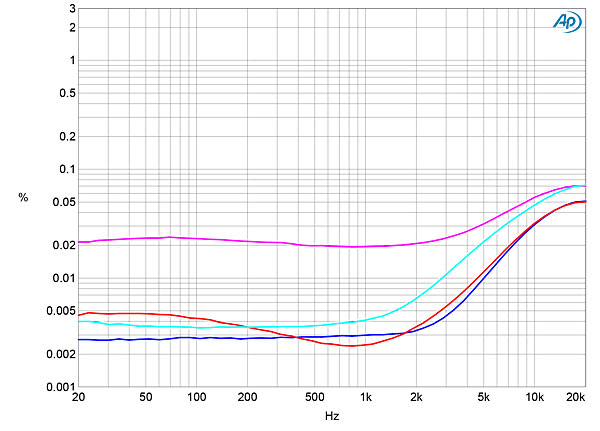
I examined how the Brooklyn's THD+N percentage varied with frequency at 20V (equivalent to 50W into 8 ohms, 100W into 4 ohms, and 200W into 2 ohms). The THD+N was extremely low in the bass and midrange into 8 and 4 ohms (fig.6), with the usual rise in the treble due to the decrease in open-loop voltage gain as the frequency increased. Note the higher level of distortion with the right channel driving 4 ohms (magenta trace) than the left (cyan trace). This graph doesn't show how the THD+N percentage varied into 2 ohms, as the amplifier went into protection at this output voltage.
Fig.6 Mytek Brooklyn AMP+, THD+N (%) vs frequency at 20V into: 8 ohms (left channel blue, right red) and 4 ohms (left cyan, right magenta).
Fig.7 Mytek Brooklyn AMP+, 1kHz waveform at 50W into 8 ohms, 0.003% THD+N (top); distortion and noise waveform with fundamental notched out (bottom, not to scale).
Fig.8 Mytek Brooklyn AMP+, spectrum of 50Hz sinewave, DC–1kHz, at 50W into 8 ohms (left channel blue, right red; linear frequency scale).
Fig.9 Mytek Brooklyn AMP+, spectrum of 50Hz sinewave, DC–1kHz, at 50W into 8 ohms (left channel blue, right red; linear frequency scale).
Despite the decrease in top-octave linearity shown in fig.6, when tested with an equal mix of 19 and 20kHz tones and the signal peaking at 100Wpc into 4 ohms, the Mytek produced low levels of intermodulation distortion (fig.10). The difference product at 1kHz lay at –94dB (0.002%) in the left channel (blue trace) and at –100dB (0.001%) in the right channel (red trace). The higher-order intermodulation products all lay close to or below –80dB (0.01%).
Fig.10 Mytek Brooklyn AMP+, HF intermodulation spectrum, DC–30kHz, 19+20kHz at 100W peak into 4 ohms (left channel blue, right red; linear frequency scale).