

Sidebar 3: Measurements
I measured the Mytek Manhattan II with my Audio Precision SYS2722 system (see the January 2008 As We See It"), using both the Audio Precision's optical and electrical digital outputs and USB data sourced from my MacBook Pro running on battery power with Pure Music 3.0 playing WAV and AIFF test-tone files. Apple's USB Prober utility identified the Mytek as "Manhattan II DAC Control\000" from "Mytek Digital\000," with the serial-number field occupied by "03303-1703-050." The USB port operated in the optimal isochronous asynchronous mode, and Apple's AudioMIDI utility revealed that, via USB, the Mytek accepted 24-bit integer data at all sample rates from 44.1 to 384kHz.
In variable mode with its volume control set to "100," the Mytek's maximum output level at 1kHz was a very high 10.6V from the balanced output jacks, 5.3V from the unbalanced jacks, and 5.3V from the headphone jacks with the headphone gain switch set to High. The two other switch positions reduced the headphone gain by 6 and 12dB. With the setup menu's Phase option set to "Pos," all outputs preserved absolute polarity (ie, were non-inverting) with digital input data except for the bottom headphone jack, which inverted polarity to allow balanced headphone operation, as explained in the manual. The output impedance was a low 74.5 ohms from 20Hz to 20kHz from the unbalanced line-output jacks, this doubling from the balanced jacks, to 149 ohms. From the headphone jacks, the output impedance was a very low 1 ohm.
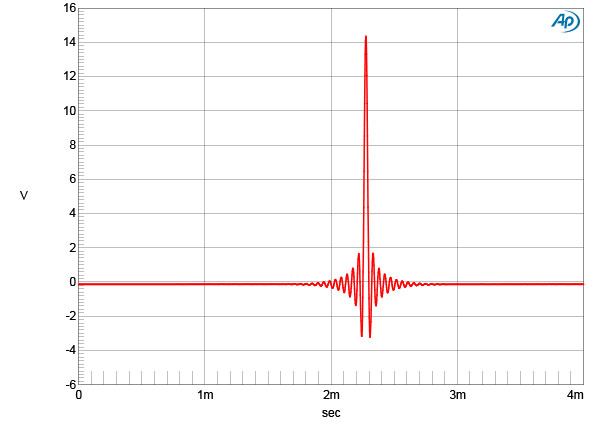
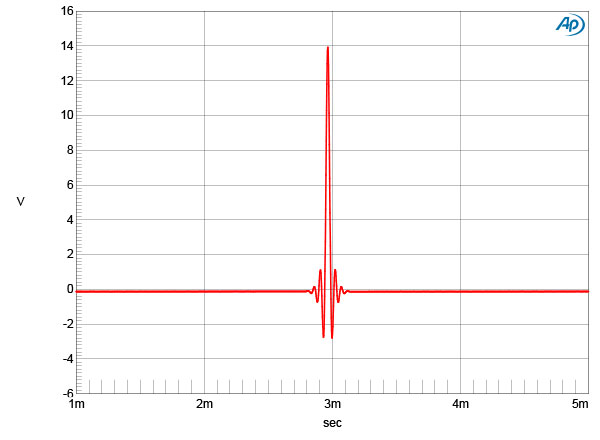
The Manhattan II offers a choice of seven reconstruction filters for PCM data, labeled: FRMP (Fast Rolloff, Minimum Phase), SRMP (Slow Rolloff, Minimum Phase), FRLP and SRLP (respectively, Fast and Slow Rolloff, Linear Phase), APDZ (fast rolloff, linear-phase Apodizing filter), HBRD (Hybrid, fast rolloff, minimum phase), and BRCK (Brickwall). The impulse responses with 44.1kHz data for the linear-phase filters were all similar to that with FRLP (fig.1), with symmetrical ringing either side of the single sample at 0dBFS—except for SRLP, which had much less ringing (fig.2). The FRMP filter's impulse response (fig.3) was as expected, with all ringing following the single high sample, while the SRMP impulse response had less ringing, also as expected (fig.4), and was similar to the MQA filter (fig.5). The HBRD filter's impulse response resembles that in fig.2, but with some pre-ringing visible. The APDZ filter had a linear-phase impulse response, making it very different from the minimum-phase apodizing filters featured in Meridian's processors.






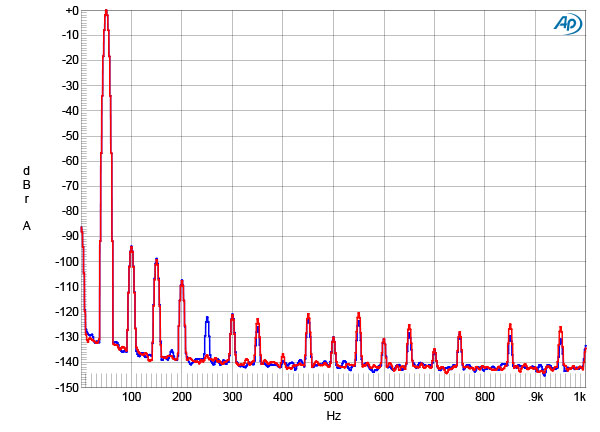
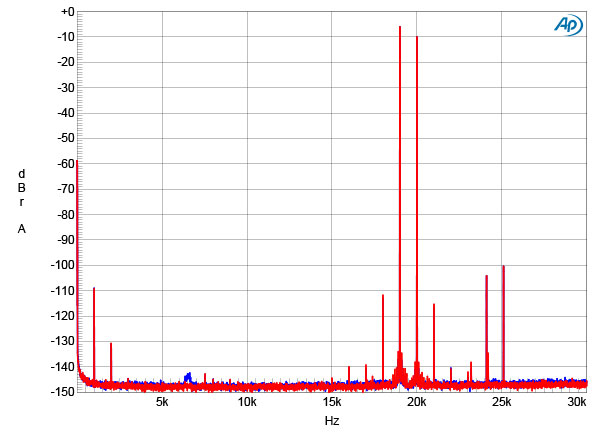
 The Manhattan II has low levels of distortion present in its output, with the second and third harmonics the highest in level (fig.16), though still very low in absolute terms. The levels of these distortion harmonics rose only a little when the processor drove the punishing 600 ohm load, even at maximum output. With the fast-rolloff filters, the Mytek offered very low levels of intermodulation distortion when tested with an equal mix of high-level 19 and 20kHz tones, the signal peaking at 0dBFS (fig.17). As expected, the slow-rolloff filters gave less suppression of the aliased images of the tone at 24.1 and 25.1kHz; also as expected, the MQA filter overloaded with the 0dBFS signal. I therefore reduced the level by 3dB to examine actual intermodulation distortion (fig.18). Intermodulation products were still respectably low, with the 1kHz difference product lying at –112dB (0.00025%), but the aliasing products are suppressed by only 12–16dB. As I write elsewhere in this issue in my review of the Ayre Acoustics QX-5 Twenty digital hub, which also has a slow-rolloff reconstruction filter, it's fortunate that music almost never has high energy at the top of the audioband.

 Turning to the Manhattan II's behavior as a line preamplifier, its analog inputs offered an input impedance of 39k ohms balanced and 10k ohms unbalanced, and a maximum gain of 12dB. Peculiarly, while unbalanced analog input signals were output with the correct polarity, the balanced inputs offered inverted polarity, which suggests that the balanced XLR jacks are wired with pin 3 instead of pin 2 hot. The analog inputs offer very wide bandwidth, and the maximum output was 20V!
Summing up is easy: Mytek's Manhattan II offers superb measured performance.—John Atkinson
Turning to the Manhattan II's behavior as a line preamplifier, its analog inputs offered an input impedance of 39k ohms balanced and 10k ohms unbalanced, and a maximum gain of 12dB. Peculiarly, while unbalanced analog input signals were output with the correct polarity, the balanced inputs offered inverted polarity, which suggests that the balanced XLR jacks are wired with pin 3 instead of pin 2 hot. The analog inputs offer very wide bandwidth, and the maximum output was 20V!
Summing up is easy: Mytek's Manhattan II offers superb measured performance.—John Atkinson
Footnote 1: My thanks to Jürgen Reis of MBL for suggesting this test to me.
Fig.1 Mytek Manhattan II, FRLP filter, impulse response (one sample at 0dBFS, 44.1kHz sampling, 4ms time window).
Fig.2 Mytek Manhattan II, SRLP filter, impulse response (one sample at 0dBFS, 44.1kHz sampling, 4ms time window).
Fig.3 Mytek Manhattan II, FRMP filter, impulse response (one sample at 0dBFS, 44.1kHz sampling, 4ms time window).
Fig.4 Mytek Manhattan II, SRMP filter, impulse response (one sample at 0dBFS, 44.1kHz sampling, 4ms time window).
Fig.5 Mytek Manhattan II, MQA filter, impulse response (one sample at 0dBFS, 44.1kHz sampling, 4ms time window).
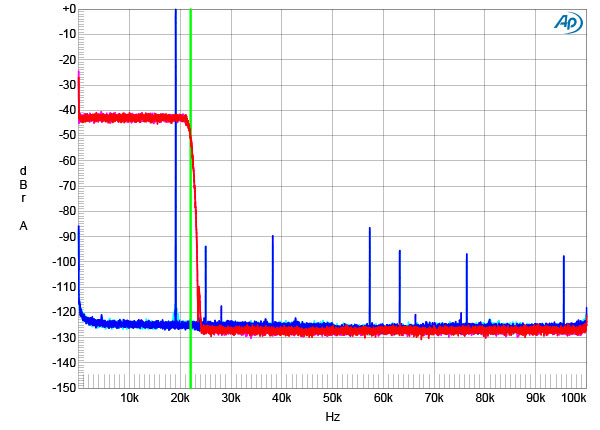
The red and magenta traces in fig.6, taken with FRMP, are identical to those with FRLP, and show that these filters roll off quickly above the audioband (footnote 1), with the image at 25kHz of a full-scale 19.1kHz tone (cyan and blue traces) suppressed by 94dB. With the slow-rolloff filters, the ultrasonic rolloff (fig.7, red and magenta traces) is slower, with the image at 25kHz suppressed by 30dB. As expected, the rolloff with the APDZ filter reaches full attenuation by half the sample rate (fig.8), while with the MQA filter (fig.9), the ultrasonic rolloff is even slower than with SRMP, and identical to that of MQA filters in other processors, I understand this being a condition of the MQA license.
Fig.6 Mytek Manhattan II, FRMP filter, wideband spectrum of white noise at –4dBFS (left channel red, right magenta) and 19.1kHz tone at 0dBFS (left blue, right cyan), with data sampled at 44.1kHz (20dB/vertical div.).
Fig.7 Mytek Manhattan II, SRMP filter, wideband spectrum of white noise at –4dBFS (left channel red, right magenta) and 19.1kHz tone at 0dBFS (left blue, right cyan), with data sampled at 44.1kHz (20dB/vertical div.).
Fig.8 Mytek Manhattan II, APDZ filter, wideband spectrum of white noise at –4dBFS (left channel red, right magenta) and 19.1kHz tone at –1dBFS (left blue, right cyan), with data sampled at 44.1kHz (20dB/vertical div.).
Fig.9 Mytek Manhattan II, MQA filter, wideband spectrum of white noise at –4dBFS (left channel red, right magenta) and 19.1kHz tone at –1dBFS (left blue, right cyan), with data sampled at 44.1kHz (20dB/vertical div.).
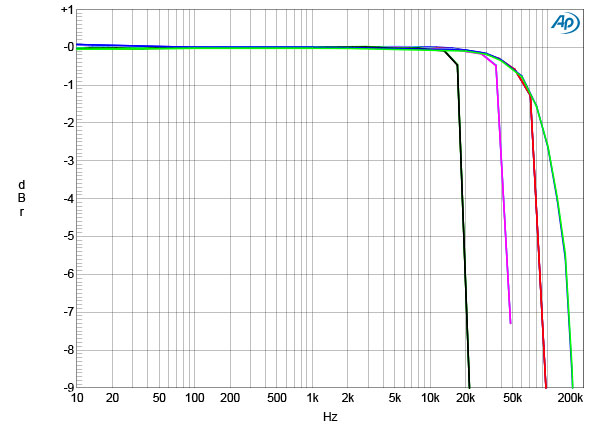
The Mytek's frequency response with FRMP, taken with spot tones at sample rates of 44.1, 96, 192, and 384kHz, is shown in fig.10. Again, the linear-phase filter was identical to the minimum-phase filter, and the response at each rate follows the same basic shape, with a sharp cutoff just below half of each rate. With the slow-rolloff filters (fig.11), again the ultrasonic rolloffs at each rate follow the same shape, but with slower rolloffs overall. The apodizing filter behaved similarly to the responses shown in fig.10, but with data sampled at 44.1kHz (fig.12) there was some ripple evident in the audioband. Passband ripple is felt by some engineers not to be a good thing.
Fig.10 Mytek Manhattan II, MQA filter, frequency response at –12dBFS into 100k ohms with data sampled at: 44.1kHz (left channel green, right gray), 96kHz (left cyan, right magenta), 192kHz (left blue, right red), 384kHz (left blue, right green) (1dB/vertical div.).
Fig.11 Mytek Manhattan II, SRMP filter, frequency response at –12dBFS into 100k ohms with data sampled at: 44.1kHz (left channel green, right gray), 96kHz (left cyan, right magenta), 192kHz (left blue, right red), 384kHz (left blue, right green) (1dB/vertical div.).
Fig.12 Mytek Manhattan II, APDZ filter, frequency response at –12dBFS into 100k ohms with data sampled at: 44.1kHz (left channel green, right gray), 96kHz (left cyan, right magenta), 192kHz (left blue, right red), 384kHz (left blue, right green) (1dB/vertical div.).
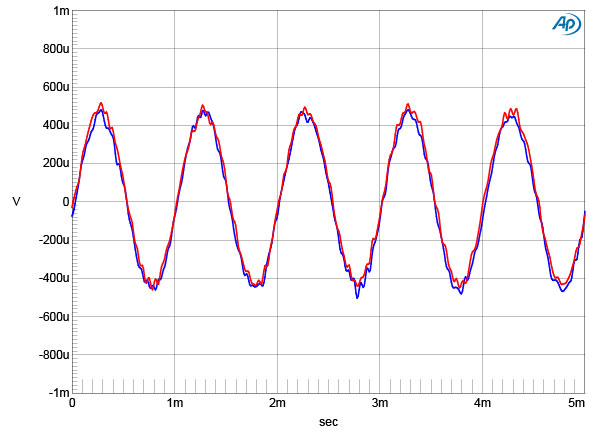
Channel separation (not shown) was excellent, at >110dB below 5kHz, and the Manhattan II's noise floor was free from power-supply–related spuriae. Increasing the bit depth of a dithered 1kHz tone at –90dBFS from 16 to 24 dropped the noise floor by 24dB (fig.13), suggesting a superb resolution of 20 bits, close to the state of the art. The waveform of an undithered tone at exactly –90.31dBFS was symmetrical (fig.14), with the three DC voltages described by the data very well defined. This graph was taken with the MQA filter, and the minimum-phase ringing on the waveform tops and bottoms is clearly visible. The Mytek output a clean sinewave with undithered 24-bit data (fig.15), despite the very low signal level.
Fig.13 Mytek Manhattan II, spectrum with noise and spuriae of dithered 1kHz tone at –90dBFS with: 16-bit data (left channel cyan, right magenta), 24-bit data (left blue, right red) (20dB/vertical div.).
Fig.14 Mytek Manhattan II, waveform of undithered 1kHz sinewave at –90.31dBFS, 16-bit TosLink data (left channel blue, right red).
Fig.15 Mytek Manhattan II, waveform of undithered 1kHz sinewave at –90.31dBFS, 24-bit TosLink data (left channel blue, right red).
Fig.16 Mytek Manhattan II, spectrum of 50Hz sinewave, DC–1kHz, at 0dBFS into 100k ohms (left channel blue, right red; linear frequency scale).
Fig.17 Mytek Manhattan II, BRCK filter, HF intermodulation spectrum, DC–30kHz, 19+20kHz at 0dBFS into 100k ohms, 44.1kHz data (left channel blue, right red; linear frequency scale).
Fig.18 Mytek Manhattan II, MQA filter, HF intermodulation spectrum, DC–30kHz, 19+20kHz at –3dBFS into 100k ohms, 44.1kHz data (left channel blue, right red; linear frequency scale).
The Mytek offered superb rejection of word-clock jitter, with all odd-order harmonics of the undithered low-frequency, LSB-level squarewave in the 16-bit Miller-Dunne J-Test signal lying at the correct levels and with no sideband pairs visible (fig.19).
Fig.19 Mytek Manhattan II, MQA filter, high-resolution jitter spectrum of analog output signal, 11.025kHz at –6dBFS, sampled at 44.1kHz with LSB toggled at 229Hz: 16-bit AES/EBU data (left channel blue, right red). Center frequency of trace, 11.025kHz; frequency range, ±3.5kHz.
Footnote 1: My thanks to Jürgen Reis of MBL for suggesting this test to me.















