Sidebar 3: Measurements
I checked the AC voltage from chassis ground to main (house) ground to determine the correct line-cord orientation. The NAD measured just over 10V (vs just under 19V the "wrong" way—and the plug is not "keyed," footnote 1); this voltage will be shunted to ground when the player is connected to a properly grounded preamplifier.
In order to determine the cause of the slight tracking problems encountered with the player, I checked it with the dropout tests on the Pierre Verany Digital Test CD. The results were perhaps indicative of the problem but not necessarily conclusive: the NAD mistracked first (on the 0.75mm gap). The CD standard only requires tracking of a 0.2mm gap, although theoretically the error-correction codes make regeneration of gaps of up to 2.47mm possible.
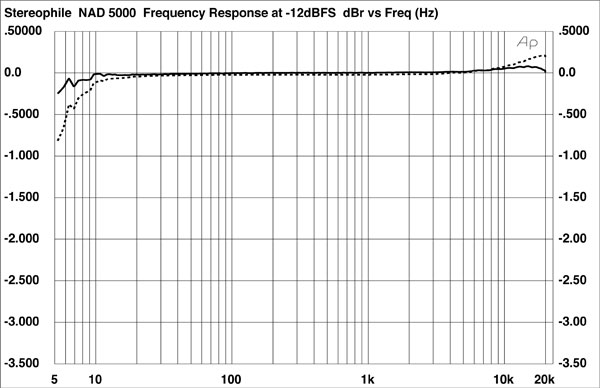
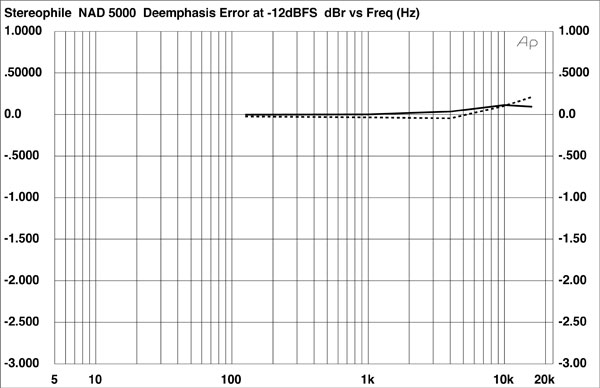
Except for a marginal increase above 10kHz, the NAD's frequency response (fig.1) was ruler-flat. The variable output response is not shown—it was identical to that from the fixed outputs. The slight de-emphasis error (fig.2) was of no practical consequence. The 5000's separation (fig.3), first-rate right up to the limit of the test, remained at or greater than 110dB right up to 10kHz, "deteriorating" to 105dB at 16kHz.

 The NAD 5000 was non-inverting. The output impedance of the NAD was 111 ohms through the fixed outputs. Through the variable outputs it was virtually identical at most settings, dropping to 75 ohms at maximum output. I found the variable outputs to be of minimal usefulness, however, since adjusting the level proved to be a very tricky proposition, a light touch on the remote volume control (the only means of adjustment) causing unpredictable changes in level—usually too much. Measurements indicated that the most fleeting touch on the remote usually resulted in changes of 6dB or so in the output, although, with some finesse, intermediate steps could be found.
Altogether, however, the lab performance of the NAD was among the best we have measured in all respects, and was impossible to fault.—Thomas J. Norton
The NAD 5000 was non-inverting. The output impedance of the NAD was 111 ohms through the fixed outputs. Through the variable outputs it was virtually identical at most settings, dropping to 75 ohms at maximum output. I found the variable outputs to be of minimal usefulness, however, since adjusting the level proved to be a very tricky proposition, a light touch on the remote volume control (the only means of adjustment) causing unpredictable changes in level—usually too much. Measurements indicated that the most fleeting touch on the remote usually resulted in changes of 6dB or so in the output, although, with some finesse, intermediate steps could be found.
Altogether, however, the lab performance of the NAD was among the best we have measured in all respects, and was impossible to fault.—Thomas J. Norton
Footnote 1: That is, both prongs are the same width, enabling it to be plugged into an outlet in any direction. Some audiophiles hold that equipment should be plugged in with an orientation which provides the least voltage on the chassis (before hookup to other equipment) for the best sound. I try to hook up my equipment this way—it costs nothing except investment in a decent voltmeter. Even "keyed" two-prong plugs, incidentally, are not always correctly wired at the factory for the correct orientation (minimum chassis voltage), requiring the use of a cheater plug.
Fig.1 NAD 5000, frequency response at –12dBFS (right channel dashed, 0.5dB/vertical div.).
Fig.2 NAD 5000, de-emphasis error (right channel dashed, 0.5dB/vertical div.).
Fig.3 NAD 5000, channel separation (20dB/vertical div.).
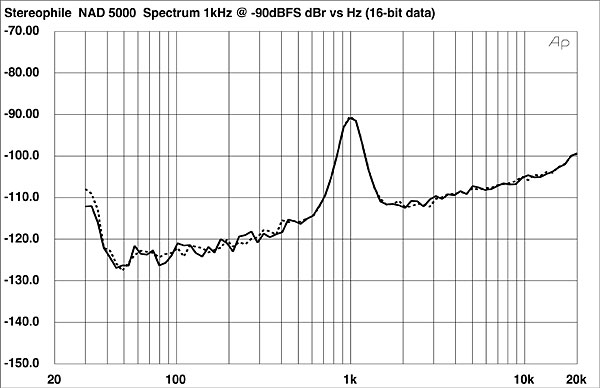
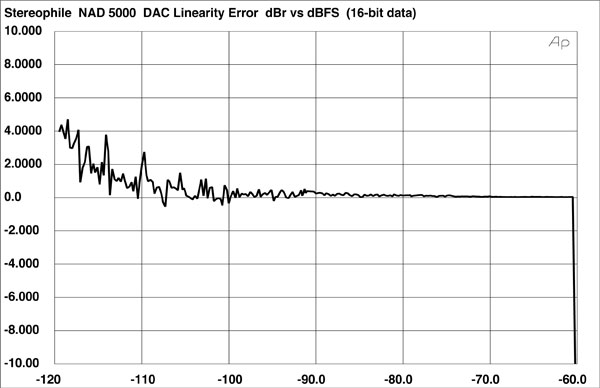
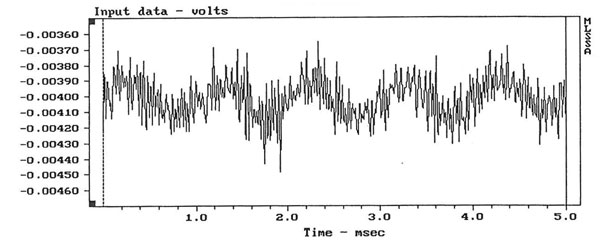
And the spectral analysis of a –90.31dB dithered 1kHz sinewave (fig.4) shows neither distortion harmonics nor power-supply noise (though some low-frequency noise can be seen at 30Hz—generally well down in level). The 5000's linearity at low levels is shown in fig.5. Only the left channel is shown—the right was equally superb and virtually identical, showing less than 1dB departure from the correct level all the way down to –105dB. The waveform of an undithered tone at –90.31dBFS (fig.6) was overlaid with high-frequency noise. The high-frequency IM test (fig.7) indicated performance virtually identical to that of the CAL and Sony—that is, as good as we have ever measured.
Fig.4 NAD 5000, spectrum of dithered 1kHz tone at –90dBFS, with noise and spuriae (16-bit data, right channel dashed).
Fig.5 NAD 5000, right-channel departure from linearity (2dB/vertical div.).
Fig.6 NAD 5000, waveform of undithered 1kHz sinewave at –90.31dBFS.
Fig.7 NAD 5000, HF intermodulation spectrum, DC–22kHz, 19+20kHz at 0dBFS (linear frequency scale, 20dB/vertical div.).
Footnote 1: That is, both prongs are the same width, enabling it to be plugged into an outlet in any direction. Some audiophiles hold that equipment should be plugged in with an orientation which provides the least voltage on the chassis (before hookup to other equipment) for the best sound. I try to hook up my equipment this way—it costs nothing except investment in a decent voltmeter. Even "keyed" two-prong plugs, incidentally, are not always correctly wired at the factory for the correct orientation (minimum chassis voltage), requiring the use of a cheater plug.