

Sidebar 3: Measurements
I measured the Naim NAIT 5si using my top-of-the-line Audio Precision SYS2722 system (see www.ap.com, and the January 2008 "As We See It"). Before performing any measurements on an amplifier, I run it for an hour with both channels operating at one-third its specified maximum power into 8 ohms. Thermally, this is the worst case for an amplifier with a class-B or -AB output stage as it results in the highest-possible heat dissipation in the output devices. As the NAIT 5si's specified output power is 60Wpc into 8 ohms, I set it running at 20Wpc into that load. After 20 minutes, however, the amplifier turned itself off, indicated by the selected input button flashing. The chassis was very hot, with the left sidewall hottest at 118.1°F (47.8°C). I let the NAIT 5si cool down, then turned it on again. All was well, and I continued with my testing.
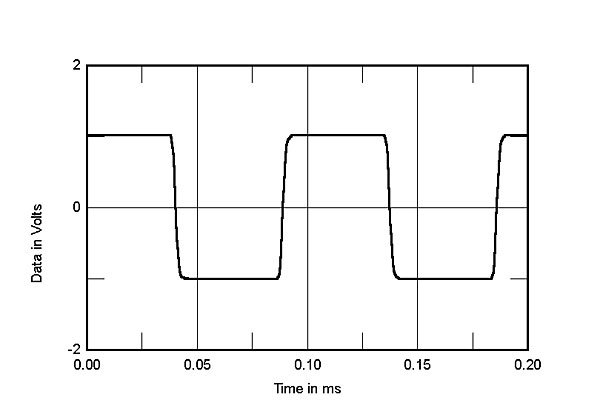
The maximum voltage gain into 8 ohms was typical for a solid-state integrated amplifier, at 41.5dB, and the NAIT 5si preserved absolute polarity (ie, was non-inverting). The input impedance was usefully higher than average, at 18k ohms at low and middle frequencies, dropping to 15.3k ohms at the top of the audioband. The output impedance ranged from 0.34 ohm at 20Hz and 1kHz to 0.36 ohm at 20kHz—a very slight increase. As a result of this higher-than-usual source impedance, the response into our standard simulated loudspeaker varied by ±0.3dB (fig.1, gray trace). The response was perfectly flat within the audioband and rolled off at ultrasonic frequencies, reaching –3dB at 160kHz, which correlated with an excellent shape to a 10kHz squarewave (fig.2). A 1kHz squarewave was equally well-shaped (fig.3). Fig.1, taken with the volume control set to 12:00, shows a 0.2dB imbalance in favor of the left channel (blue and cyan traces). With the volume control set to its maximum, the two channels matched perfectly below 20kHz, and the –3dB HF rolloff now lay at 200kHz in the left channel but 170kHz in the right.




 Naim's NAIT 5si offers a lot of low-distortion power for $1895. That neat, slim chassis doesn't offer sufficient heatsinking for sustained high-power use—at a party, say—but for normal listening, it will work fine.—John Atkinson
Fig.1 Naim NAIT 5si, volume control set to 12:00, frequency response at 2.83V into: simulated loudspeaker load (gray), 8 ohms (left channel blue, right red), 4 ohms (left cyan, right magenta), 2 ohms (green) (1dB/vertical div.).
Fig.2 Naim NAIT 5si, small-signal 10kHz squarewave into 8 ohms.
Fig.3 Naim NAIT 5si, small-signal 1kHz squarewave into 8 ohms.
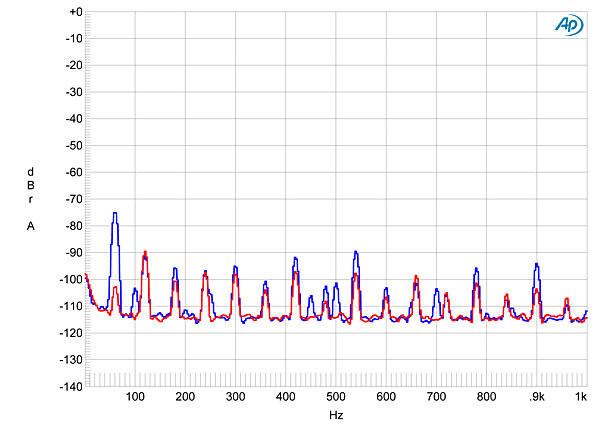
L–R channel separation was >80dB below 1kHz and still 55dB at 20kHz. It was less good in the other direction, however, at 65dB below 3kHz and 50dB at 20kHz. The wideband, unweighted signal/noise ratio, taken with the inputs shorted to ground and with the volume set to its maximum—very much the worst case—were relatively modest, at 63.6dB left and 65.3dB right, both ratios ref. 2.83V into 8 ohms. Restricting the measurement bandwidth to the audioband improved these ratios to, respectively, 74.8 and 79.8dB, while switching into circuit an A-weighting filter gave another 3dB of improvement. Spectral analysis of the noise floor (fig.4) revealed a regular series of power-supply–related spuriae, the left channel having a higher level of 60Hz in its output, this perhaps due to its circuit being physically closer to the AC transformer.
Fig.4 Naim NAIT 5si, spectrum of noise floor, DC–1kHz, ref. 1W into 8 ohms (linear frequency scale).
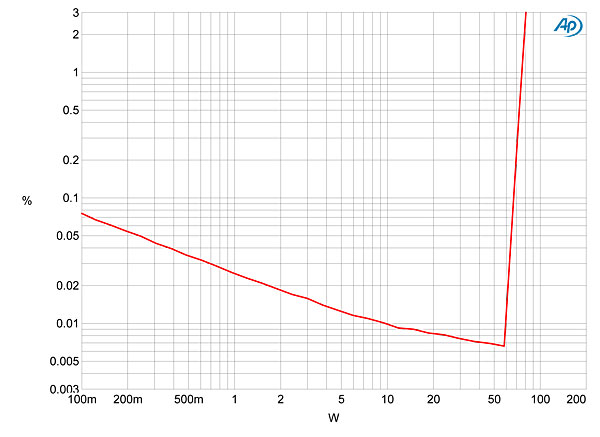
Even with both channels driven, the NAIT 5si comfortably exceeded its specified maximum power outputs into 8 ohms (fig.5) and 4 ohms (fig.5). At our standard definition of clipping (ie, when the THD+noise reaches 1%), the Naim clipped at 76Wpc into 8 ohms (18.8dBW), a full dB above the specified 60Wpc. Into 4 ohms, the NAIT clipped at 115Wpc (17.6dBW), more than a dB higher than the specified 90Wpc. The downward slope of the trace in fig.5 reveals that the actual distortion remains below the noise right up to the point where the waveform starts to clip. Therefore I examined how the THD+N percentage changed with frequency at a fairly high level, 10.2V RMS, which is equivalent to 13W into 8 ohms, 26W into 4 ohms, and 52W into 2 ohms. The results are shown in fig.7. Into 8 ohms, the THD+N remains relatively constant with frequency; into 4 ohms, there is a rise in THD in the treble, but the right channel (red and magenta traces) is a little more linear than the left (blue, cyan). The amplifier is clearly less comfortable driving 2 ohms (gray), though the distortion remains low in absolute terms.
Fig.5 Naim NAIT 5si, distortion (%) vs 1kHz continuous output power into 8 ohms.
Fig.6 Naim NAIT 5si, distortion (%) vs 1kHz continuous output power into 4 ohms.
Fig.7 Naim NAIT 5si, THD+N (%) vs frequency at 10.2V into: 8 ohms (left channel blue, right red), 4 ohms (left cyan, right magenta), 2 ohms (left gray).
At levels of 1W and below into 8 ohms, the dominant distortion harmonic was the innocuous second, at a very low level, but as the power rose and the load impedance dropped, the third harmonic appeared (fig.8). However, even at high powers into 8 ohms (fig.9), the second harmonic remained the strongest, though at –94dB (0.002%) it was still below the level of the spurious supply component at 120Hz. Tested with an equal mix of 19 and 20kHz tones at a level a couple of dB below visible waveform clipping on the oscilloscope, the NAIT 5si produced low levels of intermodulation distortion, even into 4 ohms (fig.10). The difference products at 1kHz were below –90dB (0.003%) in both channels.
Fig.8 Naim NAIT 5si, 1kHz waveform at 10W into 4 ohms, 0.025% THD+N (top); distortion and noise waveform with fundamental notched out (bottom, not to scale).
Fig.9 Naim NAIT 5si, spectrum of 50Hz sinewave, DC–1kHz, at 40W into 8 ohms (linear frequency scale).
Fig.10 Naim NAIT 5si, HF intermodulation spectrum, DC–30kHz, 19+20kHz at 40W peak into 4 ohms (linear frequency scale).
I took a brief look at the headphone output. It offers a sensible maximum gain of 15.6dB, with an output impedance of 12 ohms at low and middle frequencies and 13.5 ohms at the top of the audioband. Unusually, the headphone output inverted signal polarity.















