

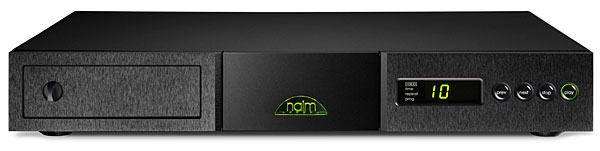
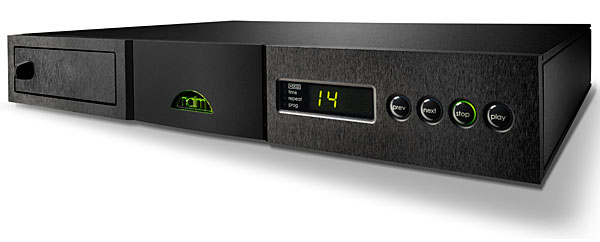
One more thing: To prevent the swing-out drawer from swinging out all over the place during shipping, and thus damaging the transport, Naim fits to the bottom of the CD5 XS's casework a transit bolt—as they've done with all their players equipped with such transports. I'd warn you against using the CD5 XS without removing its transit bolt, but because it isn't possible to do so—if you can't open the drawer, you can't insert a disc—I won't bother with that, either.
Listening
One thing in particular that characterized the pre–break-in Naim CD5 XS—and, if I recall correctly, the CD3—was that it took a couple of days of 'round-the-clock playing before it could really do legato. Cold, out of the box, it was slightly mechanical, at times even plodding, in its conveyance of strings of notes. This was especially evident in piano music, such as Martin Jones's collection of Szymanowski's Complete Piano Music: Volume 1 (2 CDs, Nimbus NI 5405/6). After running-in the Naim for a few days, I returned to the Jones CD and heard a better and altogether convincingly lovely sense of flow. With another CD of piano music, Jerome Rose's recordings of the four Chopin Ballades (Monarch Classics M20052), the Naim sounded appropriately lyrical—especially in the Ballade 3 in A-flat, which Rose doesn't burden with ornamentation, lines of notes were purposeful but human, never stiff or mechanical. The CD5 XS also did a superb job of reproducing Daniel Barenboim's recent collection On My New Piano (Deutsche Grammophon 479 6724). Tonally, it gave a strong account of the greater clarity and vividness of color that distinguish the Barenboim-Maene concert grand, especially in the spellbinding performance of Liszt's Funerailles. No less important, the Naim made clear the adventurousness the new instrument coaxed from the artist—how Barenboim leans into certain phrases in the Liszt, and brings a rare intensity to even the relatively staid Scarlatti Sonata in C.
 Intensity was also the watchword while listening to the "Red Book" layer of the hybrid SACD of Roxy Music's final studio album, Avalon (Virgin 5 83871 2). For decades, reviewers have puzzled over—and tied ourselves in lexical knots trying to describe—Naim's apparent superiority at making products that excel at conveying timing and rhythmic nuance in recorded music, and the CD5 XS did not encourage a break with that tradition. The percussion in "Take a Chance With Me" had far greater snap, and propelled the song more effectively, than I've experienced from my Sony SCD-777 SACD/CD player (yes, that would be the one for which I traded in my old CD3), and the Naim described the whipcrack timing of Phil Manzanera's guitar accents with analog-like precision.
Maybe because the qualities I associate with mono sound at its best—good senses of presence, substance, and forcefulness—are themselves part and parcel of the Naim house sound, I wasn't surprised that the CD5 did such a fine job of playing some of my CDs of historical recordings, such as the 1927 recording of Beethoven's Symphony 3 by Hans Pfitzner and the Berlin Philharmonic (Naxos 8110910). I recall John Atkinson mentioning his preference for Otto Klemperer's (stereo, 1960s-era) version of the second-movement funeral march, but after hearing Pfitzner through the Naim I made a note to keep the CD5 for as long as possible, so JA can hear this disc the next time he visits. Especially in the movement's first few minutes, the lower strings sounded convincingly weighty in a way that increased the momentum of those lines, and near the end of the movement, the sense—the audible feeling—of mallet hitting kettledrum skin was so palpable that I could forget, a moment at a time, that I was hearing a transfer from 90-year-old 78s. And my all-time favorite Mahler Symphony 1, recorded in mono by Dmitri Mitropoulos and the Minneapolis Symphony Orchestra (Sony Classical MHK 62342), sounded as present and tactile as I've ever heard it—though not as vividly colorful as through the Luxman D-06u CD player.
Returning to the world of two-channel sound, and bearing in mind that Naim makes even less of a fuss than I do about soundstaging and stereo imaging, I set about getting a handle on the CD5 XS's spatial performance. With a great live recording of the Brahms Symphony 4, by Rudolf Kempe and the BBC Symphony Orchestra (BBCL 4003-2)—a recording notable for having the violins split, 19th-century style, with firsts on the left and seconds on the right—the Naim sounded considerably more forward than my Sony player, yet did a fine job of sorting out the seating of the players. Especially during some of the strings' pizzicato phrases in the first movement—eg, the one that begins at about 8:50—the Naim portrayed spatial distinctions not as gimmicks but as welcome complements to Brahms's counterpoint. For its part, the Sony made more of the recording's spatial content, communicating more explicitly the sense of left-right movement in some of the swoopier phrases. For that, one might consider the Sony's performance more accomplished, and truer to the information on the disc. But for my money, the Naim's approach to imaging was more musically meaningful. (And while this paragraph is all about space as opposed to substance, I can't help mentioning the good, meaty sounds of the flutes on this recording through the Naim, along with strings that were similarly substantial, if lacking the textural subtleties heard through other CD players. The Naim also avoided the slight shrillness I heard in some of the higher-pitched violin notes through my Sony SCD-777.)
Intensity was also the watchword while listening to the "Red Book" layer of the hybrid SACD of Roxy Music's final studio album, Avalon (Virgin 5 83871 2). For decades, reviewers have puzzled over—and tied ourselves in lexical knots trying to describe—Naim's apparent superiority at making products that excel at conveying timing and rhythmic nuance in recorded music, and the CD5 XS did not encourage a break with that tradition. The percussion in "Take a Chance With Me" had far greater snap, and propelled the song more effectively, than I've experienced from my Sony SCD-777 SACD/CD player (yes, that would be the one for which I traded in my old CD3), and the Naim described the whipcrack timing of Phil Manzanera's guitar accents with analog-like precision.
Maybe because the qualities I associate with mono sound at its best—good senses of presence, substance, and forcefulness—are themselves part and parcel of the Naim house sound, I wasn't surprised that the CD5 did such a fine job of playing some of my CDs of historical recordings, such as the 1927 recording of Beethoven's Symphony 3 by Hans Pfitzner and the Berlin Philharmonic (Naxos 8110910). I recall John Atkinson mentioning his preference for Otto Klemperer's (stereo, 1960s-era) version of the second-movement funeral march, but after hearing Pfitzner through the Naim I made a note to keep the CD5 for as long as possible, so JA can hear this disc the next time he visits. Especially in the movement's first few minutes, the lower strings sounded convincingly weighty in a way that increased the momentum of those lines, and near the end of the movement, the sense—the audible feeling—of mallet hitting kettledrum skin was so palpable that I could forget, a moment at a time, that I was hearing a transfer from 90-year-old 78s. And my all-time favorite Mahler Symphony 1, recorded in mono by Dmitri Mitropoulos and the Minneapolis Symphony Orchestra (Sony Classical MHK 62342), sounded as present and tactile as I've ever heard it—though not as vividly colorful as through the Luxman D-06u CD player.
Returning to the world of two-channel sound, and bearing in mind that Naim makes even less of a fuss than I do about soundstaging and stereo imaging, I set about getting a handle on the CD5 XS's spatial performance. With a great live recording of the Brahms Symphony 4, by Rudolf Kempe and the BBC Symphony Orchestra (BBCL 4003-2)—a recording notable for having the violins split, 19th-century style, with firsts on the left and seconds on the right—the Naim sounded considerably more forward than my Sony player, yet did a fine job of sorting out the seating of the players. Especially during some of the strings' pizzicato phrases in the first movement—eg, the one that begins at about 8:50—the Naim portrayed spatial distinctions not as gimmicks but as welcome complements to Brahms's counterpoint. For its part, the Sony made more of the recording's spatial content, communicating more explicitly the sense of left-right movement in some of the swoopier phrases. For that, one might consider the Sony's performance more accomplished, and truer to the information on the disc. But for my money, the Naim's approach to imaging was more musically meaningful. (And while this paragraph is all about space as opposed to substance, I can't help mentioning the good, meaty sounds of the flutes on this recording through the Naim, along with strings that were similarly substantial, if lacking the textural subtleties heard through other CD players. The Naim also avoided the slight shrillness I heard in some of the higher-pitched violin notes through my Sony SCD-777.)
 With the Sonny Rollins Quartet's Rollins Plays for Bird (Prestige/JVC JVCXR-0055-2), the Naim's punchy sound and upfront spatial presentation seemed to contribute to a lifelike re-creation of Rollins's tenor-sax tone: colorful and appropriately reedy, especially in the "They Can't Take That Away from Me" portion of the medley that opens the album, and in the trill that begins the "Star Eyes" segment. Equally well served, earlier in the medley, was the smooth, rich tone of trumpeter Kenny Dorham. Yet all those parts, revealed in dissection, paled in comparison to the importance of the whole: The music moved forward with the relentlessness that is usually the sole province of the real thing. It swung. The only other thing I'll single out about the Naim's performance on this disc was the believable impact and, at times, dangerous-sounding explosiveness of drummer Max Roach's breaks, which were godlike. The same was true of his even harder-hitting solo near the end of "Kids Know."
Conclusions
With the Sonny Rollins Quartet's Rollins Plays for Bird (Prestige/JVC JVCXR-0055-2), the Naim's punchy sound and upfront spatial presentation seemed to contribute to a lifelike re-creation of Rollins's tenor-sax tone: colorful and appropriately reedy, especially in the "They Can't Take That Away from Me" portion of the medley that opens the album, and in the trill that begins the "Star Eyes" segment. Equally well served, earlier in the medley, was the smooth, rich tone of trumpeter Kenny Dorham. Yet all those parts, revealed in dissection, paled in comparison to the importance of the whole: The music moved forward with the relentlessness that is usually the sole province of the real thing. It swung. The only other thing I'll single out about the Naim's performance on this disc was the believable impact and, at times, dangerous-sounding explosiveness of drummer Max Roach's breaks, which were godlike. The same was true of his even harder-hitting solo near the end of "Kids Know."
Conclusions
A confession: I tend not to think highly of one-brand systems. Just as I don't know of a single manufacturer, past or present, whose every product is recommendable, I don't know of a single manufacturer that has applied the same levels of insight and craft to every single product category in domestic audio. That said, in my esteem, Naim Audio enjoys an ironic combination of extremes: Assuming I could be satisfied with only digital sources—and I could not—if I were forced, at gunpoint, to own such a system, Naim would be near or at the top of my list. Yet at the same time, beginning with my first exposure to their CD3, Naim's CD players have struck me as so musically competent and yet so tonally reticent—by which I mean that when they fall short in the reproduction of tonality, they do so by being a little colorless, not by having an abundance of one color or another—that I find it difficult to imagine the musically accomplished system, regardless of the brands or technologies it might include, in which a Naim CD player would not only thrive but drive the sound to new heights. The lack of froufrou in Naim's CD players only strengthens that point of view, and could be improved only if they offered a CD player without a remote control. (A guy can dream, can't he?)
The Naim CD5 XS only strengthens that conviction: Its sound quality ranges between good and very good—and musically, it is nothing short of superb. It also offers nongaudy, nondated cosmetics, and superb value for the dollar (footnote 1). Very strongly recommended.
Footnote 1: After this issue with this review had been sent to the printer but before it went out in the mail, Naim's PR rep informed us that the CD5 XS was no longer in production. However, dealers should have stock through to the end of 2017, we were told.—John Atkinson
One thing in particular that characterized the pre–break-in Naim CD5 XS—and, if I recall correctly, the CD3—was that it took a couple of days of 'round-the-clock playing before it could really do legato. Cold, out of the box, it was slightly mechanical, at times even plodding, in its conveyance of strings of notes. This was especially evident in piano music, such as Martin Jones's collection of Szymanowski's Complete Piano Music: Volume 1 (2 CDs, Nimbus NI 5405/6). After running-in the Naim for a few days, I returned to the Jones CD and heard a better and altogether convincingly lovely sense of flow. With another CD of piano music, Jerome Rose's recordings of the four Chopin Ballades (Monarch Classics M20052), the Naim sounded appropriately lyrical—especially in the Ballade 3 in A-flat, which Rose doesn't burden with ornamentation, lines of notes were purposeful but human, never stiff or mechanical. The CD5 XS also did a superb job of reproducing Daniel Barenboim's recent collection On My New Piano (Deutsche Grammophon 479 6724). Tonally, it gave a strong account of the greater clarity and vividness of color that distinguish the Barenboim-Maene concert grand, especially in the spellbinding performance of Liszt's Funerailles. No less important, the Naim made clear the adventurousness the new instrument coaxed from the artist—how Barenboim leans into certain phrases in the Liszt, and brings a rare intensity to even the relatively staid Scarlatti Sonata in C.
Intensity was also the watchword while listening to the "Red Book" layer of the hybrid SACD of Roxy Music's final studio album, Avalon (Virgin 5 83871 2). For decades, reviewers have puzzled over—and tied ourselves in lexical knots trying to describe—Naim's apparent superiority at making products that excel at conveying timing and rhythmic nuance in recorded music, and the CD5 XS did not encourage a break with that tradition. The percussion in "Take a Chance With Me" had far greater snap, and propelled the song more effectively, than I've experienced from my Sony SCD-777 SACD/CD player (yes, that would be the one for which I traded in my old CD3), and the Naim described the whipcrack timing of Phil Manzanera's guitar accents with analog-like precision.
Maybe because the qualities I associate with mono sound at its best—good senses of presence, substance, and forcefulness—are themselves part and parcel of the Naim house sound, I wasn't surprised that the CD5 did such a fine job of playing some of my CDs of historical recordings, such as the 1927 recording of Beethoven's Symphony 3 by Hans Pfitzner and the Berlin Philharmonic (Naxos 8110910). I recall John Atkinson mentioning his preference for Otto Klemperer's (stereo, 1960s-era) version of the second-movement funeral march, but after hearing Pfitzner through the Naim I made a note to keep the CD5 for as long as possible, so JA can hear this disc the next time he visits. Especially in the movement's first few minutes, the lower strings sounded convincingly weighty in a way that increased the momentum of those lines, and near the end of the movement, the sense—the audible feeling—of mallet hitting kettledrum skin was so palpable that I could forget, a moment at a time, that I was hearing a transfer from 90-year-old 78s. And my all-time favorite Mahler Symphony 1, recorded in mono by Dmitri Mitropoulos and the Minneapolis Symphony Orchestra (Sony Classical MHK 62342), sounded as present and tactile as I've ever heard it—though not as vividly colorful as through the Luxman D-06u CD player.
Returning to the world of two-channel sound, and bearing in mind that Naim makes even less of a fuss than I do about soundstaging and stereo imaging, I set about getting a handle on the CD5 XS's spatial performance. With a great live recording of the Brahms Symphony 4, by Rudolf Kempe and the BBC Symphony Orchestra (BBCL 4003-2)—a recording notable for having the violins split, 19th-century style, with firsts on the left and seconds on the right—the Naim sounded considerably more forward than my Sony player, yet did a fine job of sorting out the seating of the players. Especially during some of the strings' pizzicato phrases in the first movement—eg, the one that begins at about 8:50—the Naim portrayed spatial distinctions not as gimmicks but as welcome complements to Brahms's counterpoint. For its part, the Sony made more of the recording's spatial content, communicating more explicitly the sense of left-right movement in some of the swoopier phrases. For that, one might consider the Sony's performance more accomplished, and truer to the information on the disc. But for my money, the Naim's approach to imaging was more musically meaningful. (And while this paragraph is all about space as opposed to substance, I can't help mentioning the good, meaty sounds of the flutes on this recording through the Naim, along with strings that were similarly substantial, if lacking the textural subtleties heard through other CD players. The Naim also avoided the slight shrillness I heard in some of the higher-pitched violin notes through my Sony SCD-777.)
With the Sonny Rollins Quartet's Rollins Plays for Bird (Prestige/JVC JVCXR-0055-2), the Naim's punchy sound and upfront spatial presentation seemed to contribute to a lifelike re-creation of Rollins's tenor-sax tone: colorful and appropriately reedy, especially in the "They Can't Take That Away from Me" portion of the medley that opens the album, and in the trill that begins the "Star Eyes" segment. Equally well served, earlier in the medley, was the smooth, rich tone of trumpeter Kenny Dorham. Yet all those parts, revealed in dissection, paled in comparison to the importance of the whole: The music moved forward with the relentlessness that is usually the sole province of the real thing. It swung. The only other thing I'll single out about the Naim's performance on this disc was the believable impact and, at times, dangerous-sounding explosiveness of drummer Max Roach's breaks, which were godlike. The same was true of his even harder-hitting solo near the end of "Kids Know."
ConclusionsA confession: I tend not to think highly of one-brand systems. Just as I don't know of a single manufacturer, past or present, whose every product is recommendable, I don't know of a single manufacturer that has applied the same levels of insight and craft to every single product category in domestic audio. That said, in my esteem, Naim Audio enjoys an ironic combination of extremes: Assuming I could be satisfied with only digital sources—and I could not—if I were forced, at gunpoint, to own such a system, Naim would be near or at the top of my list. Yet at the same time, beginning with my first exposure to their CD3, Naim's CD players have struck me as so musically competent and yet so tonally reticent—by which I mean that when they fall short in the reproduction of tonality, they do so by being a little colorless, not by having an abundance of one color or another—that I find it difficult to imagine the musically accomplished system, regardless of the brands or technologies it might include, in which a Naim CD player would not only thrive but drive the sound to new heights. The lack of froufrou in Naim's CD players only strengthens that point of view, and could be improved only if they offered a CD player without a remote control. (A guy can dream, can't he?)
Footnote 1: After this issue with this review had been sent to the printer but before it went out in the mail, Naim's PR rep informed us that the CD5 XS was no longer in production. However, dealers should have stock through to the end of 2017, we were told.—John Atkinson















