

 According to designer Bill Reed, the Nelson-Reed 8-04/B was not originally intended to be an audiophile speaker system, but was instead designed as a high-quality monitor for the critical recording engineer who wanted to be able to walk from the studio into the control room and hear the same thing from his speakers that he heard "live." The fact that modern studio mike technique ensures that this could never happen is probably beside the point. The point is that reproducing the original power and dynamic range of live music is a formidable challenge, which practically no audiophile speakers have met successfully. On the other hand, so-called studio monitors, which can do that routinely, have tended to be highly colored and otherwise generally lousy in all areas of fidelity except output capability. The 8-04/B was an attempt to combine the strengths of both kinds of speaker, while avoiding their usual weaknesses.
Reproducing original "live music" volume levels requires three things in a loudspeaker: high signal-to-sound conversion efficiency (sensitivity), high power-handling capability, and freedom from amplitude compression. The first two are self-explanatory, but the third may not be. In the ideal loudspeaker, the forward and backward displacements of the driver diaphragms should be directly related to the amplitude of the input signal. This is usually the case only up to a certain output level, beyond which all speakers start to run out of travel range. That is, the diaphragms start to approach the mechanical limit of their flexible suspension system, which begins to impose increasing amounts of stiffness on the diaphragm. The effect of this is that, when the signal amplitude increases by 20%, the amplitude of diaphragm displacement may increase by only 15%. This causes an effective form of mechanical volume compression.
With most loudspeakers intended for home use, some degree of amplitude compression starts setting in at output levels (Sound-Pressure Levels) of around 85 to 90dB. Since few people listen at peak SPLs of more than 90dB, the compression is rarely noticed, although our reviewers frequently observe in their equipment reports that some speaker systems seem to be "more dynamic" than others. A second, much more noticeable result is that some upper-range drivers start producing large amounts of harmonic distortion when approaching their displacement limit. This explains the occasional system which sounds fine at moderate listening levels, but which seems to change its spectral balance when driven hard, becoming excessively bright or shrill.
There is no generally accepted measurement for dynamic range, and pertinent information about it is rarely included in published specifications. Its efficiency (or, rather, sensitivity) spec is of no help, because it relates only to SPL output for 1W of input signal, at which level no loudspeaker will be compressing at all. But if a maximum-output figure is cited, along with the necessary input power, you can (assuming the figures are accurate) get an idea of the speaker's dynamic-range capability by how well the numbers correlate with expectation (see sidebar). For example, if a speaker is rated at 84dB SPL sensitivity, and at a certain SPL for 200W of input, the latter figure should be 23dB higher than its sensitivity, or 107dB. If it's lower than that, the difference is probably due to amplitude compression. But a severe disparity here may not in fact tell you much, because that second SPL figure may have been measured at the level where amplitude compression puts a cap on the speaker's maximum output; compression may be far less, or only negligibly less, at an input power of only a few watts less. Only if the rated maximum output is 10dB louder than you will ever listen can you safely assume that the speaker will be reasonably free from compression at your normal listening levels.
According to designer Bill Reed, the Nelson-Reed 8-04/B was not originally intended to be an audiophile speaker system, but was instead designed as a high-quality monitor for the critical recording engineer who wanted to be able to walk from the studio into the control room and hear the same thing from his speakers that he heard "live." The fact that modern studio mike technique ensures that this could never happen is probably beside the point. The point is that reproducing the original power and dynamic range of live music is a formidable challenge, which practically no audiophile speakers have met successfully. On the other hand, so-called studio monitors, which can do that routinely, have tended to be highly colored and otherwise generally lousy in all areas of fidelity except output capability. The 8-04/B was an attempt to combine the strengths of both kinds of speaker, while avoiding their usual weaknesses.
Reproducing original "live music" volume levels requires three things in a loudspeaker: high signal-to-sound conversion efficiency (sensitivity), high power-handling capability, and freedom from amplitude compression. The first two are self-explanatory, but the third may not be. In the ideal loudspeaker, the forward and backward displacements of the driver diaphragms should be directly related to the amplitude of the input signal. This is usually the case only up to a certain output level, beyond which all speakers start to run out of travel range. That is, the diaphragms start to approach the mechanical limit of their flexible suspension system, which begins to impose increasing amounts of stiffness on the diaphragm. The effect of this is that, when the signal amplitude increases by 20%, the amplitude of diaphragm displacement may increase by only 15%. This causes an effective form of mechanical volume compression.
With most loudspeakers intended for home use, some degree of amplitude compression starts setting in at output levels (Sound-Pressure Levels) of around 85 to 90dB. Since few people listen at peak SPLs of more than 90dB, the compression is rarely noticed, although our reviewers frequently observe in their equipment reports that some speaker systems seem to be "more dynamic" than others. A second, much more noticeable result is that some upper-range drivers start producing large amounts of harmonic distortion when approaching their displacement limit. This explains the occasional system which sounds fine at moderate listening levels, but which seems to change its spectral balance when driven hard, becoming excessively bright or shrill.
There is no generally accepted measurement for dynamic range, and pertinent information about it is rarely included in published specifications. Its efficiency (or, rather, sensitivity) spec is of no help, because it relates only to SPL output for 1W of input signal, at which level no loudspeaker will be compressing at all. But if a maximum-output figure is cited, along with the necessary input power, you can (assuming the figures are accurate) get an idea of the speaker's dynamic-range capability by how well the numbers correlate with expectation (see sidebar). For example, if a speaker is rated at 84dB SPL sensitivity, and at a certain SPL for 200W of input, the latter figure should be 23dB higher than its sensitivity, or 107dB. If it's lower than that, the difference is probably due to amplitude compression. But a severe disparity here may not in fact tell you much, because that second SPL figure may have been measured at the level where amplitude compression puts a cap on the speaker's maximum output; compression may be far less, or only negligibly less, at an input power of only a few watts less. Only if the rated maximum output is 10dB louder than you will ever listen can you safely assume that the speaker will be reasonably free from compression at your normal listening levels.
The 8-04/Bs proved to be generally quite forgiving of room placement. I started with them subtending an included angle with my listening "sweet spot" of 80°, about 5' from the rear wall, and aimed straight forward (without toeing-in). This starting location was more than just an educated guess, though; it is where most other speakers in my room have given of their best. Subsequently, I found it possible to move them a little farther apart, to 90°, without impairing midspeaker imaging, but obtained the widest listening area by toeing them inward so their axes converged on my ears. I don't know whether or not the 8-04/Bs were "broken-in" at the factory before they were shipped to us, but indications are that they either were or they don't need it. They showed no sign of performance change during the two weeks I was using them. When I fired them up, my instant reaction was shock! I believe it was Doug Sax of Sheffield Records who coined the term "jump factor" to describe a loudspeaker that is so alive that an unexpected sound from it elicits an involuntary startle reaction. When I put the first record on—Sheffield's Dave Grusin D-to-D—I was of course expecting to hear sound, and I still jumped.
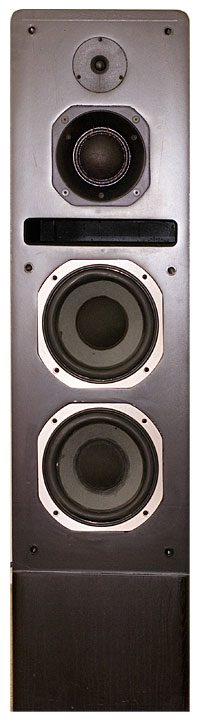 The system's low-frequency Q is rated at 0.8, just a shade higher than the classic Butterworth alignment, which is supposed to yield maximum LF output linearity with a slight compromise of damping. But it must be stated that the 8-04/B's transient performance does not appear to be appreciably compromised. Its low end is very detailed and controlled by any standard, but particularly by comparison with the majority of systems of this size. There is hardly even a trace of the monotonicity—the tendency for all bass notes to sound alike—supposed to characterize all reflex-port systems. Yet the system Q could, I believe, be profitably set lower than 0.8, because the 8-04/Bs have a definite tendency toward LF heaviness which, in some rooms, can become wretchedly excessive.
The solution is simple enough, in those cases where one is needed: Simply place foam-plastic plugs in the reflex ports. The instructions for the speakers describe how to do this, and N-R supplies suitable inserts with the speakers. Unfortunately, the 4" x 10" x 1½" ones from N-R are too effective, rolling-off the whole bottom range below 90Hz, but you can experiment with different amounts of penetration into the port until you find the optimum, then use a razor blade to lop off the unwanted portion, so the needed portion will fit flush with the front panel. (I would advise retaining the leftover pieces for possible future use in case you change amplifiers.) In my case, a 1½" thickness worked best: The low end had tremendous visceral impact, and still sounded subjectively flat down to around 35Hz. Bass reflex or not, the 8-04/B produced some of the highest-quality bass I have heard for some time.
These speakers can float a soundstage almost as well as the smallest mini-monitors, placing the performers (with appropriate recordings) between the speakers rather than stretching them from speaker to speaker. With many systems, including my Sound-Lab A-3s, the sides of a performing group rarely detach from the loudspeakers; the performing group is not heard framed by the space of the surrounding hall.
With the speakers aimed parallel to one another, it was necessary to place them fairly close together, for an included angle of about 60°, in order to get solid center-fill and imaging. When toed-in, though, the 8-04/B produces an outstanding center image, even when the speakers are spaced much farther apart than I can usually get away with. The center is solid and stable when listening from dead center, but tends to lose specificity as one moves to either side, even with the speakers toed inward toward the center seat.
The system's low-frequency Q is rated at 0.8, just a shade higher than the classic Butterworth alignment, which is supposed to yield maximum LF output linearity with a slight compromise of damping. But it must be stated that the 8-04/B's transient performance does not appear to be appreciably compromised. Its low end is very detailed and controlled by any standard, but particularly by comparison with the majority of systems of this size. There is hardly even a trace of the monotonicity—the tendency for all bass notes to sound alike—supposed to characterize all reflex-port systems. Yet the system Q could, I believe, be profitably set lower than 0.8, because the 8-04/Bs have a definite tendency toward LF heaviness which, in some rooms, can become wretchedly excessive.
The solution is simple enough, in those cases where one is needed: Simply place foam-plastic plugs in the reflex ports. The instructions for the speakers describe how to do this, and N-R supplies suitable inserts with the speakers. Unfortunately, the 4" x 10" x 1½" ones from N-R are too effective, rolling-off the whole bottom range below 90Hz, but you can experiment with different amounts of penetration into the port until you find the optimum, then use a razor blade to lop off the unwanted portion, so the needed portion will fit flush with the front panel. (I would advise retaining the leftover pieces for possible future use in case you change amplifiers.) In my case, a 1½" thickness worked best: The low end had tremendous visceral impact, and still sounded subjectively flat down to around 35Hz. Bass reflex or not, the 8-04/B produced some of the highest-quality bass I have heard for some time.
These speakers can float a soundstage almost as well as the smallest mini-monitors, placing the performers (with appropriate recordings) between the speakers rather than stretching them from speaker to speaker. With many systems, including my Sound-Lab A-3s, the sides of a performing group rarely detach from the loudspeakers; the performing group is not heard framed by the space of the surrounding hall.
With the speakers aimed parallel to one another, it was necessary to place them fairly close together, for an included angle of about 60°, in order to get solid center-fill and imaging. When toed-in, though, the 8-04/B produces an outstanding center image, even when the speakers are spaced much farther apart than I can usually get away with. The center is solid and stable when listening from dead center, but tends to lose specificity as one moves to either side, even with the speakers toed inward toward the center seat.
In short, I was very impressed with the 8-04/Bs. I am still in love with my Sound Lab A-3s, but there are many ways in which the 8-04/Bs give me more musical satisfaction from many recordings. When it comes to dynamic range, for example, the A-3s are wimps and, at 77dB sensitivity, formidably power-hungry. (A recent factory modification, which increases their efficiency by about 6dB, has been promised but has not yet arrived. And 6dB more sensitivity would still make them 9dB less so than the 8-04/B.) However, regardless of how enjoyable I find the 8-04/B, there is no way I could describe it as an "audiophile" loudspeaker, because its strong points are not important to most audiophiles while its weaknesses very definitely are. If the ultimate in soundstaging and subtlety are your prime criteria for judging sound, then you'd be better off with large electrostatics or Apogee ribbons, or maybe even a pair of Celestion SL600s. But if it's emotional involvement you're looking for from your reproduced music, these will provide it, from a wider variety of musical fare than any other speakers I know of. I have only listened to the N-Rs for two weeks, but I have still not found anything about them that irritates me. These are very musical speakers, that do for me what I ask of reproduced sound. Whether their special qualities will ultimately seduce me away from my (legendary?) attraction for full-range electrostatics is something I cannot predict at this time. But right now, the Sound Labs are in the storage area, the N-R 8-04/Bs dominate my listening area, and I am in the process of relistening to much of my record collection that I haven't dragged out in years. I like these speakers, but if you don't, I will not be at all surprised.
Footnote 1: In an SPL meter, C-weighting provides the flattest frequency response the meter is capable of.















