

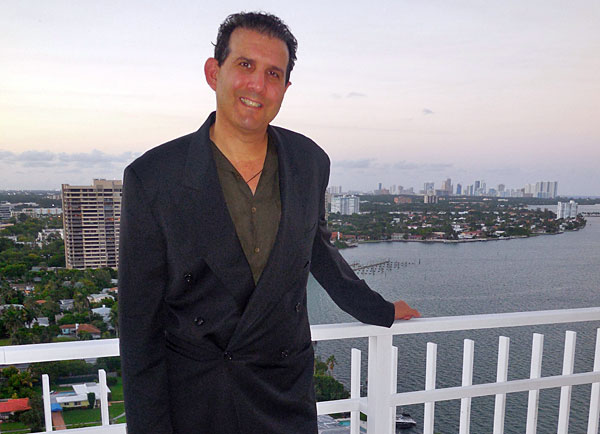
Both Chesky Records and HDtracks have a pair of co-founding partners, but the music-minded press has perpetually focused on one of them, pianist and composer David Chesky, while ignoring his younger brother, Norman. Mainstream reporters and photographers did converge on Norman Chesky once, when they spotted him rolling a bulky, rough-hewn, wooden artifact from the 2009 auction at which Bernard Madoff's personal effects were sold for the benefit of bilked investors. Leading newspapers ran photos of Norman with the tree-trunk table he'd bought after happening on the sale, and the New York Times identified him as "a music executive from Manhattan." As the exchange that follows shows, that description was a glaring oversimplification.
David Lander: You were born in 1958, which makes you two years younger than your brother David. He's talked about the influence of your mother, Betty, an award-winning teacher who loved jazz and created a musical atmosphere in your Miami Beach home.
Norman Chesky: There's no question that she played an important role in molding us. When we were young, she was the one who encouraged us to be connected to the arts and take piano lessons—I have to be honest and say that David was better—and if she never gave us those piano lessons, who knows where we'd be today?
Lander: David left home for New York at age 17, and you joined him about four years later, after dropping out of Florida State University. Why didn't you finish college?
Chesky: I ran out of money. I thought I'd go back one day, but I got involved in business with David.
Lander: What course did you pursue in school?
Chesky: Believe it or not, I studied playwriting. I wanted to be a writer when I was younger. Actually, I liked people like Neil Simon; I wanted to do comedy. When I first came to New York, I hung out at the comedy clubs, and I actually wrote for some comedians, like Nipsey Russell.
Lander: Julius "Nipsey" Russell had a long career. He did a lot of TV, and he's credited with being the first regular African-American panelist on a daily game show—Missing Links, back in 1964. How did you get to know him?
Chesky: We both lived at the Henry Hudson Hotel, which had entrances on both 57th and 58th Streets, between Eighth and Ninth Avenues. Today, it's an upscale hotel, but when I first came to New York, you could live in a little room there for $40 a week. That hotel was where David and I both started out. I lived there for a couple of years, and from there my brother and I moved into our first apartment, on W. 52nd Street. That came through a musician. My brother used to hang out at a restaurant called the China Song, on 54th and Broadway, where musicians doing commercials would hang out between sessions. We made a great deal; I think we were paying under $400 a month for a two-bedroom apartment.
 Lander: Tell us about the music-business ventures that led up to Chesky Records and HDtracks.
Chesky: My brother put together a big band when he was only 18 years old, the David Chesky Band. I was managing the band, which used to play every Monday at Storyville, a famous jazz club, and developed a very good following: Kurt Vonnegut was a fan; Jackie Onassis showed up; George Wein came. I helped my brother get a record deal—he signed with Bruce Lundvall, at Columbia, and came out with an album, in 1980, called Rush Hour. That really started us moving, because a producer at CBS Sports started playing the title cut on shows, and one day I went to the mailbox and found a check from ASCAP for $3000. That was like winning the lottery. I said to my brother, "My God, if we can get $3000 from music being played on TV by accident, maybe we should make a record just for TV." So we took the money and made a record called Chesky Productions. David wrote all these sports themes, and I went to all the network producers and gave it out, trying to sell the music. Those were the early years of ESPN, and our music was featured on many sporting events—it was the theme music played in the background, like a frame for the picture. We also licensed our music to local television stations around the country. So that was the start of our first company, Manhattan Production Music.
Lander: I understand that production music can be very lucrative.
Chesky: More composers make their living with production music than in any other part of the music business. It's a very, very vibrant industry.
Lander: How successful was Manhattan Production Music?
Chesky: We never became the largest, but how do you quantify success? Did we make a nice living from it? Yes. The most important thing is, because we had Manhattan Production Music, we learned how to make a record, we learned how to master a record—this was pre-CD. It taught us, and it also allowed us to make enough money to put out some of the vinyl that David, who was always an audiophile, wanted to produce. Manhattan Music Productions was a very important part of the Cheskys' evolution. We still own the company, by the way. It's still out there, still licensing music, and still a sister company to HDtracks and Chesky Records. At the beginning, David was the writer, but as the company grew, we hired independent writers and salespeople. Ron Goldberg, who has the office next to mine and has been here for over 20 years, runs it. We have a sales team, and we have good accounts. I oversee it.
Lander: How much of your time does that require?
Chesky: It takes probably 10% of my time. Most of my energy today is focused on HDtracks.
Lander: Tell us about the music-business ventures that led up to Chesky Records and HDtracks.
Chesky: My brother put together a big band when he was only 18 years old, the David Chesky Band. I was managing the band, which used to play every Monday at Storyville, a famous jazz club, and developed a very good following: Kurt Vonnegut was a fan; Jackie Onassis showed up; George Wein came. I helped my brother get a record deal—he signed with Bruce Lundvall, at Columbia, and came out with an album, in 1980, called Rush Hour. That really started us moving, because a producer at CBS Sports started playing the title cut on shows, and one day I went to the mailbox and found a check from ASCAP for $3000. That was like winning the lottery. I said to my brother, "My God, if we can get $3000 from music being played on TV by accident, maybe we should make a record just for TV." So we took the money and made a record called Chesky Productions. David wrote all these sports themes, and I went to all the network producers and gave it out, trying to sell the music. Those were the early years of ESPN, and our music was featured on many sporting events—it was the theme music played in the background, like a frame for the picture. We also licensed our music to local television stations around the country. So that was the start of our first company, Manhattan Production Music.
Lander: I understand that production music can be very lucrative.
Chesky: More composers make their living with production music than in any other part of the music business. It's a very, very vibrant industry.
Lander: How successful was Manhattan Production Music?
Chesky: We never became the largest, but how do you quantify success? Did we make a nice living from it? Yes. The most important thing is, because we had Manhattan Production Music, we learned how to make a record, we learned how to master a record—this was pre-CD. It taught us, and it also allowed us to make enough money to put out some of the vinyl that David, who was always an audiophile, wanted to produce. Manhattan Music Productions was a very important part of the Cheskys' evolution. We still own the company, by the way. It's still out there, still licensing music, and still a sister company to HDtracks and Chesky Records. At the beginning, David was the writer, but as the company grew, we hired independent writers and salespeople. Ron Goldberg, who has the office next to mine and has been here for over 20 years, runs it. We have a sales team, and we have good accounts. I oversee it.
Lander: How much of your time does that require?
Chesky: It takes probably 10% of my time. Most of my energy today is focused on HDtracks.
Lander: Tell us about the music-business ventures that led up to Chesky Records and HDtracks.
Chesky: My brother put together a big band when he was only 18 years old, the David Chesky Band. I was managing the band, which used to play every Monday at Storyville, a famous jazz club, and developed a very good following: Kurt Vonnegut was a fan; Jackie Onassis showed up; George Wein came. I helped my brother get a record deal—he signed with Bruce Lundvall, at Columbia, and came out with an album, in 1980, called Rush Hour. That really started us moving, because a producer at CBS Sports started playing the title cut on shows, and one day I went to the mailbox and found a check from ASCAP for $3000. That was like winning the lottery. I said to my brother, "My God, if we can get $3000 from music being played on TV by accident, maybe we should make a record just for TV." So we took the money and made a record called Chesky Productions. David wrote all these sports themes, and I went to all the network producers and gave it out, trying to sell the music. Those were the early years of ESPN, and our music was featured on many sporting events—it was the theme music played in the background, like a frame for the picture. We also licensed our music to local television stations around the country. So that was the start of our first company, Manhattan Production Music.















