The September 2009 issue of
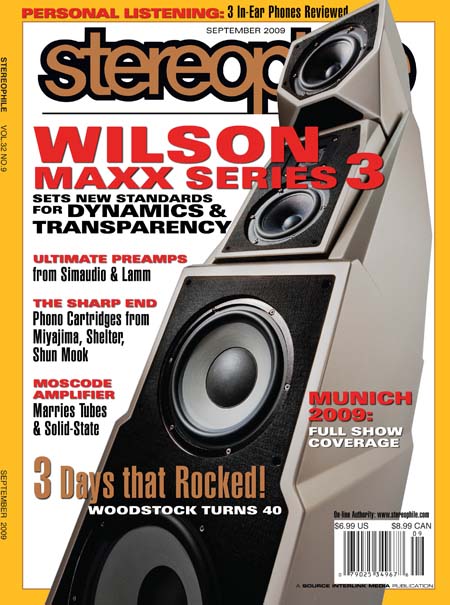
Stereophile is now on newsstands. What do you think of the cover? Is it exciting enough for you? Does it make you want to rescue our darling magazine from the clutches of the ungodly newsstand and kiss it? Did we obscure too much of our logo with the big Wilson MAXX 3? Did you think that our magazine was called
Stereop?
I'm not kidding. These are serious concerns. The Wilson MAXX 3 is a serious speaker. It's so big and heavy that it was easier for us to
ship our photographer, Eric Swanson, to it than to have it shipped to Eric. I know, I know: You're wondering how we can afford such lavish expenses in these troubling economic times. This isn't 1999. Well, we made Eric fly in the cargo bin and then sleep in a bedbug motel. It was cool. Eric didn't mind. He is adventurous like that. I am just kidding, ha ha, about the cargo bin.
Anyhoo, what do you think about the color choices for the cover? The cover we used was not my first pick. I wanted to go with
this cream-colored version, which sort of reminds me of a sweet
Linus Roadster, or
the new Fiery Furnaces album cover: subtle and elegant (like me). But perhaps a magazine cover is the wrong place for subtlety and elegance. What do you think?
Initially, we had hoped to shoot the MAXX 3 in Ferrari Red or Yellow (nothing subtle about that), but those finishes weren't available. What you see here is Wilson's Desert Silver. Our other options were Dark Titanium, Black, and Macadamia Metallic. O, how serious! O, how grim! I humbly suggest that Wilson change the names of their custom finishes to Death Titanium, Blacker Than Death, and Metallic Macadeathia. Jenna, Eric's assistant, thought the speaker looked like an oversized automatic teller machine. I disagree. The MAXX 3
takes your money; it doesn't dispense it. And I think it sort of looks like Darth Vader. Can you imagine?
Luke, I am your speaker.
I am being silly. It is just so easy to make fun of a $68,000 speaker that stands over 5' tall, weighs 425lbs, and looks like it's going to eat you for breakfast. On the other hand, there's no making fun of its sound. I've heard it. It's pretty special. It's difficult to imagine that something as large and imposing as the MAXX 3 can completely disappear from a listening room, leaving nothing but performers and instruments and
music, but that's what it does. John Atkinson and Michael Fremer were impressed, too. They both agreed that the MAXX3 produced the best sound they'd ever heard in Mikey's listening room. And you can't really argue with that. As Mikey has been known to say: There's no excuse for the price, except for the sound, so get over it.
I refuse to get over it, however. The day I get used to $68,000 loudspeakers is the day the music dies. I'd rather join the Big Bopper in the sky.
Moving beyond the cover, we find a stirring "As We See It" by Michael Lavorgna. Michael is new to our pages, but he is well-loved
in our forum. A longer version of his essay, "Fragile Souls: The Truth About Perception or Why You Can't Just Enjoy Your Hi-Fi," originally appeared on 6moons.com. I had sent
the link to JA with a message stating, "This is good."
JA agreed. He walked into my office and said, "I wish Michael had written it for us."
I thought he was hinting at something, so I ventured, "Do you want me to ask him to
re-write it for us?"
John's eyes kind of lit up the way they do. And that was that.
Michael was psyched. Within minutes, he had cut the piece down to around 1000 words. Such whittling would have taken me days. The result was some of the most clearly written, precise prose I've ever read from ML. And I love the ending. It's something I'll commit to memory:
The only way to leave our differences and distractions behind is to listen with abandon.
Michael Lavorgna has taught me a lot about music and a lot about
how to listen to music on the hi-fi, but that final thought is some
serious serious greatness. We should all
listen with abandon. Doing so would allow us to get to know each other better, and would help us to better understand ourselves, and would even be a lot of fun, I bet.
But there's more. We have full equipment reports on the Wilson MAXX 3, the groovy Moscode 402Au hybrid power amplifier ($6495), and three in-ear headphones: the Westone 3 ($399), Shure SE310 ($300), and the Phiaton PS 200 ($249). There is also "Follow-Up" coverage on the Parasound JC 1 monoblock power amplifier, Lamm LL-2.1 preamp and LP2 Deluxe phono preamp, and Simaudio Moon Evolution P-8 preamp.
In our columns, foreign contributors Paul Messenger and Markus Sauer report from the Munich High End Show, bringing us more on the radical
Thorens TD-309 turntable, as well as news on affordable components like Pro-Ject's miniature Box series, and some not-so-affordable components like the Consensus Audio four-way Passion loudspeaker from Austria. Meanwhile, Sam Tellig reports from the headquarters of Opera Loudspeakers in Treviso, Italy: We find out who's got the best sideburns in hi-fi (it's not me), and where to get the best spaghetti in Venice. Michael Fremer auditions three moving-coil phono cartridges: the Shelter 7000, Shun Mook Signature, and Miyajima Shilabe; and Kal Rubinson gets busy with bass traps from Ready Acoustics, a subwoofer EQ from SVSound, and the new HDMI Audio Processor from Meridian.
Robert Baird brings us news of an avalanche of books, DVDs, and remastered CDs celebrating the 40th anniversary of Woodstock; reviews the new Willie Nelson album,
American Classic; and salivates for the $500 Pixies deluxe boxed set.
Finally, Art Dudley shares his enthusiasm for the recent Sundazed reissues of Leonard Cohen's early albums. In just three pages, Art tells us a bit about the history of the songs, discusses the recording process, contrasts the recorded works with Cohen's on-stage persona, conveys something of his own personal connection to the music, and describes how well the new reissues succeed in reproducing all of that. In doing so, we get to know Art a little better, and we want to know more about these Leonard Cohen albums. We are almost there, sitting with Art, as he remembers, as he listens to Cohen sing his songs of love and hate.
One small drawback among all the good, egalitarian consequences of art-as-merchandise is that in music, all but the most ardent consumers think not of a great corpus of work but rather of individual pieces that, taken together, comprise a soundtrack to their own lives: distinct points along the lines of their constellations-in-progress. These are the records we love, this is when we bought them.
It's great stuff, isn't it? Music.