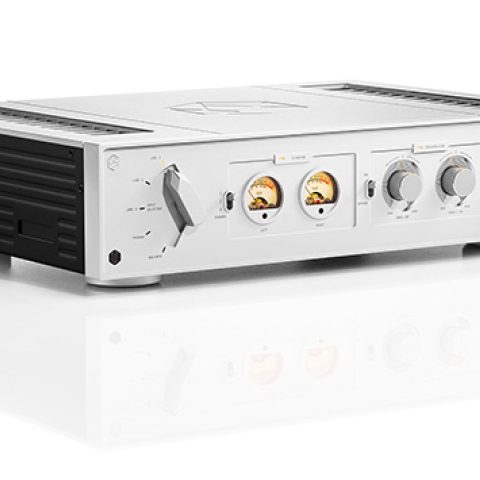
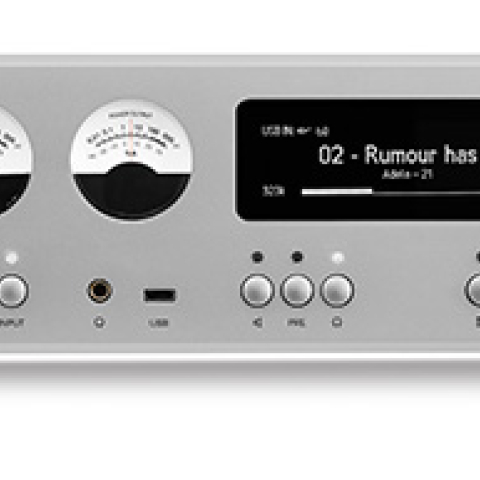
 Next up: Desert Lady/Fantasy (CD, Columbia CK 57856) by Toshiko Akiyoshi and her 16-piece Jazz Orchestra, featuring Lew Tabackin. I played three minutes of the first track, then three of the next, the title track. The soundstage was grand: flush with detail, big pictures, and colorful images, except this time, during some parts, its pacing and images seemed to drift more than usual, none of which I had noticed on the Adderley CD, which is a much more sterile-sounding recording than this more harmonically tufted Akiyoshi one.
I substituted my iFi DSD Diablo DAC, whose character is a little tighter, drier, and more forceful than that of the Cambridge Audio DAC. That did it. It increased force and gravity, sped things up (footnote 4), and, as a side bonus, made the presentation more transparent and detailed. This got me wondering if something in the Octave's own character might have made it and the Cambridge DAC a less-than-ideal match. I'm going to go with maybe, considering the Octave-iFi combination sounded fast, dynamic, and substantial. Pluses and minuses.
The V 70's soundstage sounded airy but also densely populated. It drew a circus tent that englobed my listening space and gave me a fifth-row perspective from the stands that required me to occasionally crane my neck upward to catch the acrobatics vying for my attention: "Hey, look what I can do!"
Next up: Desert Lady/Fantasy (CD, Columbia CK 57856) by Toshiko Akiyoshi and her 16-piece Jazz Orchestra, featuring Lew Tabackin. I played three minutes of the first track, then three of the next, the title track. The soundstage was grand: flush with detail, big pictures, and colorful images, except this time, during some parts, its pacing and images seemed to drift more than usual, none of which I had noticed on the Adderley CD, which is a much more sterile-sounding recording than this more harmonically tufted Akiyoshi one.
I substituted my iFi DSD Diablo DAC, whose character is a little tighter, drier, and more forceful than that of the Cambridge Audio DAC. That did it. It increased force and gravity, sped things up (footnote 4), and, as a side bonus, made the presentation more transparent and detailed. This got me wondering if something in the Octave's own character might have made it and the Cambridge DAC a less-than-ideal match. I'm going to go with maybe, considering the Octave-iFi combination sounded fast, dynamic, and substantial. Pluses and minuses.
The V 70's soundstage sounded airy but also densely populated. It drew a circus tent that englobed my listening space and gave me a fifth-row perspective from the stands that required me to occasionally crane my neck upward to catch the acrobatics vying for my attention: "Hey, look what I can do!"
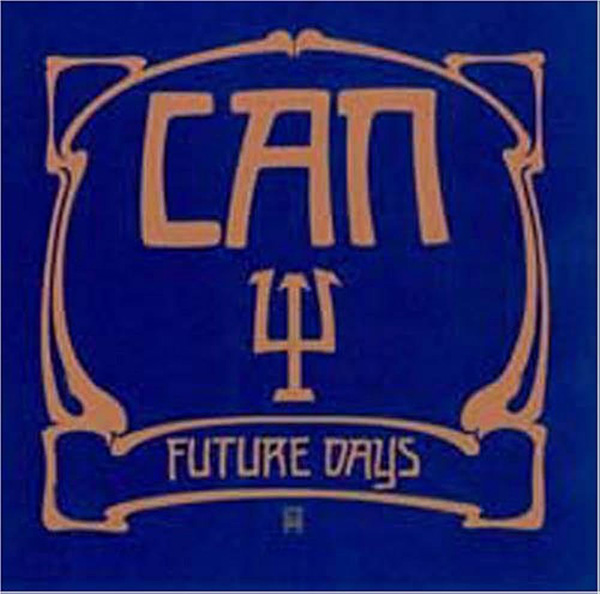 The Octave heightened the mind-expanding effects of Can's Future Days (CD, Spoon Records 9385-2 724596938522; footnote 5), as much psychedelically as creatively. The art stood out—the elaborateness of the music's construction, with its multiplicity of sound effects coexisting with a core of more conventional sounds: a slow-beating bass pulse, djembe hand drum slaps, twangy guitar pickings, muffled singing. That girl with the foreign—presumably German—accent? I'd never heard her lyrics so intelligibly rendered, erasing all prior doubts I had about what she was saying. This clear, sensical view on things changed my mind: Those studio effects weren't as improvised as I'd thought; like a well-crafted picture collage that may at first glance seem haphazardly composed, Future Days sounded like a carefully crafted piece whose whole was greater than the sum of its parts.
I cranked the volume to feel the full effect of this ambient, textured, special-effects–laden Krautrock classic lap over me. The Octave produced a panoramic view of deep abstractions and reach-out-and-touch pictures that traveled in elaborate patterns leading into one another. Both color and detail were abundant, swamping my room. Even though I was listening to this track louder than normal, I experienced no listener fatigue, no desire to lower the volume (neither to relieve the sonic pressure nor so that I could feel the handset's cushy buttons again).
Just as I'd never heard Desert Lady/Fantasy sound as cinematic as it did through the V 70, I'd never heard Future Days sound this much like a performance piece or theatrical art installation.
The Octave heightened the mind-expanding effects of Can's Future Days (CD, Spoon Records 9385-2 724596938522; footnote 5), as much psychedelically as creatively. The art stood out—the elaborateness of the music's construction, with its multiplicity of sound effects coexisting with a core of more conventional sounds: a slow-beating bass pulse, djembe hand drum slaps, twangy guitar pickings, muffled singing. That girl with the foreign—presumably German—accent? I'd never heard her lyrics so intelligibly rendered, erasing all prior doubts I had about what she was saying. This clear, sensical view on things changed my mind: Those studio effects weren't as improvised as I'd thought; like a well-crafted picture collage that may at first glance seem haphazardly composed, Future Days sounded like a carefully crafted piece whose whole was greater than the sum of its parts.
I cranked the volume to feel the full effect of this ambient, textured, special-effects–laden Krautrock classic lap over me. The Octave produced a panoramic view of deep abstractions and reach-out-and-touch pictures that traveled in elaborate patterns leading into one another. Both color and detail were abundant, swamping my room. Even though I was listening to this track louder than normal, I experienced no listener fatigue, no desire to lower the volume (neither to relieve the sonic pressure nor so that I could feel the handset's cushy buttons again).
Just as I'd never heard Desert Lady/Fantasy sound as cinematic as it did through the V 70, I'd never heard Future Days sound this much like a performance piece or theatrical art installation.
 Vinyl Listening
The V 70 arrived fitted with the company's MC phono board—an MM one is also available—to go with the MusiKraft Denon DL-103 cartridge on my Rega P5. The board is installed by the dealer and has no user-adjustable settings. The loading values are fixed for both MC and MM cartridges. In my case, that meant an input impedance of 150 ohms, input sensitivity of 0.5 mV, and the subsonic filter set at –12dB/octave. If you're a habitual cartridge swapper, a better solution might be to purchase Octave's external phono stage, the Phono EQ.2 MM/MC, at a cost $1100 higher than the $850 internal phono option. The EQ.2 features multiple loading options and is switchable between MM and MC. I started my vinyl listening with Bell Orchestre's House Music (LP, Erased Tapes Records ERATP141LP-CA), a rock-classical hybrid instrumental work that includes several string instruments, group chanting, and a menagerie of seamlessly integrated studio sound effects. Via the Octave's phono stage, the band sounded bigger than six members—more vaulted and sonically varied with a richer, more reverberant consistency. The V 70's characteristic transparency, big-picture boldness, and the detail retrieval I'd heard with digital came through, if not quite to the same level. (That limitation could be a reflection more of the sources I was using than of the phono itself.) Texture and transient tactility were conspicuous. On the first track, "Opening," violin and double bass produced vibrant, rich-brown tone and vibrational texture that seemed serrated. The drums were focused, dynamically spry, and, judging by the arc of the drum hits, compact. The group chanting was almost Star Trek–y, with its extended-vowel, dashing-through–outer-space aura, vocally layered and luxuriantly toned. The phono stage emphasized the music's coherency, both in the sense of a band playing together in the same room and in their creative complicity, the feeding-off-each-other group dynamic.
 About that Super Black Box
Using the V 70 without it resulted in a general reduction in tonal color, soundstage size, instrumental separation, and sense of musical ease. On the other hand, with material with minimal instrumentation, such as just Nina Simone singing and playing her piano or Patricia Barber singing and playing hers, I couldn't be sure I heard any benefit in using the Super Black Box. For everything else, the V 70's fundamental character and qualities mentioned in my review were still there without the Super Black Box, just less so. Tube Rolling
Finally came the moment to AB-test swap the KT120 and KT88 output tubes, and it's at this juncture that the concept of synergy became a theme for this review, because while I expected my tube comparisons to result in a universal winner, that's not what happened. The KT88's generally denser tone, more cut-out imaging, and more realistic timbre suited some recordings particularly well, while with other recordings I preferred the KT120's more panoramic, harmonically developed, bassier, more dramatic presentation. In the end, I chose the KT120s over the KT88s, in part because they sounded a smidge more refined and less grainy than the KT88. That could be because, though I burned them in for 50 or so hours, it might not have been enough. The wrap
I found the Octave V 70 to be a slightly tweaky component (in view of its several options) that presented music on a grand scale, with vivid colors and shapes and a dynamic momentum that was emotionally engaging. It did a few things that don't often coexist in a single product as well as they did in this one: color, texture, transparency, tonal density, sense of touch, bass heft, and dynamic power. Does that sound like your typical tube amp?
Footnote 4: That is, it made the music pacier. Footnote 5: Can vocalist Damo Suzuki passed away on February 9. Future Days was the last Can album Suzuki appeared on. RIP.