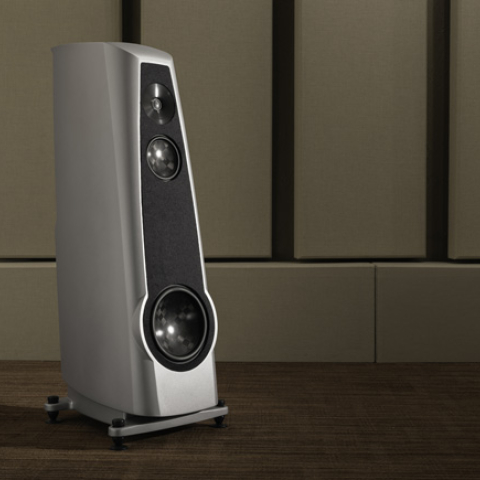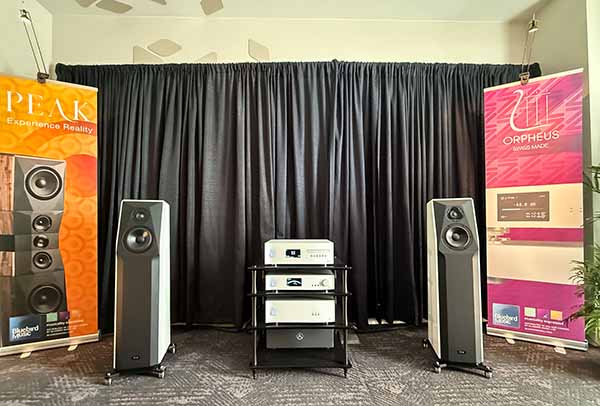
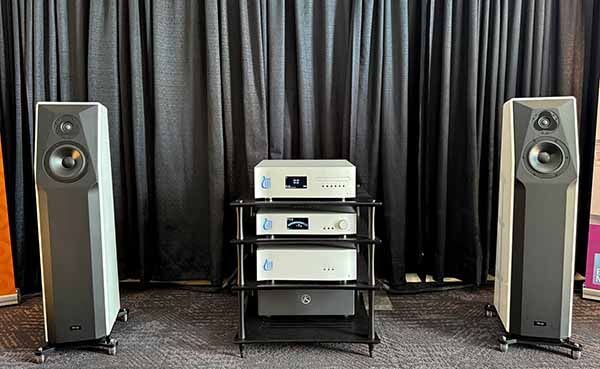
Room 672 at AXPONA 2026 featured a collaborative exhibit from importer and distributor Bluebird Music that paired Swiss precision with Danish craftsmanship. The system showcased Peak Consult Sonora loudspeakers ($34,900)—two-way floorstanders with leather-covered baffles, solid walnut cabinets, and thick, triple-layered construction.
A rear-mounted passive bass radiator supplements the main driver pair. The tweeter is a 1" Scan-Speak Illuminator soft silk dome; the bass/midrange driver uses an Audio Technology 6" sandwich-molded cone in a diecast magnesium chassis.
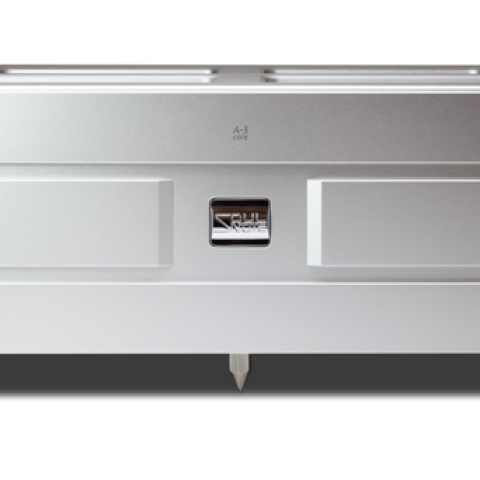
Powering the Sonoras was a full stack of Orpheus Lab electronics from the Swiss brand's Absolute Line, including the A Two 22D preamplifier ($18,900), the A Three S200 stereo amplifier ($19,500), and the A Zero PS SACD player ($25,900). The system was wired with more than $60,000 worth of Kubala-Sosna cabling.
 Neither Peak Consult nor Orpheus are household names in the U.S., but based on what I heard during the demo, they deserve more attention. The Danes at Peak Consult aim to build speakers that eliminate the cabinet's voice, aiming for the character of the music to pass through unobstructed. The Swiss contenders at Orpheus Lab make precision electronics, including amplifiers designed to provide high current with absolute control over the drivers.
The synergy comes through loud and clear. What I heard was refined and had great tonal density. "Digital? Sounds analog," I wrote in my notes. The Peak/Orpheus pairing leaned toward a natural tonality that prioritized musical flow over technical fireworks.
The system handled both delicate classical and rowdy rock very well. It revealed tight, generous bass on a Daft Punk track whose title I forgot to jot down, and brash, juicy horns on Lyle Lovett's "The Blues Walk" (originally from his 1989 album on MCA/Curb, Lyle Lovett and His Large Band).
Neither Peak Consult nor Orpheus are household names in the U.S., but based on what I heard during the demo, they deserve more attention. The Danes at Peak Consult aim to build speakers that eliminate the cabinet's voice, aiming for the character of the music to pass through unobstructed. The Swiss contenders at Orpheus Lab make precision electronics, including amplifiers designed to provide high current with absolute control over the drivers.
The synergy comes through loud and clear. What I heard was refined and had great tonal density. "Digital? Sounds analog," I wrote in my notes. The Peak/Orpheus pairing leaned toward a natural tonality that prioritized musical flow over technical fireworks.
The system handled both delicate classical and rowdy rock very well. It revealed tight, generous bass on a Daft Punk track whose title I forgot to jot down, and brash, juicy horns on Lyle Lovett's "The Blues Walk" (originally from his 1989 album on MCA/Curb, Lyle Lovett and His Large Band).
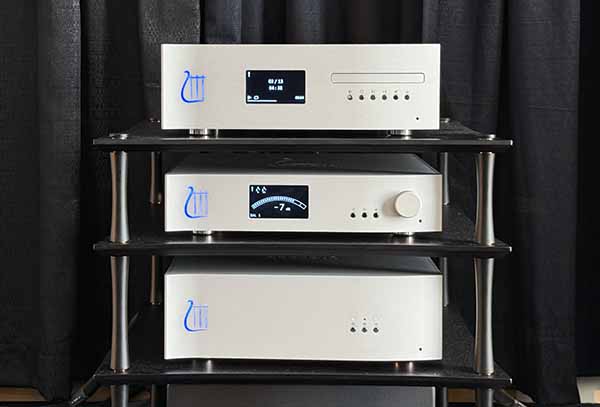 The unhurried musical presentation was complemented by the Orpheus Lab SACD player that seemed downright thoughtful in announcing its relaxed intentions. Press the eject button and the display says, "The tray will open." And it does, after a suspenseful pause. The electronics' large logo is a backlit lyre—a reference to the Greek mythological musician Orpheus, whose playing was said to be irresistible. The lyre logo on the Orpheus faceplates can't be dimmed or switched off independently.
Good thing I like blue.
The unhurried musical presentation was complemented by the Orpheus Lab SACD player that seemed downright thoughtful in announcing its relaxed intentions. Press the eject button and the display says, "The tray will open." And it does, after a suspenseful pause. The electronics' large logo is a backlit lyre—a reference to the Greek mythological musician Orpheus, whose playing was said to be irresistible. The lyre logo on the Orpheus faceplates can't be dimmed or switched off independently.
Good thing I like blue.
Neither Peak Consult nor Orpheus are household names in the U.S., but based on what I heard during the demo, they deserve more attention. The Danes at Peak Consult aim to build speakers that eliminate the cabinet's voice, aiming for the character of the music to pass through unobstructed. The Swiss contenders at Orpheus Lab make precision electronics, including amplifiers designed to provide high current with absolute control over the drivers.
The synergy comes through loud and clear. What I heard was refined and had great tonal density. "Digital? Sounds analog," I wrote in my notes. The Peak/Orpheus pairing leaned toward a natural tonality that prioritized musical flow over technical fireworks.
The system handled both delicate classical and rowdy rock very well. It revealed tight, generous bass on a Daft Punk track whose title I forgot to jot down, and brash, juicy horns on Lyle Lovett's "The Blues Walk" (originally from his 1989 album on MCA/Curb, Lyle Lovett and His Large Band).
The unhurried musical presentation was complemented by the Orpheus Lab SACD player that seemed downright thoughtful in announcing its relaxed intentions. Press the eject button and the display says, "The tray will open." And it does, after a suspenseful pause. The electronics' large logo is a backlit lyre—a reference to the Greek mythological musician Orpheus, whose playing was said to be irresistible. The lyre logo on the Orpheus faceplates can't be dimmed or switched off independently.
Good thing I like blue.