

Sidebar 3: Measurements
I used DRA Labs' MLSSA system and a calibrated DPA 4006 microphone to measure the Paradigm Persona 5F's frequency response in the farfield, and an Earthworks QTC-40 for the nearfield responses. Paradigm specifies the Persona 5F's anechoic voltage sensitivity as 90dB/2.83V/m. My estimate was slightly lower, at 88.7dB(B)/2.83V/m, but this is still higher than average. The Paradigm's impedance is specified as "compatible with 8 ohms." The impedance drops below 6 ohms between 70Hz and 1kHz, and reaches a minimum magnitude of 2.85 ohms just below 20kHz (fig.1). There is also a combination of 5 ohms and an electrical phase angle of –50° at 73Hz; I think this speaker would work best with an amplifier compatible with 4 ohm loads.

 The saddle centered on 25Hz in the impedance-magnitude trace in fig.1 suggests that this is the tuning frequency of the large, downward-firing port. This was confirmed by the plot of the summed output of the three woofers—all three behave identically—which has the expected minimum-motion notch at this frequency (fig.3, blue trace). However, the port's response (red trace) peaks a little lower in frequency, between 15 and 40Hz. The port's output rolls off smoothly above 50Hz, and while that rolloff is disturbed by a peak at 520Hz, this is well down in level. In the farfield, the woofers (blue) appear to be crossed over to the midrange unit (green) just above 500Hz, rolling out steeply above that frequency.
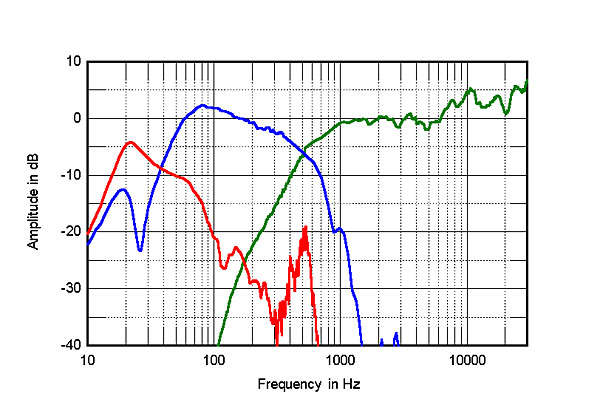

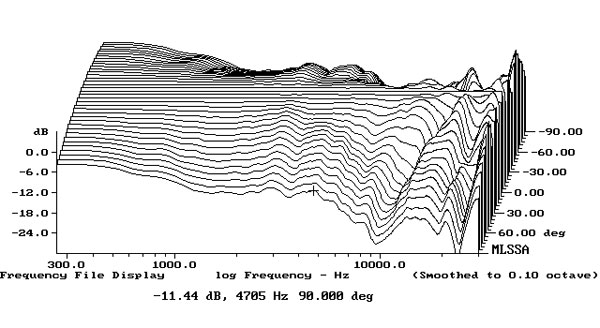


Fig.1 Paradigm Persona 5F, electrical impedance (solid) and phase (dashed) (2 ohms/vertical div.).
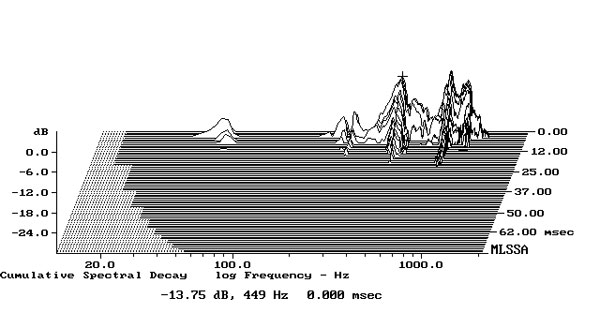
The traces in fig.1 are free from the small wrinkles that would imply the presence of cabinet-wall resonances, and while I did find some resonant modes when I investigated the vibrational behavior with a plastic-tape accelerometer, these are all very low in level. For example, fig.2, which was taken on one of the sidewalls level with the midrange drive-unit, shows modes at 449Hz and 1kHz, but I am confident that this behavior will not introduce any coloration.
Fig.2 Paradigm Persona 5F, cumulative spectral-decay plot calculated from output of accelerometer fastened to center of sidewall level with midrange unit (MLS driving voltage to speaker, 7.55V; measurement bandwidth, 2kHz).
Fig.3 Paradigm Persona 5F, acoustic crossover on tweeter axis at 50", corrected for microphone response; and nearfield responses of woofers (blue) and port (red), respectively plotted below 350 and 650Hz.
Higher in frequency in fig.3, the midrange unit's output on the tweeter axis is smooth and even, but the top two octaves of the region covered by the tweeter are a little exaggerated in level. The black trace below 300Hz in fig.4 shows the complex sum of the nearfield woofer and port outputs, taking into account amplitude, phase, and the different distances from a nominal farfield microphone position. The broad peak in the upper bass is primarily due to the nearfield measurement technique, which assumes that the drive-units are mounted in a baffle that extends to infinity in both planes. Though the Persona 5F's output is down by 5dB at the bottom of the audioband, the usual low-frequency boundary reinforcement will result in excellent low-bass extension in-room.
Fig.4 Paradigm Persona 5F, anechoic response on tweeter axis at 50", averaged across 30° horizontal window and corrected for microphone response, with complex sum of nearfield responses plotted below 300Hz.
The Paradigm's farfield response, averaged across a 30° horizontal window centered on the tweeter axis, is shown as the black trace above 300Hz in fig.4; it is superbly flat and even from the midrange through the mid-treble. Again, a boost in output is apparent in the top two octaves of the audioband, but the plot of the Paradigm's lateral dispersion, normalized to the tweeter-axis response (fig.5), reveals that the tweeter starts to become directional above 5kHz, which will tend to compensate for the excess of on-axis energy in this region. (I write "tend to compensate" because I note KR did experiment with toe-in to get the most neutral top-octave balance.) The contour lines in this graph are both even and evenly spaced, which always correlates with stable stereo imaging. In the vertical plane (fig.6), the Persona 5F maintains its tweeter-axis response up to 10° below that axis. This is just as well, considering that the tweeter is 42" from the floor, which is above the ear height of a typical seated listener.
Fig.5 Paradigm Persona 5F, lateral response family at 50", normalized to response on tweeter axis, from back to front: differences in response 90–5° off axis, reference response, differences in response 5–90° off axis.
Fig.6 Paradigm Persona 5F, vertical response family at 50", normalized to response on tweeter axis, from back to front: differences in response 15–5° above axis, reference response, differences in response 5–15° below axis.
In the time domain, the Studio HD's step response on the tweeter axis (fig.7) shows that all five drive-units are connected in positive acoustic polarity, with the tweeter's output arriving at the microphone before the midrange unit's, which in turn arrives before that of the three woofers. In each case, the decay of the higher-frequency driver's step blends smoothly with the start of the lower-frequency driver's step, which implies optimal crossover design. Finally, other than a very slight amount of delayed energy in the presence region, the Paradigm's cumulative spectral-decay plot (fig.8) is very clean.
Fig.7 Paradigm Persona 5F, step response on tweeter axis at 50" (5ms time window, 30kHz bandwidth).
Fig.8 Paradigm Persona 5F, cumulative spectral-decay plot on tweeter axis at 50" (0.15ms risetime).
The Paradigm Persona 5F's measured performance indicates textbook audio engineering.—John Atkinson















