

Sidebar 3: Measurements
I used DRA Labs' MLSSA system and a calibrated DPA 4006 microphone to measure the Paradigm Prestige 95F's frequency response in the farfield; for the nearfield frequency response, I used an Earthworks QTC-40, which has a ¼" capsule and thus doesn't present a significant obstacle to the sound.
The Prestige 95F's voltage sensitivity is specified as 91dB/2.83V/m anechoic and 94dB in-room. My estimate was very close to this, at 92dB(B)/2.83V/m. This is a speaker that plays loudly with very few watts. The 95F's impedance is specified as being "compatible with 8 ohms." You can see from the solid trace in fig.1 that the impedance magnitude drops below 4 ohms only in the lower midrange and high treble, with a minimum audioband value of 3.5 ohms at 160Hz. Though the impedance drops to 2.4 ohms at 50kHz, very little musical energy is present above 40kHz, and this should not present amplifiers with any problems. The combination of 6.6 ohms and a –42° electrical phase angle at 82Hz will also not be an issue.
The traces in fig.1 are free from the small wrinkles that would imply the existence of cabinet vibrational resonances of some kind. However, using a simple accelerometer, I did find a cluster of resonances in the midrange, with the highest in level at 301Hz, on the sidewall, level with the top woofer (fig.2). These were lower in level farther down the sidewall, though another mode appeared in that vicinity, just below 600Hz. The top and rear panels were also relatively lively, but it's fair to note that Thomas J. Norton didn't comment on any midrange congestion that might have resulted from this behavior. The Prestige 95F's high sensitivity means that any cabinet resonances will not be excited as much for a given playback level as they are in my measurements, for which I use a consistent voltage stimulus.


 This behavior can be seen in the 95F's overall farfield response on the tweeter axis (fig.4 above 300Hz). Below 300Hz, the graph shows the complex sum of the nearfield woofer and port responses; the upper-bass peak is, in part, an artifact of the nearfield measurement technique, but it does suggest that the Paradigm's low frequencies are balanced on the rich side, as TJN noted in his listening. But higher in frequency in this graph, the sharp step upward in the 95F's response at 1kHz, the valley between 2 and 4kHz, and the excessive level of the tweeter between 5 and 12kHz, are all puzzling.

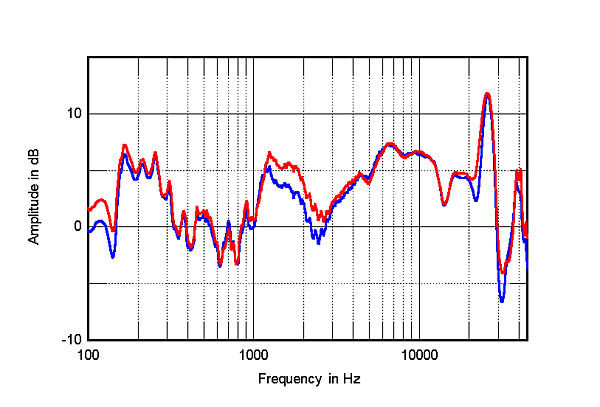

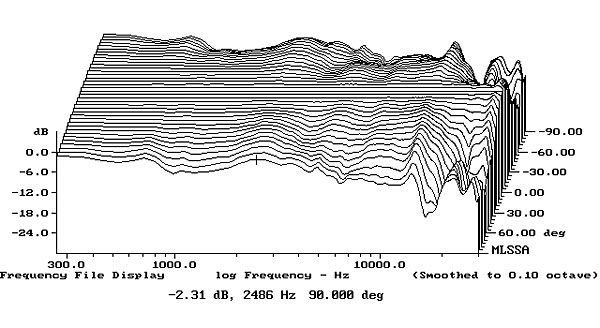


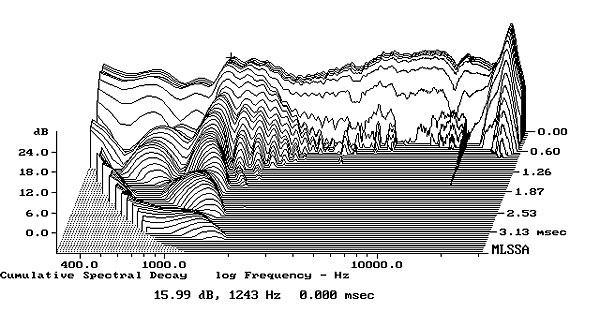
Fig.1 Paradigm Prestige 95F, electrical impedance (solid) and phase (dashed) (2 ohms/vertical div.).
Fig.2 Paradigm Prestige 95F, cumulative spectral-decay plot calculated from output of accelerometer fastened to center of sidewall level with top woofer (MLS driving voltage to speaker, 7.55V; measurement bandwidth, 2kHz).
The saddle just below 40Hz in the impedance-magnitude trace suggests that this is the tuning frequency of the two ports on the rear panel. The sum of the woofers' nearfield responses (fig.3, green trace) does indeed have a well-defined notch at 39Hz, and the sum of the ports' nearfield outputs (blue) peaks in classic manner between 30 and 60Hz, with a relatively smooth rolloff disturbed by only slight peaks around 150 and 900Hz. The individual responses of the three woofers are not shown in this graph, but as specified by Paradigm, only the top woofer's response extends up to the crossover to the tweeter (red trace). As conjectured by TJN, the tweeter's output appears to be a little too high in level; of more importance, in my opinion, is the behavior of the top woofer in the octave below the crossover frequency, where a slight lack of energy is followed by a sharply defined peak.
Fig.3 Paradigm Prestige 95F, sample 'H04, acoustic crossover on tweeter axis at 50", with sum of nearfield woofer responses (green) and sum of nearfield port responses (blue) respectively plotted below 350Hz and 1kHz.
Fig.4 Paradigm Prestige 95F, sample 'H04, anechoic response on tweeter axis at 50", averaged across 30° horizontal window and corrected for microphone response, with complex sum of nearfield woofer and port responses plotted below 300Hz.
So far, all the measurements were taken with the sample with serial no. ADN1079521H04. I therefore unpacked the other sample, 'H05, and examined its behavior. (Logistical issues meant that I had to do this with a different measurement system and microphone, respectively Fuzzmeasure 3 and the Earthworks QTC-40, so I remeasured 'H04.) The results, necessarily taken at a closer distance than before (30" vs 50"), are shown in fig.5: The blue trace is 'H04, the red trace 'H05. Both speakers still feature the step upward in response and the responses in the tweeter's passband are superbly well-matched, but 'H05 can be seen to have 2–3dB more energy at the top of the uppermost woofer's passband.
Fig.5 Paradigm Prestige 95F, 1?12-octave–smoothed response on tweeter axis at 30" of samples 'H04 (blue) and 'H05 (red).
I asked TJN, therefore if he had heard a difference between the two samples. (I had not yet read his review text when I performed the measurements.) Tom responded that while he thought he'd heard some minor differences, he put them down to his new listening room, which is acoustically different at the left and right.
Nonetheless, I asked him to send me the in-room measurements he'd taken using the OmniMic system. The results are shown in fig.6, plotted above 100Hz. While both speakers exhibit a lack of energy between 2 and 4kHz, sample 'H05 (bottom) does indeed have more energy present between 1 and 2kHz. However, the response step below that region is diminished in these in-room traces.
Fig.6 Paradigm Prestige 95F, in-room response in TJN's listening room of samples 'H04 (top) and 'H05 (bottom).
Returning to my own measurements: Fig.7 shows the horizontal radiation pattern of sample 'H04, normalized to the tweeter-axis response. Paradigm specifies very well-behaved off-axis behavior, and fig.7 confirms it, at least up to the top octave. However, the elevated on-axis response of the tweeter between 5 and 12kHz is not entirely compensated for by a lack of energy off axis. As TJN commented, the Prestige 95F will not be particularly forgiving of overbright recordings. But it is fair to note his observation that, with well-recorded music, the 95F "sparkled with life." In the vertical plane (fig.8), the dispersion is wide and even, and a suckout in the crossover region doesn't develop until 15° below the tweeter axis. Although the 95F's tweeter is a high 43" above the floor and the seated ear height of the average listener is 36", this will not be an issue.
Fig.7 Paradigm Prestige 95F, lateral response family at 50", normalized to response on tweeter axis, from back to front: differences in response 90–5° off axis, reference response, differences in response 5–90° off axis.
Fig.8 Paradigm Prestige 95F, vertical response family at 50", normalized to response on tweeter axis, from back to front: differences in response 10–5° above axis, reference response, differences in response 5–15° below axis.
The Paradigm 95F's step response on the tweeter axis (fig.9, taken with sample 'H04) indicates that its four drive-units are connected in positive acoustic polarity, with the decay of the tweeter's step blending smoothly with the start of the woofers' step. I assumed that the ripples in the woofers' step were due to the multiple arrivals from the spaced woofers. However, the cumulative spectral-decay plot on the tweeter axis (fig.10) does suggest that the peak between 1 and 2kHz results from a problem with the top woofer.
Fig.9 Paradigm Prestige 95F, step response on tweeter axis at 50" (5ms time window, 30kHz bandwidth).
Fig.10 Paradigm Prestige 95F, cumulative spectral-decay plot on tweeter axis at 50" (0.15ms risetime).
When I visited Paradigm's facility in Toronto in summer 2014, I was very impressed by the depth of the company's engineering and manufacturing expertise. They have a large anechoic chamber for acoustical analysis and state-of-the-art measuring equipment, including the Klippel system for analyzing the behavior of drive-units. I'm puzzled, therefore, by the departure of both samples from what I regard as an optimal target response, though it is fair again to note that TJN's in-room measurements are better than I would have expected from the quasi-anechoic behavior.—John Atkinson















