

Sidebar 3: Measurements
I tested the Pathos InPoL Remix MkII with my Audio Precision SYS2722, checking some of the results with the magazine's APx500 system.
The review sample was not fitted with the optional HiDac Mk2 digital-input board. Although the Remix MkII's output stages are described as operating in class-A, where the maximum heat dissipation is with no signal, I still preconditioned the Pathos amplifier before the testing by following the CEA's recommendation of operating it at one-eighth the specified power into 8 ohms for 30 minutes. At the end of that time, the heatsinks were hot, at 118.1°F (42.9°C), as was the top panel, at 113.6°F (45.3°C). This amplifier needs to be well-ventilated.
The Pathos's volume control operated in accurate 0.5dB steps, and the maximum voltage gain from the loudspeaker outputs into 8 ohms was 36.2dB for both the balanced and unbalanced inputs. The maximum gain at the balanced Pre outputs was 17dB; at the single-ended Pre outputs it was 10.1dB; and from the headphone output it was 8dB. The Remix MkII preserved absolute polarity (ie, was noninverting) at all the outputs with both input types. The input impedance is specified as 47k ohms.
I measured a usefully higher 92k ohms for the unbalanced input at low and middle frequencies, dropping to a still-high 50.5k ohms at the top of the audioband. The balanced input impedance was 176k ohms at 20Hz, 180k ohms at 1kHz, and 137k ohms at 20kHz. The Pathos won't load down source components,
The Pathos's line-level source impedances were 929 ohms from the balanced Pre output, 465 ohms from the unbalanced Pre output, and a usefully low 1 ohm from the headphone output, these values consistent across the audioband. The loudspeaker output impedance was a relatively high 0.8 ohm at 20Hz and 1kHz, increasing slightly to 0.84 ohm at 20kHz. (These impedances include the series impedance of 6' of spaced-pair loudspeaker cable.) The modlation of the amplifier's frequency response, due to the Ohm's law interaction between this source impedance and the impedance of our standard simulated loudspeaker, was therefore ±0.7dB (fig.1, gray trace), which may well be audible. The response into resistive loads was flat in the audioband but rolled off above 20kHz. The response into 8 ohms (fig.1, blue and red traces) was down by 1dB at 80kHz, that into 2 ohms (green trace) was –1dB at 55kHz.
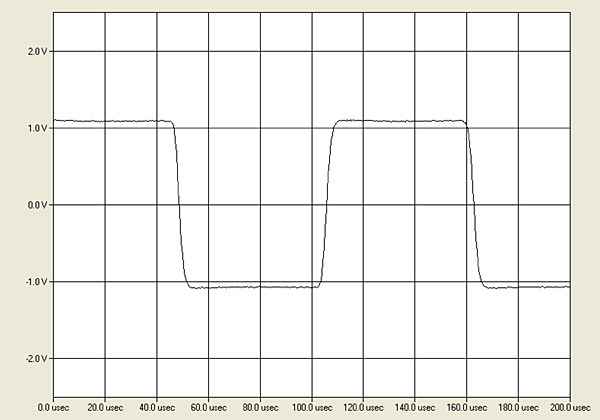
 Note the 0.25dB channel imbalance in favor of the right channel in this graph, which was taken with the volume control set to its maximum; the imbalance was identical when I repeated the response measurement with the control set to –20dB. The frequency response at the headphone output was down by just 1dB at 200kHz. As expected from the Remix MkII's wide small-signal bandwidth, its reproduction of a 10kHz squarewave from the loudspeaker output into 8 ohms (fig.2) was superb, with no overshoot or ringing.
 The Pathos InPoL Remix MkII is specified to deliver up to 25Wpc into 8 ohms (14dBW) and 38Wpc into 4 ohms (12.8dBW), the former at 0.1% THD. With our definition of clipping, which is when the output's percentage of THD+noise reaches 1%, and with both channels driven, the Remix MkII clipped with a 1kHz signal at 20W into 8 ohms (13dBW, fig.4) and at 8W into 4 ohms (6dBW, fig.5). Relaxing the definition of clipping to 3% THD+N gave powers of 30W into 8 ohms (14.8dBW) and 12W into 4 ohms (7.8dBW). The amplifier met its specified maximum power into 4 ohms at 6.5% THD+N.


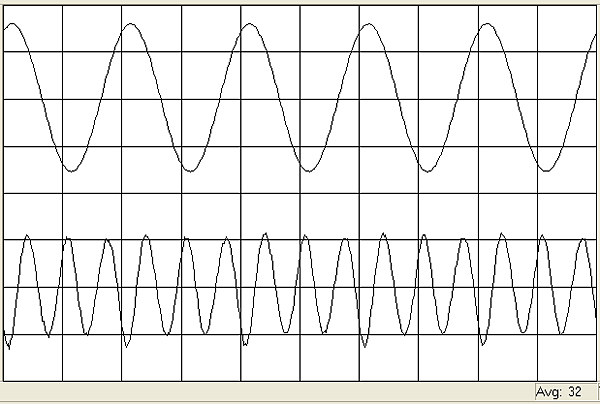
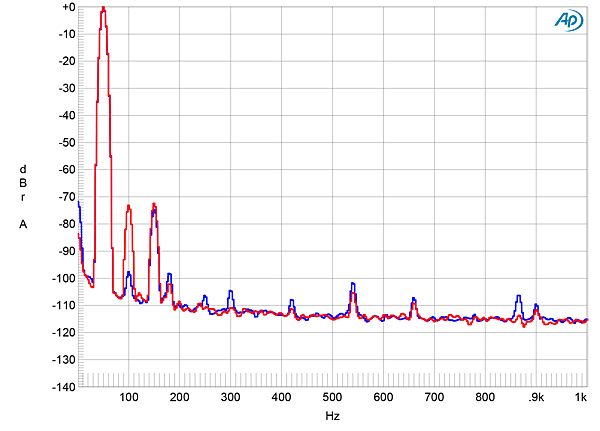
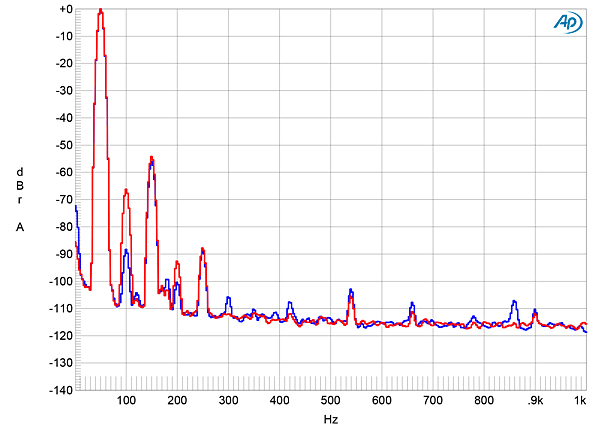
 The left channel's distortion with 1kHz into 8 ohms was predominantly the third harmonic (fig.7), but in the right channel (fig.8, red trace) it was joined by the second harmonic at the same level, –73dB or 0.02%. At the same voltage, 2.83V, into 4 ohms (fig.9), the third harmonic rose to –54dB (0.2%) in both channels. Intermodulation distortion with the amplifier driving an equal mix of 19 and 20kHz tones at 1W into 8 ohms (fig.10) was low in level. Both the second-order difference product at 1kHz and the higher-order intermodulation products lay at –80dB (0.01%). A peculiar rise in the high-frequency noisefloor can be seen in the right channel's spectrum (red trace).

Footnote 1: Although in an InPoL circuit, transistors meet the demand for current.—Jim Austin
Fig.1 Pathos InPol Remix MkII, frequency response at 2.83V into: simulated loudspeaker load (gray), 8 ohms (left channel blue, right red), 4 ohms (left cyan, right magenta), 2 ohms (green) (1dB/vertical div.).
Fig.2 Pathos InPol Remix MkII, small-signal 10kHz squarewave into 8 ohms.
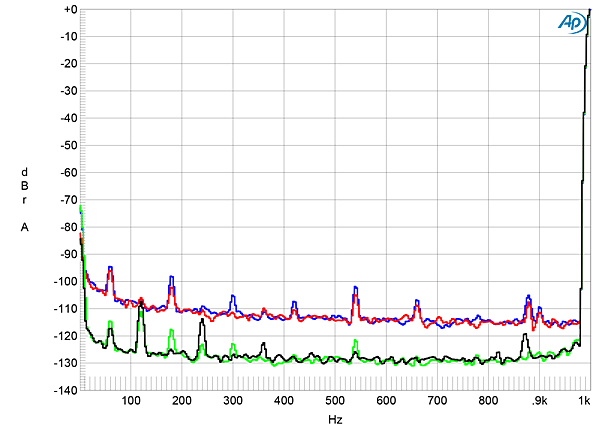
Channel separation was very good, at >95dB below 2kHz and still 73dB at the top of the audioband. Measured with the unbalanced input shorted to ground and the volume control set to its maximum, the amplifier's unweighted, wideband signal/ noise ratio was a disappointing 52.2dB ref. 1W into 8 ohms (average of both channels), improving to 71.9dB when the measurement bandwidth was restricted to 22Hz– 22kHz. Switching an A-weighting filter into circuit further improved the ratio to 75.6dB. Spectral analysis of the Remix MkII's low-frequency noisefloor with the volume control set to its maximum (fig.3, blue and red traces) revealed a relatively high level of random noise, with low-level spuriae visible at the 60Hz power-supply frequency and its odd-order harmonics. Repeating the analysis with the volume control set to –20dB (green and gray traces) reduced the levels of both the random noise and the 60Hz-related spuriae by the same 20dB. This suggests that the noise occurs in the circuit ahead of the volume control, perhaps in the input tubes.
Fig.3 Pathos InPol Remix MkII, spectrum of 1kHz sinewave, DC–1kHz, at 1W into 8 ohms with volume control at maximum (left channel blue, right red) and at –20dB (left green, right gray) (linear frequency scale).
Fig.4 Pathos InPol Remix MkII, distortion (%) vs 1kHz continuous output power into 8 ohms.
Fig.5 Pathos InPol Remix MkII, distortion (%) vs 1kHz continuous output power into 4 ohms.
The shape of the traces in figs.4 and 5 suggests that the actual distortion starts to rise above the noisefloor at a few hundred milliwatts and increases steadily as the power rises. This implies that little or no loop negative feedback is present. I examined how the percentage of THD+noise changed with frequency at 5.3V, which is equivalent to 3.5W into 8 ohms and 7W into 4 ohms. The THD+N was close to 0.1% into 8 ohms (fig.6, blue and red traces), but was 10 times higher into 4 ohms (green and gray traces). The THD+N percentage was a little higher in the right channel into both loads.
Fig.6 Pathos InPol Remix MkII, THD+N (%) vs frequency at 5.3V into: 8 ohms (left channel blue, right red), 4 ohms (left green, right green).
Fig.7 Pathos InPol Remix MkII, 1kHz waveform at 10W into 8 ohms, 0.257% THD+N (top); distortion and noise waveform with fundamental notched out (bottom, not to scale).
Fig.8 Pathos InPol Remix MkII, spectrum of 50Hz sinewave, DC–1kHz, at 1Wpc into 8 ohms (linear frequency scale).
Fig.9 Pathos InPol Remix MkII, spectrum of 50Hz sinewave, DC–1kHz, at 2Wpc into 4 ohms (linear frequency scale).
Fig.10 Pathos InPol Remix MkII, HF intermodulation spectrum, DC–24kHz, 19+20kHz at 1Wpc peak into 8 ohms (linear frequency scale).
The Pathos InPoL Remix MkII's measured performance appears to be dominated by its use of a tubed input stage with little or no loop negative feedback. (I note that the manufacturer says that their patented InPoL topology "allows the tube input stage to effectively drive your speakers with no further amplification," footnote 1) But the amplifier's inability to drive low impedances without what I feel to be excessive levels of harmonic distortion is a matter for concern.—John Atkinson
Footnote 1: Although in an InPoL circuit, transistors meet the demand for current.—Jim Austin















