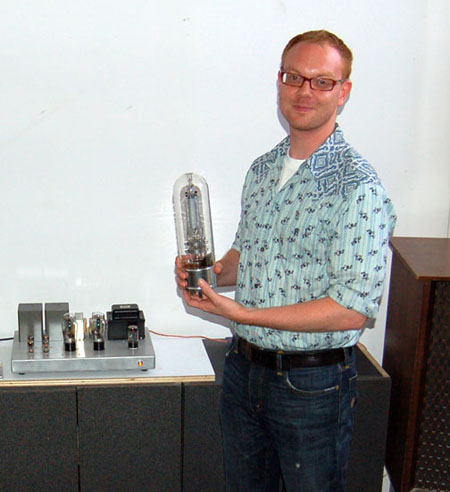
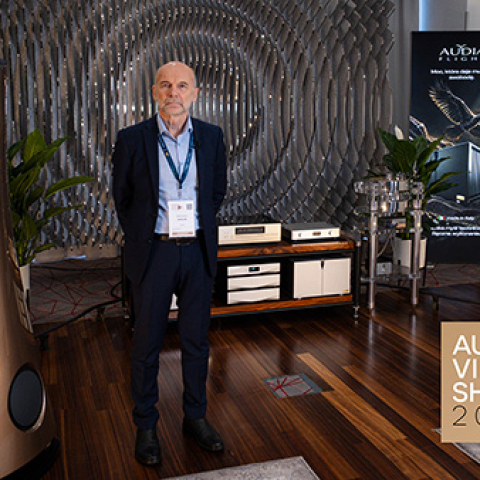
Me, holding a very big tube, at Nori Komuro's place in Brooklyn. To my right, Komuro's prototype VT-52 sits quietly. Photo by Michael Lavorgna.
Last Wednesday, I tagged along with Michael Lavorgna on his latest
6moons.com RoadTour. I feel very fortunate to have been a part of it. Michael's RoadTours are not about declaring bests or absolutes. They are about people, places, music, and gear—pretty much in that order. Michael wants to know more about what happens to a piece of gear after it leaves the dealer—after the reviews have been read, the auditions have been made, and the money is spent. What happens next? How does that piece of gear fit into a music system? And how does that system communicate the passions and opinions of its owner? Michael is most interested in people. He writes:
Whether or not I care for the sound is of very little relevance to the subject at hand. The fact that the people I'll meet have put together a system they want to share is what counts. And what does this actually mean to them? How does owning and enjoying a Hi-Fi fit into their lives?
On this occasion, Michael found himself in Brooklyn.
An amplifier designer lives delicately upon the ruffled outskirts of Williamsburg—rising up from the naughty summer wind—just around the corner from all that is young and hot and high-heeled, at the far, far end of persistent Manhattan Avenue—any farther and you'd fall right into the East River! There, in some sort of unfinished loft-space (Was it once a warehouse? An auto-parts garage?), behind a chain-link fence and with a tempting view of the red-striped Brooklyn Ice Cream Factory, he makes his home. Who would have guessed that all sorts of sounds came to life behind those old steel doors? The amplifier designer's name is
Nori Komuro, and he may be best known for his
high-powered triode-based amplifiers, one of which uses the profanely massive Western Electric 212e. I got to hold it in my hands and feel funny.
When I showed up, Michael and Komuro were just making room for Michael's beefy and boxy Altec Valencia loudspeakers. They would rest atop a couple of homemade subs, flanking a simple row of cabinets along one wall of the white room. Moments earlier, John DeVore called.
"I'm right around the corner," he said. "I'm just stopping to get a six-pack. Do we need anything else?"
"It's John," I told Michael. "He's stopping to get a six-pack. Do we need anything else?"
"We'll need more beer than that," Michael said.
"We'll need more beer than that," I relayed.
"That's what I like to hear," John said.
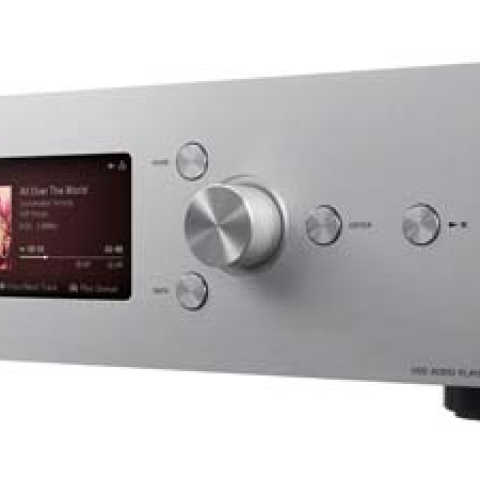
Michael's Shindo Monbrison preamplifier (which looked so scrumptious I threatened to eat it) was placed right on top of Komuro's Sony DVD player. John arrived with a bag of Nacho Cheesier Doritos and the beer. "We've got Budweiser, the King of Beers," he said, "and Presidente, the… President of Beers. Which will you have?"
"I'll take the King of Beers."
"Nice."
We were there, however, to listen to Komuro's newest creation, his VT-52 amplifier. It features new old-stock Western Electric VT-52 tubes and pumps out a mighty three watts. "About three watts," that is. Maybe less.
We were soon joined by a fellow named Don Garber. He strode in lightly, wearing blue jeans, a plain black tee, and round-rimmed spectacles, his carefree gray hair going this way and that. In no time at all, it became obvious that Don and Komuro had shared some history together. "It just occurred to me," Don said at one point, "that we're listening to a
stereo design by Komuro.
A stereo design." Some history, for sure.
Back in 1992, the year after punk broke, Don Garber opened up a high-end audio shop on Watts Street (how appropriate!). You might've heard Art Dudley talk about it. It was called Fi. I've been told that some of the very first American single-ended triode amplifiers came from that small shop. And I've been told they were very special things—exotic, handmade amplifiers using all sizes and shapes of glorious tubes and built to make music, to make music, to make music. There, at Fi, Komuro met Don. Who knows what really happened when these two men shook hands? Curses were shouted and tubes fell from the shelves. That's the way I like to imagine it.
We had been listening for only a short while when Komuro's friend, Fumio Ito of Quest America, arrived with a bag of cables. Quest America is the new US importer for Nanotec Systems. Their cables are interesting for their supreme pliability—they bend and twist as simply as any electric guitar cable, though they are about twice as thick. They are sheathed in attractive 10mm PVC—the speaker cables that Fumio had with him were bright red, while the interconnects were a deep blue—which surrounds a layer of Japanese rice paper, which in turn surrounds bunches of braided cotton string. Inside there, you'll find 50 strands of 0.18mm oxygen-free copper conductors, which have been soaked with a colloidal liquid of gold and silver particles! The result of all this is said to be "rich bass, clear midrange, and sharp, natural highs." Not in those words.
Anyway, the cables are really bendy. We inserted them into the system and we were greeted by fuller bass and greater detail. We listened for quite some time, then—casually, as other friends came and went, we shared music, swapped seats, drank beers, and passed the bag of chips. It was a good time. The music was alive and true, with a remarkable lack of anything approaching etch or glare. The presentation was greatly dependent upon one's position in the room. Sitting just about five feet from the speakers was like sitting
on the stage, the performers playing in your face, bass and percussive sounds delivered with outstanding immediacy and impact. You would never, ever—never, ever, ever, ever—guess that you were only hearing
maybe three watts. There was no lack of power at all.
"It feels like those bongos are in my sinuses."
The bass, especially, was round and full and as all-encompassing as your grandma's most affectionate embrace—the gentlest pummeling ever. Moving just one foot back, however, set things in a more realistic perspective. The sweetest spot in Komuro's room was about four steps up a short wooden staircase. From there, the sound was exquisite—as welcoming as our host, as distracting as the women on Bedford Avenue.
But, as Michael Lavorgna reminds us, the point of this visit was not the sound. Though the sound could have kept us there all night, it was the people that brought us there. I was very happy to listen to music with this bunch of friends. I hope you'll read Michael's "
RoadTour 16: Komuro's VT-52 amp" for another perspective (and many more photos!).