

Measurements
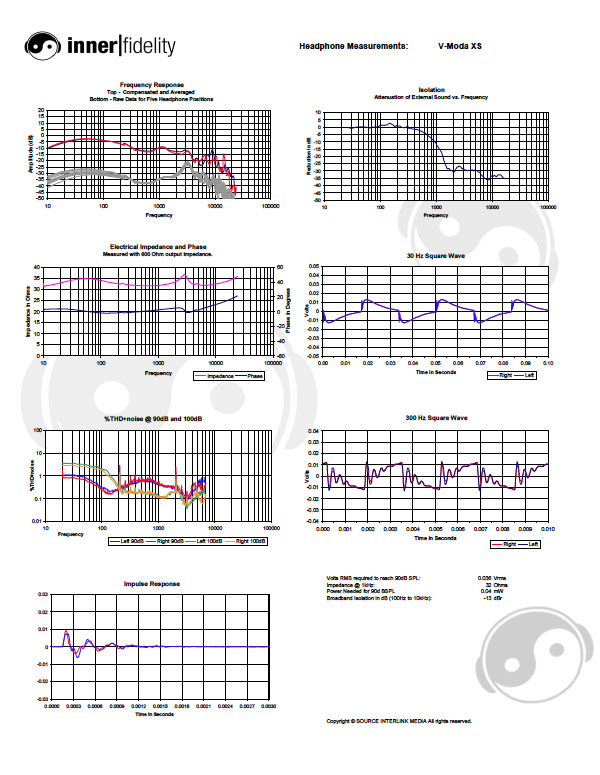 The impedance plot shows a bit of a bumpy ride with a broad primary driver resonance and pretty sizable blip at 3kHz. These usually occur from the acoustics around the driver; often they can look dirty and are accompanied by distortion. The THD plot shows low distortion in this area, so the clean blips in impedance are likely well controlled in this design.
(I need to interject, I'm not a headphone engineer, so please take all my interpretations of these data with a big grain of salt.)
Isolation above 2kHz is quite good, but below 1kHz they isolate very little. These will be good headphones for walking around where some awareness of outside noise is a good thing. But these will not be good for regular use to quiet the noise on trains and planes.
At 32 Ohms and 36mVrms needed to achieve 90dBspl at the ear, the V-Moda XS will be easily driven to solid volume by portable devices.
The impedance plot shows a bit of a bumpy ride with a broad primary driver resonance and pretty sizable blip at 3kHz. These usually occur from the acoustics around the driver; often they can look dirty and are accompanied by distortion. The THD plot shows low distortion in this area, so the clean blips in impedance are likely well controlled in this design.
(I need to interject, I'm not a headphone engineer, so please take all my interpretations of these data with a big grain of salt.)
Isolation above 2kHz is quite good, but below 1kHz they isolate very little. These will be good headphones for walking around where some awareness of outside noise is a good thing. But these will not be good for regular use to quiet the noise on trains and planes.
At 32 Ohms and 36mVrms needed to achieve 90dBspl at the ear, the V-Moda XS will be easily driven to solid volume by portable devices.
Click on graphs image to download .pdf for closer inspection.
Raw frequency plots are astonishingly similar to the Harman Response curve. Looking at the compensated plot you can see a fairly good resemblance of a flat but warm tilted response. The XS sounded really balanced to me—other than the loose bass and lithpy articulation in the treble. I'm thinking what we want to see in a headphone's compensated response plot, is a straight line with a -15dB tilt, 20Hz to 20kHz. It might be that if I mix my head's ID HRTF with a -15dB tilt....well, I think you can see where my head is headed. And I'm quite a bit off topic, sorry. Let's just say I think the XS frequency response overall is astonishingly good for a sealed, on-ear headphone.
30 Hz square wave has good shape overall, but a bit swayback indicative of a headphone rolling-off due to going below the primary drive resonance, which you can see as the hump centered at 60Hz in the impedance plot. One wonders why we're seeing so much bass distortion in the THD plot. My guess is the driver is nicely under control, but all the air leaks of being an on-ear prevent the air compression needed for the long cycle times of the bass notes. Gonna have to ask a headphone engineer about that the next time I bump into one.
300 Hz square wave is quite familiar to me. The Focal Spirit Professionals, Sennheiser HD 600, and Skullcandy Aviators—among others—all have this signature. It results, to my ears, with a "lithpy" sound to the treble. It also sometimes reminds me of the sound cellophane (the stuff sometimes used as wrapping on fruit baskets) makes when you crinkle it. Anyway, three distinct cycles that look like this—as long as they're not excessive in amplitude—generally blurs treble articulation, but also tends to soften harsh recordings. The impulse response is likewise fundamentally characterized by the three cycles, but is otherwise fairly free of uncontrolled spuria.















