

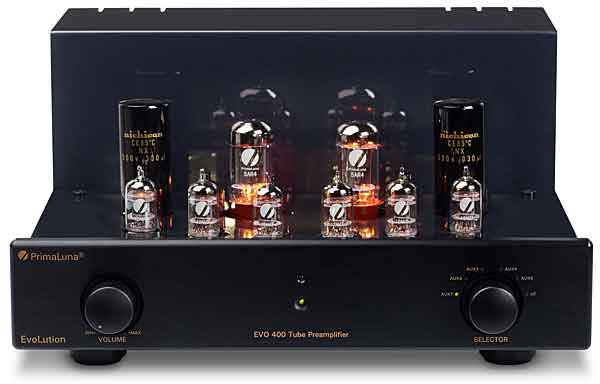
We all know our father's jazz records were about the sounds of acoustic bass, saxophone, and piano. In response to all that unamplified acousticness, Ventures' records—especially those on the Dolton label—were all about the new, powerful, driving sound of electric guitars. (The Ventures, along with Chet Atkins and Link Wray, played a significant role in making electric guitars the most important instruments in 1960s popular music.) Therefore, any playback of their recordings that doesn't convey the expressive reality of those guitars and their associated tubed amplifiers is a fail. The all-tube EVO 400 preamp and the ProLogue Premium amplifier triumphed: They brought the Ventures' incomparable guitar sound to ravishing new life. The PrimaLuna tubes let the Ventures' reverb-soaked essence fill my room; they made me feel like a "ho-dad" (a greaser/hot-rodder) and let me go "ten-over" until I wiped out.
Rogue RP-7 comparison
Remember when I said that changing from the Rogue RP-7 hybrid preamp to PrimaLuna's all-tube EVO 400 was like switching brands of oil paint? Actually, it was slightly more dramatic than that, especially when I switched from the EVO 400 back to the RP-7. While doing this review, I was simultaneously working on some cartridge reviews, so I went eight full days without listening to any digital program (except when watching tractor pulls and drag-race videos on YouTube). Can you imagine life without CDs or streaming? Better yet, can you imagine playing the same LP on the AMG Giro G9 record player with a 9W tonearm and EMT TSD 75 moving-coil cartridge, and then switching to the Feickert Blackbird turntable with a Jelco TK-850L tonearm and a My Sonic Lab Ultra Eminent Ex MC? Think PrimaLuna tubeness plus superanalog coolosity.
 During my digital abstinence, I was obsessed with the great teal-label LPs from Argo—many of which were recorded by legendary engineer Kenneth Wilkinson—so I played Evensong for Ascensiontide with at least four different phono cartridges. With every cartridge, the Rogue was just a teensy bit more sharply focused than the PrimaLuna. You know that imaginary dividing line between the left and right sides of your brain? The RP-7 and EVO 400 were both standing right at that line, next to each other, holding hands. The RP-7 was on the left side of my brain centerline, and the EVO was on the right. Their yin-yangs were almost touching. Both preamps separated the voices of the St. John's College Choir extremely well, but the Rogue RP-7 made each voice more solid than the EVO 400, which seemed very slightly more diffuse. Yet during the opening and closing voluntaries, the EVO 400 made the St. John's organ feel larger and more air-movingly expansive. It emphasized the church's cubic space and atmosphere. In contrast, Rogue's RP-7 made the organ's sound feel denser, more direct, more powerful.
Late one night, my system was sounding super-scintillating. Singers were sounding like they are supposed to sound. I had the Rogue RP-7 driving the Rogue Stereo 100 amplifier driving the Harbeth M30.2s, and as my attention locked onto French experimental singer Brigitte Fontaine's Comme à la radio (LP, Superior Viaduct SV042), I realized that the most obvious differences in sound character between the Rogue RP-7 and the PrimaLuna EVO 400 were probably due to the differences in power-supply design. The RP-7 uses 17 separate solid-state power supplies, including an individual regulated filament supply for each tube. This is 100% new-school tube-audio design. In contrast, PrimaLuna's tube-rectified, choke-filtered power supply is certified old school.
I listened at length to Brigitte Fontaine's well-recorded sound collages while alternating between the RP-7 and EVO 400 preamps. Both tube line stages did vivid. Both did scintillating. And they did them in ways my third comparison preamp, the more buttoned-down, all-solid-state Pass Labs HPA-1 ($3500), could not match.
When I compared these three preamps, I found the sonic differences were mostly subtle and mostly in the realms of color saturation, viscosity, and texture—just like the differences between brands of oil paint. The all-solid-state HPA-1 is fine-grained, dynamic, and disappears readily. It generates an ultra-pasteurized viscosity. It tames music's natural wildness. It has a slightly grayish tonal character, and its soundstage is less commodious than either the Rogue's or the PrimaLuna's. However, most audiophiles would, I think, describe the HPA-1 as an exceedingly neutral component.
Compared to the all-transistor Pass Labs HPA-1, the all-tube EVO 400 develops deeper, darker shadows, is more three-dimensional, makes more saturated tonal color, and has more eye-catching highlights. Its sound is thicker in viscosity than that of the HPA-1. Old-school tube aficionados would likely describe the EVO 400 as the clearest, fastest, most transparent all-tube preamp ever. Contemporary fans of solid-state might concede its transparency but would probably declare the bass not tight enough.
Not surprisingly, the hybrid tube-MOSFET Rogue RP-7 sits authoritatively between these pure-tube and pure-transistor extremes. The Rogue allows a modest gleam of tubes to enhance the Apollonian steadiness of its transistor-regulated power supplies. Its bass packs a greater wallop than the EVO 400. To an unbiased audiophile observer, the RP-7 is the product that might seem the most neutral. But, to me, each of these preamps offers a different, but equally legitimate, perspective on the recordings I played. Remember the parable of the blind men and the elephant . . . ?
March 25, 2019: Scott Walker, experimental pop-music hero, dies, age 76. Suddenly, the next morning, it's Scott Walker Day, and I bowed my head and gave thanks for Walker's long run of edgy creativity. Overnight, I went from Brigitte Fontaine's sound collages to Scott Walker's powerful collaboration with Sunn O))), Soused (2 LPs, 4AD CAD 3428). The PrimaLuna EVO 400 exposed every electron of Soused's primeval darkness. When I played Soused really loud, its massive, expanding, synth-generated spatiality held me by my chestplate and forced me to stare at flickering galaxies floating in voids of black ether. The EVO showcased the dark strangeness of Walker's voice. This kind of music sounds best with tubes, and even better with tubes and giant horns. (Imagine enormous volumes of densely charged air.)
During my digital abstinence, I was obsessed with the great teal-label LPs from Argo—many of which were recorded by legendary engineer Kenneth Wilkinson—so I played Evensong for Ascensiontide with at least four different phono cartridges. With every cartridge, the Rogue was just a teensy bit more sharply focused than the PrimaLuna. You know that imaginary dividing line between the left and right sides of your brain? The RP-7 and EVO 400 were both standing right at that line, next to each other, holding hands. The RP-7 was on the left side of my brain centerline, and the EVO was on the right. Their yin-yangs were almost touching. Both preamps separated the voices of the St. John's College Choir extremely well, but the Rogue RP-7 made each voice more solid than the EVO 400, which seemed very slightly more diffuse. Yet during the opening and closing voluntaries, the EVO 400 made the St. John's organ feel larger and more air-movingly expansive. It emphasized the church's cubic space and atmosphere. In contrast, Rogue's RP-7 made the organ's sound feel denser, more direct, more powerful.
Late one night, my system was sounding super-scintillating. Singers were sounding like they are supposed to sound. I had the Rogue RP-7 driving the Rogue Stereo 100 amplifier driving the Harbeth M30.2s, and as my attention locked onto French experimental singer Brigitte Fontaine's Comme à la radio (LP, Superior Viaduct SV042), I realized that the most obvious differences in sound character between the Rogue RP-7 and the PrimaLuna EVO 400 were probably due to the differences in power-supply design. The RP-7 uses 17 separate solid-state power supplies, including an individual regulated filament supply for each tube. This is 100% new-school tube-audio design. In contrast, PrimaLuna's tube-rectified, choke-filtered power supply is certified old school.
I listened at length to Brigitte Fontaine's well-recorded sound collages while alternating between the RP-7 and EVO 400 preamps. Both tube line stages did vivid. Both did scintillating. And they did them in ways my third comparison preamp, the more buttoned-down, all-solid-state Pass Labs HPA-1 ($3500), could not match.
When I compared these three preamps, I found the sonic differences were mostly subtle and mostly in the realms of color saturation, viscosity, and texture—just like the differences between brands of oil paint. The all-solid-state HPA-1 is fine-grained, dynamic, and disappears readily. It generates an ultra-pasteurized viscosity. It tames music's natural wildness. It has a slightly grayish tonal character, and its soundstage is less commodious than either the Rogue's or the PrimaLuna's. However, most audiophiles would, I think, describe the HPA-1 as an exceedingly neutral component.
Compared to the all-transistor Pass Labs HPA-1, the all-tube EVO 400 develops deeper, darker shadows, is more three-dimensional, makes more saturated tonal color, and has more eye-catching highlights. Its sound is thicker in viscosity than that of the HPA-1. Old-school tube aficionados would likely describe the EVO 400 as the clearest, fastest, most transparent all-tube preamp ever. Contemporary fans of solid-state might concede its transparency but would probably declare the bass not tight enough.
Not surprisingly, the hybrid tube-MOSFET Rogue RP-7 sits authoritatively between these pure-tube and pure-transistor extremes. The Rogue allows a modest gleam of tubes to enhance the Apollonian steadiness of its transistor-regulated power supplies. Its bass packs a greater wallop than the EVO 400. To an unbiased audiophile observer, the RP-7 is the product that might seem the most neutral. But, to me, each of these preamps offers a different, but equally legitimate, perspective on the recordings I played. Remember the parable of the blind men and the elephant . . . ?
March 25, 2019: Scott Walker, experimental pop-music hero, dies, age 76. Suddenly, the next morning, it's Scott Walker Day, and I bowed my head and gave thanks for Walker's long run of edgy creativity. Overnight, I went from Brigitte Fontaine's sound collages to Scott Walker's powerful collaboration with Sunn O))), Soused (2 LPs, 4AD CAD 3428). The PrimaLuna EVO 400 exposed every electron of Soused's primeval darkness. When I played Soused really loud, its massive, expanding, synth-generated spatiality held me by my chestplate and forced me to stare at flickering galaxies floating in voids of black ether. The EVO showcased the dark strangeness of Walker's voice. This kind of music sounds best with tubes, and even better with tubes and giant horns. (Imagine enormous volumes of densely charged air.)
 With the Rogue RP-7, the sound was considerably denser but less voluminous and dramatically expansive, and textures were less prominent. With the Pass Labs HPA-1, the depth and strangeness of this music were still expressed, but the spectral color and quirky affectedness of Scott Walker's voice were diminished.
Epilogue
With the Rogue RP-7, the sound was considerably denser but less voluminous and dramatically expansive, and textures were less prominent. With the Pass Labs HPA-1, the depth and strangeness of this music were still expressed, but the spectral color and quirky affectedness of Scott Walker's voice were diminished.
Epilogue
As I had hoped, PrimaLuna's new EVO 400 was more concise-sounding than the ProLogue Premium preamp. It generated clearer, more muscular presentations, with sharper focus, and more distinctly punctuated momentums.
My elaborate comparisons revealed that these three preamplifiers—the Pass Labs HPA-1, the Rogue Audio RP-7, and the PrimaLuna EVO 400—offer distinctly different physical and illusory representations of whatever musical program they are fed. These differences were more covert than overt and showed themselves mainly as variations of texture, spatial volume, and viscosity.In the end, the Rogue RP-7 still seemed like the best-balanced, most open, most neutral-sounding of the three. The Pass Labs HPA-1 still seemed like a relaxed, neutral-sounding preamp for use in systems where headphone listening is primary. But, of the three, the PrimaLuna EVO 400 dissolved into the music more completely than the others. It seemed the most highly resolved and naturally transparent. Class A all the way.
Remember when I said that changing from the Rogue RP-7 hybrid preamp to PrimaLuna's all-tube EVO 400 was like switching brands of oil paint? Actually, it was slightly more dramatic than that, especially when I switched from the EVO 400 back to the RP-7. While doing this review, I was simultaneously working on some cartridge reviews, so I went eight full days without listening to any digital program (except when watching tractor pulls and drag-race videos on YouTube). Can you imagine life without CDs or streaming? Better yet, can you imagine playing the same LP on the AMG Giro G9 record player with a 9W tonearm and EMT TSD 75 moving-coil cartridge, and then switching to the Feickert Blackbird turntable with a Jelco TK-850L tonearm and a My Sonic Lab Ultra Eminent Ex MC? Think PrimaLuna tubeness plus superanalog coolosity.
During my digital abstinence, I was obsessed with the great teal-label LPs from Argo—many of which were recorded by legendary engineer Kenneth Wilkinson—so I played Evensong for Ascensiontide with at least four different phono cartridges. With every cartridge, the Rogue was just a teensy bit more sharply focused than the PrimaLuna. You know that imaginary dividing line between the left and right sides of your brain? The RP-7 and EVO 400 were both standing right at that line, next to each other, holding hands. The RP-7 was on the left side of my brain centerline, and the EVO was on the right. Their yin-yangs were almost touching. Both preamps separated the voices of the St. John's College Choir extremely well, but the Rogue RP-7 made each voice more solid than the EVO 400, which seemed very slightly more diffuse. Yet during the opening and closing voluntaries, the EVO 400 made the St. John's organ feel larger and more air-movingly expansive. It emphasized the church's cubic space and atmosphere. In contrast, Rogue's RP-7 made the organ's sound feel denser, more direct, more powerful.
Late one night, my system was sounding super-scintillating. Singers were sounding like they are supposed to sound. I had the Rogue RP-7 driving the Rogue Stereo 100 amplifier driving the Harbeth M30.2s, and as my attention locked onto French experimental singer Brigitte Fontaine's Comme à la radio (LP, Superior Viaduct SV042), I realized that the most obvious differences in sound character between the Rogue RP-7 and the PrimaLuna EVO 400 were probably due to the differences in power-supply design. The RP-7 uses 17 separate solid-state power supplies, including an individual regulated filament supply for each tube. This is 100% new-school tube-audio design. In contrast, PrimaLuna's tube-rectified, choke-filtered power supply is certified old school.
I listened at length to Brigitte Fontaine's well-recorded sound collages while alternating between the RP-7 and EVO 400 preamps. Both tube line stages did vivid. Both did scintillating. And they did them in ways my third comparison preamp, the more buttoned-down, all-solid-state Pass Labs HPA-1 ($3500), could not match.
With the Rogue RP-7, the sound was considerably denser but less voluminous and dramatically expansive, and textures were less prominent. With the Pass Labs HPA-1, the depth and strangeness of this music were still expressed, but the spectral color and quirky affectedness of Scott Walker's voice were diminished.
EpilogueAs I had hoped, PrimaLuna's new EVO 400 was more concise-sounding than the ProLogue Premium preamp. It generated clearer, more muscular presentations, with sharper focus, and more distinctly punctuated momentums.















