

Sidebar 3: Measurements
I used DRA Labs' MLSSA system to measure the ProAc Response D2R, using a calibrated DPA 4006 microphone for the farfield behavior and an Earthworks QTC-40 mike for the nearfield responses. Though ProAc specifies the Response D2R's sensitivity as 88.5dB, presumably for 1W at 1m, my estimate was somewhat lower, at 85dB(B)/2.83V/m.
The ProAc's specified impedance is 8 ohms; the solid trace in fig.1 reveals that, other than two regions in the midbass and lower midrange, the impedance remains above 8 ohms for the entire audioband. The minimum value is 6.22 ohms between 170Hz and 180Hz, and while the electrical phase angle (dashed trace) is high at some frequencies, the impedance magnitude is also high at those frequencies. The Response D2R will therefore be a very easy load for the partnering amplifier to drive. Note that the average impedance is higher in the treble than it is in the midrange. As a result, the response will be tilted up a little when the speaker is partnered with a tube amplifier having a high output impedance.


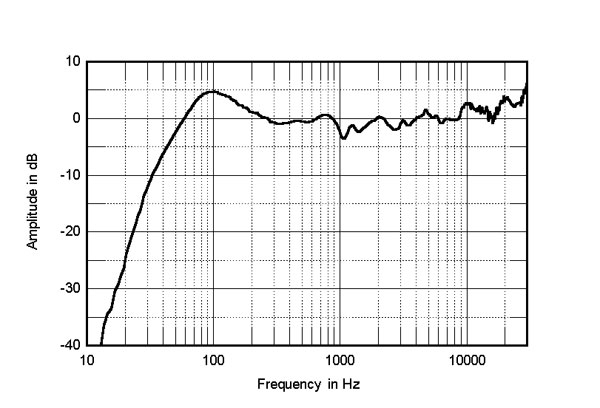
 There is a small suckout just above 1kHz in the woofer's output, and it crosses over to the tweeter (fig.3, green trace) at 2.3kHz with what appears to be a third-order, 18dB/octave, low-pass slope. The rolloff is disturbed by some small peaks, however. The tweeter rolls out very rapidly below the crossover frequency, and its top-octave output is 3–5dB too high in level compared with the average level of the woofer. This can also be seen in the Response D2R's farfield response, averaged across a 30° horizontal window centered on the tweeter axis (fig.4, black trace above 300Hz), along with a slight lack of energy between 900Hz and 2kHz. (The latter may well have affected my sensitivity estimate.)
 The plot of the Response D2R's horizontal dispersion, referenced to the response on the tweeter axis, is shown in fig.5. (Because the tweeter is mounted asymmetrically on the front baffle, I have plotted the differences in response on the tweeter side of the baffle to the front of the graph and the differences on the other side to the rear.) The speaker's output drops off to the sides above 10kHz, which will tend to balance the on-axis peakiness in the top audio octave in medium-sized and large rooms. The lack of energy in the low treble in the tweeter-axis response is maintained to the speaker's sides, which, all things being equal, will make the Response D2R sound a little polite. In the vertical plane (fig.6), as the ribbon tweeter is relatively long—2.75"—its dispersion is limited in the high treble, though there is a little more top-octave output 5° above the tweeter axis. A suckout develops in the crossover region 10° above and below the tweeter axis. The D2Rs should be used on stands that place the listener's ears close to the tweeter axis. (ProAc recommends stands that are at least 18" high.)

 In the time domain, the Response D2R's step response on the tweeter axis (fig.7) indicates that the tweeter and woofer are both connected in positive acoustic polarity. The decay of the tweeter's step, which arrives first at the microphone, smoothly blends with the start of the woofer's step, indicating optimal crossover topology. The ProAc's cumulative spectral-decay plot (fig.8) is clean over most of the audioband, though undulations in the decay of the woofer's step response are associated with some delayed energy at the frequency of the suckout in the on-axis output. The decay of the tweeter's output above 10kHz is initially clean, but some low-level hash develops.


Fig.1 ProAc Response D2R, electrical impedance (solid) and phase (dashed) (2 ohms/vertical div.).
When I investigated the enclosure's vibrational behavior with a plastic-tape accelerometer, I found two resonant modes, at 250Hz and 281Hz, on the top panel and sidewalls (fig.2). Given that these modes are both high in level and relatively low in frequency, I would expect this behavior to add some congestion in the midrange.
Fig.2 ProAc Response D2R, cumulative spectral-decay plot calculated from output of accelerometer fastened to center of sidewall (MLS driving voltage to speaker, 7.55V; measurement bandwidth, 2kHz).
The saddle centered on 45Hz in the impedance magnitude plot suggests that this is the tuning frequency of the ProAc's port. This was confirmed by the fact that the nearfield response of the woofer (fig.3, blue trace) has its minimum-motion notch at that frequency. (The back pressure from the port resonance holds the cone stationary at this frequency.) The nearfield response of the port (red trace) broadly peaks between 30Hz and 90Hz, and its upper-frequency rolloff is clean. (I have only plotted the port's output up to 400Hz; above that frequency, the measurement was affected by crosstalk from the woofer, which is just above the port on the front panel.)
Fig.3 ProAc Response D2R, acoustic crossover on tweeter axis at 50", corrected for microphone response, with the nearfield responses of the woofer (blue) and port (red), respectively plotted below 350Hz and 400Hz.
Fig.4 ProAc Response D2R, anechoic response on tweeter axis at 50", averaged across 30° horizontal window and corrected for microphone response, with the complex sum of the nearfield woofer and port responses plotted below 300Hz.
The black trace below 300Hz in fig.4 shows the complex sum of the D2R's nearfield woofer and port outputs. The peak in the upper bass will be due to the nearfield measurement technique, which assumes that the radiators are mounted on a baffle that extends to infinity in both horizontal and vertical planes. The D2R's low-frequency alignment is actually maximally flat and down by 6dB at the port's tuning frequency, which is close to that of the lowest open string on the double bass and four-string bass guitar.
Fig.5 ProAc Response D2R, lateral response family at 50", normalized to response on tweeter axis, from back to front: differences in response 90–5° off axis on other side of baffle, reference response, differences in response 5–90° off axis on tweeter side of baffle.
Fig.6 ProAc Response D2R, vertical response family at 50", normalized to response on tweeter axis, from back to front: differences in response 45–5° above axis, reference response, differences in response 5–45° below axis.
Fig.7 ProAc Response D2R, step response on tweeter axis at 50" (5ms time window, 30kHz bandwidth).
Fig.8 ProAc Response D2R, cumulative spectral-decay plot on tweeter axis at 50" (0.15ms risetime).
The ProAc Response D2R's measured behavior suggests that experimentation with toe-in and taking care over vertical listening axis will result in the most even tonal balance.—John Atkinson















