Jason Victor Serinus wrote about the PS Audio DirectStream Power Plant 20 in May 2019 (Vol.42 No.5):
The last thing I expected to rave about was a PS Audio Power Plant AC regenerator—not when, over a decade ago, I'd tested an early model, the Power Plant P600, and it shot 18"-high flames and acrid black smoke into my living room. And after reviewing two Power Plants for other publications, I concluded that, for all the good they did, they tended to homogenize the sound of my system.
Nonetheless, in fall 2018, after trying four power conditioners that either buzzed and hummed far too loudly, lacked transparency, exacerbated brightness, or squashed dynamics, I decided to give one of PS Audio's latest line of Power Plants another try. PS Audio loaned me a DirectStream Power Plant 15 ($7499), aka the P15, for my dCS front end. After plugging the P15 into the wall with a 15-amp Nordost Odin 2 power cord, I connected all of my dCS components to a Nordost QB8 power distributor, then plugged the QB8 into the P15. The P15's MultiWave function, which allows the user to vary the normal 60Hz waveform in an effort to increase the charging time of power-supply capacitors, was disengaged—I wanted to hear what the Power Plant 15 could do in its purest state.
When the P15 had fully settled in, the artificial shine it had at first brought to my system was replaced by an extremely transparent, detailed, and neutral sound. Not only did the P15's meters declare that it was removing from my electrical line more than 2% of total harmonic distortion, my ears told me that the sound was extremely natural, with less edgy treble and more tightly focused bass than I'd heard from my system in a long time.
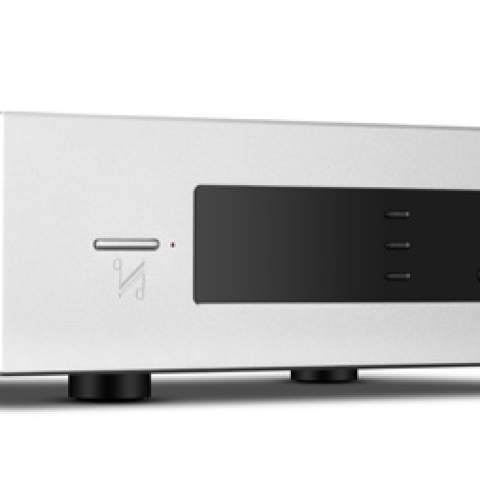
Being an audiophile, I also wished to address the quality of power fed to my reference Dan D'Agostino Master Audio Systems Progression class-AB monoblocks, which deliver up to 1000Wpc into 4 ohms—the nominal impedance of my Wilson Audio Alexia 2 loudspeakers. PS Audio's Bill Leebens postulated that I'd need either two P15s ($7499 each), one per monoblock, or a single Power Plant 20 ($9999).
Two P15s requiring two power cables—or a single, taller, heavier Power Plant 20 with the same footprint? No contest. When a broken-in P20 arrived, I had just enough time to power it up with a 15-amp Nordost Odin 2 power cord, plug everything in, and ascertain that it worked with the D'Agostinos—before Paul Manos, of High Fidelity Services, arrived to install the Verity Audio Monsalvat Amp-60 stereo amplifier that I review elsewhere in this issue. Manos and I first plugged the Monsalvat Amp-60 into the wall, and connected everything else to the P20. After noting the sound, we connected the Amp-60 to one of the P20's high current outlets and discovered that it then sounded fuller, warmer, smoother, and more controlled.
I continued my review of the Verity amplifier without the P20. But once I had submitted my review to Stereophile home base, I reinstated the P20 to see if it squashed the Amp-60's dynamics? To find out, I'd previously asked Keith Johnson and Sean Martin of Reference Recordings and Morton Lindberg of the Norwegian label 2L to send me their most dynamic high-resolution tracks. I ended up choosing Dance of the Tumblers, from Rimsky-Korsakov's The Snow Maiden, from Eiji Oue and the Minnesota Orchestra's Exotic Dances from the Opera (24-bit/176.6kHz WAV, Reference RR-71), and Vox in Rama, from Andrew Smith's Lux, with Anita Brevik leading the Trondheim Soloists (24/352.8 MQA, 2L 2L-150-SABD). Using the dB Meter Pro app on my iPhone, I found that the dynamic range of Vox in Rama was an astounding 51dB, and that it remained so whether the Amp-60 was plugged into the wall or into the Power Plant 20.
Further tests, conducted with audiophile friend Steve Zettel, confirmed that the P20 was not squashing the Progressions' dynamics. However, when I tried the P20 with my power-guzzling Pass Laboratories XA200.8 class-A monoblocks, the P20 quickly shut down without tripping my circuit breakers—even when I powered up the Passes one at a time.
Searching for a solution, I plugged one XA200.8 into the P20 and the other into the wall. That worked. The wall-powered channel sounded a bit hard, edgy, and color-deficient; the P20-powered channel sounded smoother, warmer, more three-dimensional—and far more musically satisfying. Next, on the advice of PS Audio's Paul McGowan, I slid open the little door on the P20's rear panel to reveal its 20-amp IEC receptacle, and switched to a 20-amp Nordost Odin 2 power cord. The P20 powered both XA200.8s without a hitch. Even when I listened to a huge orchestra playing at full tilt at maximum volume level in my 20' by 16' listening room, the XA200.8s sang away.
As for homogenizing the sound, I found that the P20 did the opposite. Differences in these very different amps' dynamics, detail, tonal balance, and overall quality, bass extension and control, soundstaging and air—all were easily audible. Nor were those differences exactly as I'd expected them to be from prior listens. PS Audio's DirectStream Power Plant 20 has proven to be an opener of mind and ears that I hope to keep in my system as an essential reviewing tool and source of listening joy for a long time to come.—Jason Victor Serinus
PS Audio DirectStream Power Plant 20 AC regenerator Jason Victor Serinus May 2019

Company Info
ARTICLE CONTENTS
- Log in or register to post comments