Sidebar 4: Measurements
I performed a full suite of measurements on one of the PS Audio Stellar M1200s (serial no. 12-A1-0G0033), using my Audio Precision SYS2722 system (see the January 2008 "As We See It"). Because the Stellar M1200 features a class-D output stage, all the measurements other than the frequency response tests and one of the squarewave tests were taken with Audio Precision's AUX-0025 auxiliary passive low-pass filter, which eliminates much of the ultrasonic noise that might otherwise drive the analyzer's input into slew-rate limiting. Without the filter, 373mV of ultrasonic noise was present at the amplifier output terminals.
The Stellar M1200's voltage gain at 1kHz into 8 ohms was a little higher than usual, at 30.5dB with both balanced and unbalanced input signals. (This was also the case with PS Audio's Stellar M700, which Robert Deutsch reviewed in February 2018, and the BHK Signature 300 that Michael Fremer reviewed in February 2016.) Both inputs preserved absolute polarity (ie, were noninverting), and the single-ended input impedance was 47k ohms at low and middle frequencies, decreasing slightly and inconsequentially to 37.6k ohms at the top of the audioband. The balanced input impedance was exactly twice these values, as expected. The output impedance (including the series resistance of 6' of speaker cable) was very low, at 0.05 ohm at 20Hz and 1kHz, and 0.08 ohm at 20kHz.
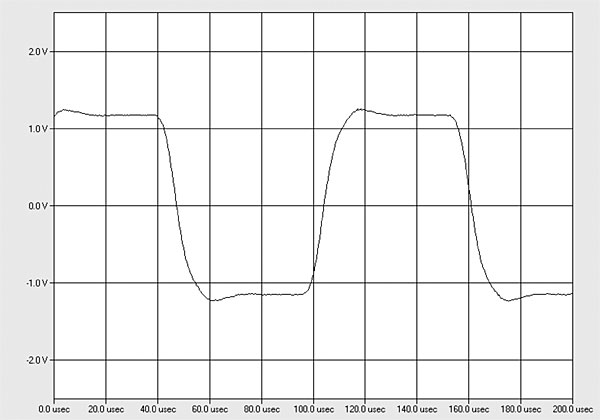
The gray trace in fig.1 shows the Stellar M1200's small-signal frequency response into our standard simulated loudspeaker. The variations in response were a negligible ±0.05dB. Into resistive loads (blue, magenta, and red traces), the amplifier rolled off above the audioband, with –3dB frequencies between 40kHz and 50kHz depend ing on the load resistance. The Stellar M1200's reproduction of a 10kHz squarewave (fig.2) featured a slight amount of well-damped overshoot. This graph was taken with the auxiliary low-pass filter; it is absent when I repeated the test without the filter (fig.3), though the trace is now overlaid with ultrasonic noise.


 The PS Audio met its specified output powers of 600W into 8 ohms and 1200W into 4 ohms (both equivalent to 27.8dBW), clipping at 610W into 8 ohms (27.9dBW, fig.5) and 1200W into 4 ohms (fig.6). Fig.7 plots the percentage of THD+noise into 8, 4, and 2 ohms at a level, 20V (equivalent to 50W into 8 ohms, 100W into 4 ohms, and 200W into 2 ohms), at which I could be sure I was looking at actual distortion rather than noise. The THD was very low at low and middle frequencies into 8 ohms (blue trace) and 4 ohms (magenta) but rose into 2 ohms (red) and in the top two audio octaves.


Fig.1 PS Audio Stellar M1200, balanced frequency response at 2.83V into: simulated loudspeaker load (gray), 8 ohms (blue), 4 ohms (magenta), 2 ohms (red) (0.5dB/vertical div.).
Fig.2 PS Audio Stellar M1200, small-signal 10kHz squarewave into 8 ohms with Audio Precision low-pass filter.
Fig.3 PS Audio Stellar M1200, small-signal 10kHz squarewave into 8 ohms without Audio Precision low-pass filter.
The unweighted, wideband signal/noise ratio (ref. 1W into 8 ohms and measured with the unbalanced input shorted to ground) was okay, measuring 66.3dB. This ratio improved to 78.6dB when the measurement was restricted to the audioband and 82.7dB when A-weighted. Spectral analysis of the low-frequency noise floor while the Stellar M1200 drove a 1kHz tone at 1W into 8 ohms (fig.4) revealed that no AC-related spuriae were present, and that the S/N ratios were dominated by random noise components.
Fig.4 PS Audio Stellar M1200, spectrum of 1kHz sinewave, DC–1kHz, at 1W into 8 ohms (linear frequency scale).
Fig.5 PS Audio Stellar M1200, distortion (%) vs 1kHz continuous output power into 8 ohms.
Fig.6 PS Audio Stellar M1200, distortion (%) vs 1kHz continuous output power into 4 ohms.
Fig.7 PS Audio Stellar M1200, THD+N (%) vs frequency at 20V into: 8 ohms (blue), 4 ohms (magenta), 2 ohms (red).
The distortion signature into 8 ohms was predominantly the relatively benign third harmonic (fig.8), which was low in level, lying at –83dB (0.007%, fig.9). To my surprise, when I repeated the spectral analysis at the same voltage into 4 ohms (fig.10), the third harmonic disappeared and was replaced by the second harmonic at –87dB (0.005%). Higher harmonics now made an appearance, though these all lie at or below –100dB (0.001%). Despite the decreasing linearity at high frequencies seen in fig.7, the M1200 performed well when driving an equal mix of 19 and 20kHz tones at 100W into 4 ohms (fig.11). The 1kHz difference product lay at –94dB from the peak signal level (0.002%), and the higher-order products at 18 and 21kHz were a little lower in level.
Fig.8 PS Audio Stellar M1200, 1kHz waveform at 50W into 8 ohms, 0.0063% THD+N (top); distortion and noise waveform with fundamental notched out (bottom, not to scale).
Fig.9 PS Audio Stellar M1200, spectrum of 50Hz sinewave, DC–1kHz, at 50W into 8 ohms (linear frequency scale).
Fig.10 PS Audio Stellar M1200, spectrum of 50Hz sinewave, DC–1kHz, at 100W into 4 ohms (linear frequency scale).
Fig.11 PS Audio Stellar M1200, HF intermodulation spectrum, DC–30kHz, 19+20kHz at 100W peak into 4 ohms (linear frequency scale).
The PS Audio Stellar M1200's performance in the test lab indicates that it is a well-designed, well-engineered powerhouse.—John Atkinson