 PSB is a small, Toronto-based manufacturer that has been collaborating with Canada's National Research Council to try and take some of the guesswork, some would say magic, out of loudspeaker design.
The NRC, financed by the Canadian government, does basic research in many technological areas and makes its findings available to any firm wishing to use them. (Most other countries provide or encourage this kind of government/business cooperation. It is against the law in the US, to our great disadvantage.) The NRC's audio division, headed by physicist Dr. Floyd E. Toole, has devoted the last several years to the rather formidable task of defining, and assigning numbers to, the various aspects of loudspeaker performance that affect listeners' subjective assessments of their sound.
To many audiophiles, much of Toole's research is tantamount to reinventing the wheel, in that his conclusions simply confirm what we have all known for ages to be true. But, in fact, his are the first efforts (on this continent, anyway) to provide irrefutable scientific evidence of what was previously only anecdotal knowledge based on informal and uncontrolled personal observations. Among the not-too-startling (to audiophiles) things Toole has proven are that 1) frequency response accounts for the most noticeable differences between different loudspeakers, 2) the audibility of a given amplitude of response irregularity depends upon its width and its location within the audible spectrum, and 3) the degree to which a loudspeaker's frequency response is affected by the listening room depends on its dispersion characteristics—that is, the proportion of its radiated sound bouncing off the room boundaries.
Any audiophile could have told him "I knew all that," but Toole's contribution to the body of knowledge we call audio is that he has irrefutable statistical proof of these contentions, as well as numbers that can be assigned to these parameters for defining, objectively, how good a loudspeaker sounds. No audio subjectivist can do that.
PSB is a small, Toronto-based manufacturer that has been collaborating with Canada's National Research Council to try and take some of the guesswork, some would say magic, out of loudspeaker design.
The NRC, financed by the Canadian government, does basic research in many technological areas and makes its findings available to any firm wishing to use them. (Most other countries provide or encourage this kind of government/business cooperation. It is against the law in the US, to our great disadvantage.) The NRC's audio division, headed by physicist Dr. Floyd E. Toole, has devoted the last several years to the rather formidable task of defining, and assigning numbers to, the various aspects of loudspeaker performance that affect listeners' subjective assessments of their sound.
To many audiophiles, much of Toole's research is tantamount to reinventing the wheel, in that his conclusions simply confirm what we have all known for ages to be true. But, in fact, his are the first efforts (on this continent, anyway) to provide irrefutable scientific evidence of what was previously only anecdotal knowledge based on informal and uncontrolled personal observations. Among the not-too-startling (to audiophiles) things Toole has proven are that 1) frequency response accounts for the most noticeable differences between different loudspeakers, 2) the audibility of a given amplitude of response irregularity depends upon its width and its location within the audible spectrum, and 3) the degree to which a loudspeaker's frequency response is affected by the listening room depends on its dispersion characteristics—that is, the proportion of its radiated sound bouncing off the room boundaries.
Any audiophile could have told him "I knew all that," but Toole's contribution to the body of knowledge we call audio is that he has irrefutable statistical proof of these contentions, as well as numbers that can be assigned to these parameters for defining, objectively, how good a loudspeaker sounds. No audio subjectivist can do that.
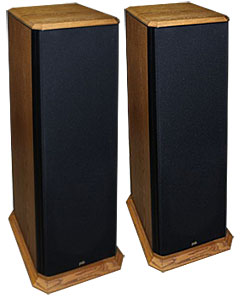
The PSB Stratus is a floor-standing two-way dynamic system, with a soft-dome tweeter and an 8" woofer in a ducted-port bass reflex enclosure. The tower-type enclosure has bevelled corners to reduce edge-diffraction interference, and the panels are assembled by means of tongue-in-groove aluminum corner pieces for increased rigidity. The walls are almost totally inert, producing nothing more than a "pock" (and acute pain) when struck hard with the fist. The woofer is semi-isolated from the front panel by rubber shock mounts, to "eliminate unwanted panel resonances"—a feature about which I am more than a little dubious (footnote 2). Floor spikes are used with loudspeakers to minimize the tendency for cone motions to "kick" the drive-unit chassis and cabinet in the opposite direction. They have been shown to improve both the range and the detail of midrange reproduction (footnote 3). A two-way system of this size and price is unusual; PSB opted for a two-way design, not as a cost-cutting expedient, but as a means for minimizing the number of crossover points (with their attendant phase problems). The crossover is a 24dB/octave Linkwitz-Reilly type, which, to quote PSB's literature, "provides a seamlessly accurate transition between drivers, not only in amplitude but also in phase." The three inductors are all air-core types, wound with 14-gauge wire (heavy!), and the capacitors are 150V film types with "very low dielectric absorption." Time alignment, usually attained by positioning the tweeter slightly behind the plane of the woofer, is achieved here by placing the woofer above and the tweeter underneath, on the same plane, so the tweeter output has a longer path length to the listener's ear than the woofer output. However, the alignment is predicated on a listening-ear height of 36", rather high for some of today's low-slung sofas. PSB obviously does not believe in the use of so-called "exotic" loudspeaker cables. The instructions recommend using various gauges (depending on amplifier-to-speaker distance) of zip cord, and the input connections discourage the use of anything else. The 5-way binding posts are too fat to accept anything but the very largest spade lugs, which are generally found only on cables so stiff and heavy that it is almost impossible to attach them to the Stratus's posts. These are recessed inside a 3½"-diameter, ¾"-deep well in the bottom of the enclosure, and although they are offset toward one side of the well, they are offset in the opposite direction from which the wires come in from the rear. This means that, if you use stiff speaker cable, it must be looped all the way 'round toward the cabinet front (underneath) in order to gain access to the terminals.
I started with the speakers in my usually optimum locations: 7' from the rear wall, 6' apart, and 7' from the center listening seat. This gives the best soundstaging and low-end performance from most speakers I have used, but the low end from the Stratus system was quite weak in this location. Moving them two feet toward the wall behind them brought the low end into balance but at the expense of some LF smoothness. (Note: The frequency-response curve shown in fig.1 was taken with them in their startup positions; the final positions gave what sounded like about 3dB more output at around 60Hz.) The best and most stable imaging was obtained with the speakers toed-in to converge on my forehead. I also found it necessary to tilt the rear of each enclosure so that the speaker was leaning about 15° forward, to make up for the facts that 1) I am short, and 2) I was seated on a low sofa.

Fig.1 PSB Stratus, measured in-room frequency response, average of 6 traces.
First, it must be said that these are eminently listenable loudspeakers. Their sound is relaxed and easy, yet they have remarkable dynamic range and quite respectable detail. They are very clean, image superbly, the highs are silky-smooth but rather closed-in, their low-end extension is impressive for their size, they throw an excellent soundstage—comparable to that of the Celestion SL600s—and they reproduce depth quite well. In fact, they are what I would call very well-behaved speakers; they don't do anything wrong. But I found them rather uninvolving. I wouldn't exactly use the word "bland," but I'm tempted. These are speakers guaranteed to offend no-one, of which I'm afraid the obverse will be equally true: They fail to elicit a great deal of excitement.
Without even comparing them directly with the first pair, it was immediately obvious that the second pair sounded very different. The new Stratuses (Strati?) were clearly better than the first samples in bass performance. Although there was no perceptible change in LF extension, the quality of bass was notably improved. Bass attacks, as from kick drum, had more impact, and pitch delineation was improved, being now what I would describe as better than average. And the laid-back blandness of the original pair of speakers was gone. Unfortunately, there was in its place a rather irritating short-"i" (as in "sit") coloration that made the sound almost shrilly strident. It sounded much like a moderate 5kHz peak, and although I did measure a small hump at 5kHz, it was no larger in amplitude than what I had measured on the first samples, which seemed to have none of this coloration.
Footnote 1: It should be pointed out, however, that all loudspeaker firms are welcome, even encouraged, to use Toole's NRC facilities to evaluate designs they've already completed.—Larry Archibald Footnote 2: KEF pioneered the decoupling of drive-units in their R105, which floated the woofer on rubber grommets. Certainly this eliminated one particular problem, but apparently was not the hoped-for panacea; recent KEF designs, such as the R104/2 and R107, appear to use a very rigid drive-unit/baffle mounting. See the introduction to Martin Colloms's review of Mordaunt-Short's System 442 in Vol.11 No.3 for a more complete discussion of the merits of drive-unit decoupling.—John Atkinson Footnote 3: It could be argued that such motions will be immeasurably small compared with the cone excursion. However, given a typical modern lightweight cabinet and a relatively heavy plastic or doped-paper cone, the reaction motion of the enclosure, which will be dependent on the ratio of the masses, will be of the order of the tweeter excursion and thus will not be insignificant.—John Atkinson