The Questyle did equally well with hi-rez PCM files. I am slowly ripping my LPs to 24/192 files using the Ayre QA-9 A/D converter. A favorite Beach Boys album is Holland (Brother/Reprise K54008), and the M12 reproduced the dropped-octave synth bass notes on "The Trader" with an excellent combination of low-frequency clarity and weight. The cloud of voices behind Carl Wilson's lead vocal was positioned well back in the soundstage. I was startled anew by the girl saying "Hi" into my left ear before the song starts.
 Comparisons
At $139.99, the Questyle M12's price falls between those of AudioQuest's DragonFly Black ($99.95) and DragonFly Red ($199.95). I didn't have a Black or a Red to hand, but I still had the sample of the AudioQuest DragonFly Cobalt I reviewed in December 2019. The Cobalt retails for $299.95 and uses the ESS ES9038Q2M DAC chip in combination with an ESS Sabre9601 amplifier chip. The Cobalt has been my go-to dongle ever since I wrote that review. Like the Questyle, the AudioQuest is an MQA renderer, but unlike the M12, it is limited to decoding PCM data with a maximum sample rate of 96kHz, and it can't convert DSD data. The AudioQuest's volume control is poorly calibrated, ie, the clipping voltage is lower than the maximum setting of the control, increasingly so as the headphone impedance drops. This wasn't an issue in actual use, as the highest setting of the volume control without waveform clipping was too loud for me to tolerate for long. By contrast, even with the low-impedance Audeze 'phones, the M12 at full volume didn't have any problem with the high-level, low-frequency organ notes in my 2014 recording of Jonas Nordwall's performance of Widor's Organ Symphony No.5 (24/88.2 ALAC file, footnote 1).
 I mentioned earlier that the Marc Copland recording was the first multitrack digital recording I had made. The second was of the Kalichstein-Laredo-Robinson Trio, augmented by violinist Daniel Phillips of the Orion String Quartet and Robert Rinehart on viola, performing that English chamber music masterwork, Elgar's Piano Quintet, at the 1998 Santa Fe Chamber Music Festival. As I wrote in the booklet for the CD release, I wasn't allowed to turn off the venue's air conditioning, so I close-miked all the instruments as well as using my usual distant-spaced pair of omnis.
Although I had used as much as I could of the distant omnis in the mix to endow the sound with enough of the lush balance that I felt appropriate, listening to the 16/44.1 files on the M12 made me wish I could have used a touch more. The clarity was impressive, however, and the positioning of the instruments was precisely as I had intended. Playing the same files with the DragonFly Cobalt, matching the levels as closely as I could by ear, the instrumental images sounded a touch more palpable—if it is appropriate to describe things that appear to be positioned inside one's head as "palpable." However, the Pat Martino album sounded a little too mellow with the AudioQuest DragonFly.
Enter the FMJ
I mentioned earlier that the Marc Copland recording was the first multitrack digital recording I had made. The second was of the Kalichstein-Laredo-Robinson Trio, augmented by violinist Daniel Phillips of the Orion String Quartet and Robert Rinehart on viola, performing that English chamber music masterwork, Elgar's Piano Quintet, at the 1998 Santa Fe Chamber Music Festival. As I wrote in the booklet for the CD release, I wasn't allowed to turn off the venue's air conditioning, so I close-miked all the instruments as well as using my usual distant-spaced pair of omnis.
Although I had used as much as I could of the distant omnis in the mix to endow the sound with enough of the lush balance that I felt appropriate, listening to the 16/44.1 files on the M12 made me wish I could have used a touch more. The clarity was impressive, however, and the positioning of the instruments was precisely as I had intended. Playing the same files with the DragonFly Cobalt, matching the levels as closely as I could by ear, the instrumental images sounded a touch more palpable—if it is appropriate to describe things that appear to be positioned inside one's head as "palpable." However, the Pat Martino album sounded a little too mellow with the AudioQuest DragonFly.
Enter the FMJ
A few weeks before I received the review sample of the M12, AudioQuest sent me their new JitterBug FMJ. The FMJ ($69.95) performs the same USB noise filtering as the original JitterBug but replaces the original plastic housing with aluminum. When I reviewed the original JitterBug in September 2015, I couldn't find any significant measured effect that the JitterBug had on the analog signals output by the three D/A processors I had to hand. Yet I heard an improvement in sound quality that I had to attribute to the JitterBug. "I hate when that happens," I wrote, but I have used a JitterBug ever since with DACs that have a USB input.
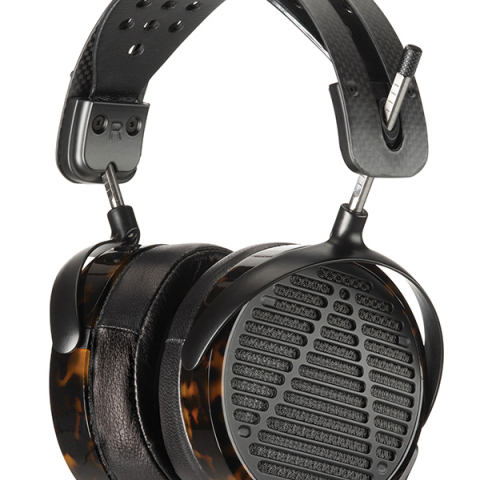
 The FMJ's case is slightly too thick for it to be plugged into one of the vertical USB ports on my Mac mini, next to the one in which I had plugged Questyle's USB adapter cable. I therefore plugged an extender USB cable into the Mac mini, the FMJ into the extender cable, the M12's USB adapter cable into the FMJ, and the Audeze LCD-X headphones into the M12.
With the JitterBug FMJ, the M12's presentation took on a tad more transparency coupled with a touch more ease to its sound. My Elgar recording sounded closer to what I had experienced with the AudioQuest DragonFly Cobalt, for example. And before the objectivists among the magazine's readers demand that my license to review audio components be rescinded, both Kal Rubinson and Jon Iverson, neither of whom is a dyed-in-the-wool subjectivist, reported hearing similar improvements with the original JitterBug and their reference DACs. (See their addenda to the website reprint of my review.)
With iOS devices
The FMJ's case is slightly too thick for it to be plugged into one of the vertical USB ports on my Mac mini, next to the one in which I had plugged Questyle's USB adapter cable. I therefore plugged an extender USB cable into the Mac mini, the FMJ into the extender cable, the M12's USB adapter cable into the FMJ, and the Audeze LCD-X headphones into the M12.
With the JitterBug FMJ, the M12's presentation took on a tad more transparency coupled with a touch more ease to its sound. My Elgar recording sounded closer to what I had experienced with the AudioQuest DragonFly Cobalt, for example. And before the objectivists among the magazine's readers demand that my license to review audio components be rescinded, both Kal Rubinson and Jon Iverson, neither of whom is a dyed-in-the-wool subjectivist, reported hearing similar improvements with the original JitterBug and their reference DACs. (See their addenda to the website reprint of my review.)
With iOS devices
My iPad mini 2 didn't recognize the M12 with a generic USB-C– Lightning adapter cable that I had to hand. I replaced it with Questyle's USB-C–USB-A cable plugged into a 2015-vintage Lightning–USB-A camera connector cable that I found in my camera bag. The combination was unwieldy, but it worked. The iPad reported that it had found a USB accessory and I was able to send music to the M12 with the iTunes and Roon apps, with YouTube videos streamed with Safari, and from audio files streamed from my DropBox folder with the DropBox iOS app.
With the DropBox and iTunes apps, volume can be adjusted with the device's control. However, the Roon app appears to control playback volume with the iPad's volume control, not that of the M12, as the app can't "see" the Questyle DAC. Out of curiosity, I selected an MQA-encoded file of one of my recordings that I had in my DropBox folder and pressed "Play." It did play, but as the M12 can't perform the first unfold of the data, the data LED glowed green, not magenta (footnote 2).
Rather than playing another of my own recordings, I then streamed YouTube videos, first from Acapella World, then from Stereo Classics, of the isolated vocals from Queen's "Bohemian Rhapsody." With the M12 and LCD-Xes, the clarity with which I could hear each of the singers supporting Freddie Mercury's impassioned lead vocal was impressive. I could even readily hear some mains hum accompanying Brian May's first guitar solo on the Acapella World version.
 Having auditioned the M12 with my iPad mini, I tried using it with my iPhone 11. Unfortunately, the cable combination that had been successful with the iPad mini didn't work, even after I blew high-pressure air into the phone's Lightning port. I bought a new, OTG-compatible USB-C/USB-A–Lightning adapter cable. (As always, the Amazon driver left the package in front of the sign facing the street that says "Do not leave packages here.") That did the trick. I clicked on a copy of David Crosby's demo of "Guinnevere" (24/44.1, 320kbps AAC) that I had uploaded to DropBox because I wanted Sasha Matson to hear Jack Casady's superbly inventive bass guitar work. Even with the lossy compression, the M12's low-frequency transparency driving the LCD-Xes served Casady's instrument well, and when he struck a low note, the bass sound impressively "phat."
I did wonder if the relatively limited capacity of the iPhone's battery would be current-limiting, given the M12's demand for current with the low-impedance Audeze LCD-X cans. I therefore finished my auditioning of the M12 with my iPhone with the Widor organ torture track and the iPhone's volume control set to its maximum—the massive sounds of the organ's 16' pipes at the work's coda had me shaking in my seat. Well, almost.
Conclusions
Having auditioned the M12 with my iPad mini, I tried using it with my iPhone 11. Unfortunately, the cable combination that had been successful with the iPad mini didn't work, even after I blew high-pressure air into the phone's Lightning port. I bought a new, OTG-compatible USB-C/USB-A–Lightning adapter cable. (As always, the Amazon driver left the package in front of the sign facing the street that says "Do not leave packages here.") That did the trick. I clicked on a copy of David Crosby's demo of "Guinnevere" (24/44.1, 320kbps AAC) that I had uploaded to DropBox because I wanted Sasha Matson to hear Jack Casady's superbly inventive bass guitar work. Even with the lossy compression, the M12's low-frequency transparency driving the LCD-Xes served Casady's instrument well, and when he struck a low note, the bass sound impressively "phat."
I did wonder if the relatively limited capacity of the iPhone's battery would be current-limiting, given the M12's demand for current with the low-impedance Audeze LCD-X cans. I therefore finished my auditioning of the M12 with my iPhone with the Widor organ torture track and the iPhone's volume control set to its maximum—the massive sounds of the organ's 16' pipes at the work's coda had me shaking in my seat. Well, almost.
Conclusions
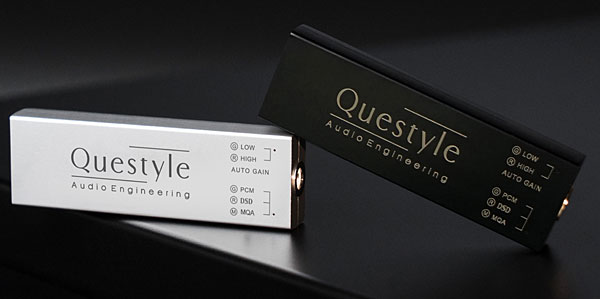
Questyle's M12 dongle—still hate that word—is an impressive-sounding portable USB DAC/headphone amplifier. Its transparency, coupled with the ability to control the low frequencies with low-impedance headphones, is impressive for such a relatively low-priced device. Add to that the fact that it can handle hi-rez PCM and DSD files, and the M12 is an easy recommendation.
Footnote 1: Readers are welcome to download this track here. Footnote 2: When playing audio sampled at 2Fs and higher from DropBox with an iOS device, the data appear to be downsampled to 44.1kHz. Playing 24/192 files on my iPad with Roon, the M12 was fed the 24/192 data while DSD128 data was transcoded by Roon to 24-bit PCM sampled at 352.8kHz.
ComparisonsAt $139.99, the Questyle M12's price falls between those of AudioQuest's DragonFly Black ($99.95) and DragonFly Red ($199.95). I didn't have a Black or a Red to hand, but I still had the sample of the AudioQuest DragonFly Cobalt I reviewed in December 2019. The Cobalt retails for $299.95 and uses the ESS ES9038Q2M DAC chip in combination with an ESS Sabre9601 amplifier chip. The Cobalt has been my go-to dongle ever since I wrote that review. Like the Questyle, the AudioQuest is an MQA renderer, but unlike the M12, it is limited to decoding PCM data with a maximum sample rate of 96kHz, and it can't convert DSD data. The AudioQuest's volume control is poorly calibrated, ie, the clipping voltage is lower than the maximum setting of the control, increasingly so as the headphone impedance drops. This wasn't an issue in actual use, as the highest setting of the volume control without waveform clipping was too loud for me to tolerate for long. By contrast, even with the low-impedance Audeze 'phones, the M12 at full volume didn't have any problem with the high-level, low-frequency organ notes in my 2014 recording of Jonas Nordwall's performance of Widor's Organ Symphony No.5 (24/88.2 ALAC file, footnote 1).
I mentioned earlier that the Marc Copland recording was the first multitrack digital recording I had made. The second was of the Kalichstein-Laredo-Robinson Trio, augmented by violinist Daniel Phillips of the Orion String Quartet and Robert Rinehart on viola, performing that English chamber music masterwork, Elgar's Piano Quintet, at the 1998 Santa Fe Chamber Music Festival. As I wrote in the booklet for the CD release, I wasn't allowed to turn off the venue's air conditioning, so I close-miked all the instruments as well as using my usual distant-spaced pair of omnis.
Although I had used as much as I could of the distant omnis in the mix to endow the sound with enough of the lush balance that I felt appropriate, listening to the 16/44.1 files on the M12 made me wish I could have used a touch more. The clarity was impressive, however, and the positioning of the instruments was precisely as I had intended. Playing the same files with the DragonFly Cobalt, matching the levels as closely as I could by ear, the instrumental images sounded a touch more palpable—if it is appropriate to describe things that appear to be positioned inside one's head as "palpable." However, the Pat Martino album sounded a little too mellow with the AudioQuest DragonFly.
Enter the FMJA few weeks before I received the review sample of the M12, AudioQuest sent me their new JitterBug FMJ. The FMJ ($69.95) performs the same USB noise filtering as the original JitterBug but replaces the original plastic housing with aluminum. When I reviewed the original JitterBug in September 2015, I couldn't find any significant measured effect that the JitterBug had on the analog signals output by the three D/A processors I had to hand. Yet I heard an improvement in sound quality that I had to attribute to the JitterBug. "I hate when that happens," I wrote, but I have used a JitterBug ever since with DACs that have a USB input.
The FMJ's case is slightly too thick for it to be plugged into one of the vertical USB ports on my Mac mini, next to the one in which I had plugged Questyle's USB adapter cable. I therefore plugged an extender USB cable into the Mac mini, the FMJ into the extender cable, the M12's USB adapter cable into the FMJ, and the Audeze LCD-X headphones into the M12.
With the JitterBug FMJ, the M12's presentation took on a tad more transparency coupled with a touch more ease to its sound. My Elgar recording sounded closer to what I had experienced with the AudioQuest DragonFly Cobalt, for example. And before the objectivists among the magazine's readers demand that my license to review audio components be rescinded, both Kal Rubinson and Jon Iverson, neither of whom is a dyed-in-the-wool subjectivist, reported hearing similar improvements with the original JitterBug and their reference DACs. (See their addenda to the website reprint of my review.)
With iOS devicesMy iPad mini 2 didn't recognize the M12 with a generic USB-C– Lightning adapter cable that I had to hand. I replaced it with Questyle's USB-C–USB-A cable plugged into a 2015-vintage Lightning–USB-A camera connector cable that I found in my camera bag. The combination was unwieldy, but it worked. The iPad reported that it had found a USB accessory and I was able to send music to the M12 with the iTunes and Roon apps, with YouTube videos streamed with Safari, and from audio files streamed from my DropBox folder with the DropBox iOS app.
Having auditioned the M12 with my iPad mini, I tried using it with my iPhone 11. Unfortunately, the cable combination that had been successful with the iPad mini didn't work, even after I blew high-pressure air into the phone's Lightning port. I bought a new, OTG-compatible USB-C/USB-A–Lightning adapter cable. (As always, the Amazon driver left the package in front of the sign facing the street that says "Do not leave packages here.") That did the trick. I clicked on a copy of David Crosby's demo of "Guinnevere" (24/44.1, 320kbps AAC) that I had uploaded to DropBox because I wanted Sasha Matson to hear Jack Casady's superbly inventive bass guitar work. Even with the lossy compression, the M12's low-frequency transparency driving the LCD-Xes served Casady's instrument well, and when he struck a low note, the bass sound impressively "phat."
Questyle's M12 dongle—still hate that word—is an impressive-sounding portable USB DAC/headphone amplifier. Its transparency, coupled with the ability to control the low frequencies with low-impedance headphones, is impressive for such a relatively low-priced device. Add to that the fact that it can handle hi-rez PCM and DSD files, and the M12 is an easy recommendation.
Footnote 1: Readers are welcome to download this track here. Footnote 2: When playing audio sampled at 2Fs and higher from DropBox with an iOS device, the data appear to be downsampled to 44.1kHz. Playing 24/192 files on my iPad with Roon, the M12 was fed the 24/192 data while DSD128 data was transcoded by Roon to 24-bit PCM sampled at 352.8kHz.