I've learned, unfortunately—even painfully—that not all vinyl sounds good. Crazy, I know. I would like to think that great performances make great recordings, and that's all there is to it. But it's not that simple. Even the greatest musical performance can be slashed to death by a bad recording, or by the foolish acts of the music industry. I learned the hard way. Is there any other way to learn?
We were tired but fulfilled, sitting at the old bar, admiring the albums we'd come away with from a long day of hunting at the Princeton Record Exchange. One by one, I pulled the albums from their bright yellow bag, allowing the guys to make comments, some dark part of me secretly hoping that my accomplices be stabbed by sudden, brief pangs of jealousy over the albums I'd rescued from the dusty bins, gorgeous albums that they had
missed. And then I got to the killer, an album that should have hit them hard, hard like the piles of chopped beef and processed cheese that sat upon the dirty plates before us, right in the gut, and then right in the heart: Nina Simone's
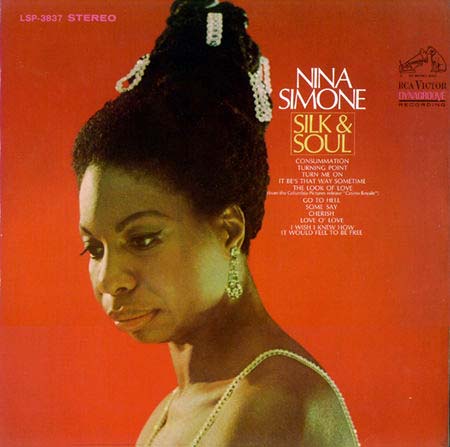
Silk and Soul, her second album for RCA Victor. Nina looks radiant against the scarlet background, like some sad and troubled queen, jewels in her hair and hanging from her delicate ears, she is poised to sing or cry or both.
I waited for their reactions.
"Oh, yeah," Michael said.
"I saw that one there," John said. "Looks good, but…"
But what?
"…it's Dynagroove."
Dynagroove?
"Oh. Is Dynagroove bad?"
"Yeah."
Shit.
I put Nina back in the yellow bag and revealed the next album, trying to shrug away my shame, as if it was no big deal.
How bad could it be? Nina Simone
is a jewel. Back at home, I listened.
Shit.
Nina's vocals are highlighted, as you might expect, leaving the accompanying instruments in the shadows. Indeed, while Nina stands strong in the center of the stage, she is propelled so very far forward that she might as well be singing in your lap. (It is not as appealing as that might seem.) She is etched into the center of the soundstage with a rusty, jagged-edged knife. It is as if some oafish fool had taken a key and scratched an image of Nina Simone onto a sheet of aluminum foil. Nina is singing to you through a megaphone, and when she really lets loose and cries, you are brought to tears, too, not by the beauty of her rich voice, but from the wretched distortion, from the gynecological exactitude of Dynagroove.
A real shame, too. There are songs hidden somewhere in all the blinding glare, and they are probably great. The cover of "Cherish" seems especially promising, and "Consummation," the album's closer, written entirely by Nina Simone, is undoubtedly glorious. If only Dynagroove didn't get in the way.
There's an explanation of Dynagroove's evil ways on the back cover of the album. RCA intended to add brilliance and clarity, offer realistic presence and full-bodied tone, while reducing surface noise and inner-groove distortion. It used "electronic brains." It is possible that a steely robot would enjoy this sound. What RCA Victor was doing was adding a sort of pre-distortion, thinking that this pre-distortion would cancel out the shitty sound of the cheap stereos used to play back their recordings. Hmm, sound familiar? In fact, it didn't work. There was no guarantee that Dynagroove's pre-distortion would be equal to but opposite than that of your shitty stereo. At worst, you'd be getting double-distortion. And those who had good hi-fis in the first place were simply stuck with Dynagroove's crap. There was no way of undoing the misery.
I, nevertheless, tried a few different things. First, I turned the volume down. Surprisingly, that didn't really help. I then put pillows over my ears. Better, but uncomfortable. I found, finally, that if I listened from the bathroom, or better yet, from the hall outside my apartment, the sound was tolerable.
I paid $7.99 for Nina Simone's
Silk and Soul. Ironically, there is nothing silky about it; Dynagroove robs Nina of most of her soul. Though both the jacket and the vinyl are in excellent condition, the album is worth no more than $2. Make it $1.99.
As with most things hi-fi,
Stereophile has been there, done that. I should have known. Shame-faced, I am again. Back in 1963 (when my mom was 1),
Stereophile's founder, J. Gordon Holt shouted, "
Down with Dynagroove!"
Let's read:
…Dynagroove is inimical to musical integrity, for not only does it constantly "rearrange" the original bass/treble balance of the music, it evidently excuses the use of more dynamic compression than we have encountered since the latter days of the 78rpm disc. If this constitutes "an evolution in the art of recording," to quote RCA Victor, then we are obliged to incite the industry to counter-evolution, for this is one kind of hanky-panky that no home-type tone control will ever be able to compensate for.
Gordon had it right. The moral of this story: Read
Stereophile and don't buy Dynagroove. Dammit. Now you know, and knowing is half the battle.