

Sidebar 3: Measurements
I used DRA Labs' MLSSA system and a calibrated DPA 4006 microphone to measure the Revel Performa F228Be's frequency response in the farfield, and an Earthworks QTC-40 for the nearfield responses. (I left off the grilles for the measurements.) My estimate of the F228Be's voltage sensitivity was 89.1dB/2.83V/m, slightly below the specified 90dB/2.83V/m but within the margin of error. The impedance magnitude remains below 8 ohms for the entire midrange and bass, with minimum values of 3.42 ohms at 98Hz and 3.55 ohms at 290Hz (fig.1). There is also a demanding combination of 5 ohms magnitude and 39.5° electrical phase angle at 390Hz. While its nominal impedance is specified as 8 ohms, the Performa F228Be would work best with an amplifier that's comfortable driving 4 ohm loads.

 The saddle centered on 25Hz in the impedance magnitude plot (fig.1, solid trace) suggests that this is the tuning frequency of the large port on the front panel. The port's output does peak at this frequency (fig.3, red trace), and its upper-frequency rolloff is free from any resonant peaks. The blue trace in fig.3 shows the sum of the two woofer outputs, measured, like that of the port, in the nearfield. Though the expected minimum-motion notch in the woofers' summed output occurs at 25Hz, looking at the individual woofer outputs reveals that the lower woofer's notch occurs at 22Hz, the upper woofer's at 28Hz. Other than that, the two drivers behave identically, their output rolling off above 100Hz and crossing over to the midrange unit, whose nearfield response is shown in fig.3 as the green trace below 500Hz, which is close to the specified 260Hz with steep filter slopes.
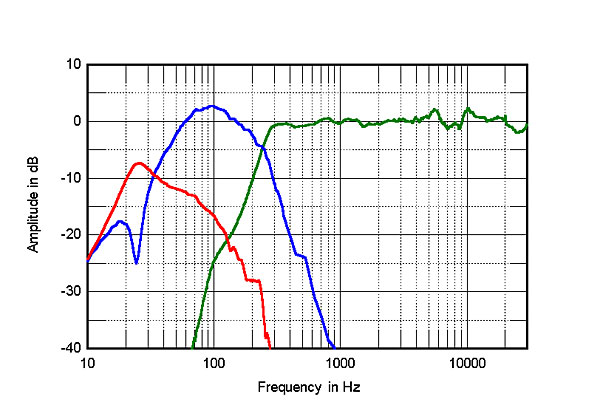


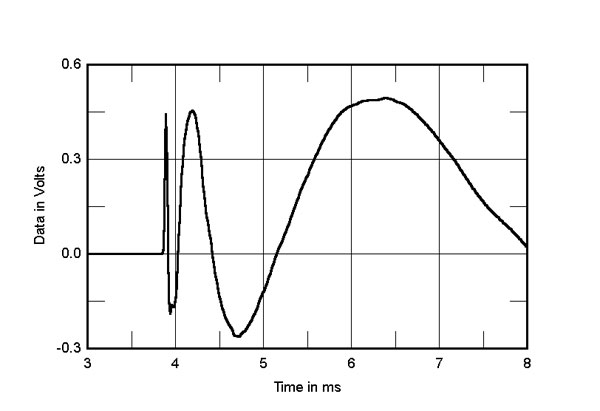

Fig.1 Revel Performa F228Be, electrical impedance (solid) and phase (dashed) (2 ohms/vertical div.).
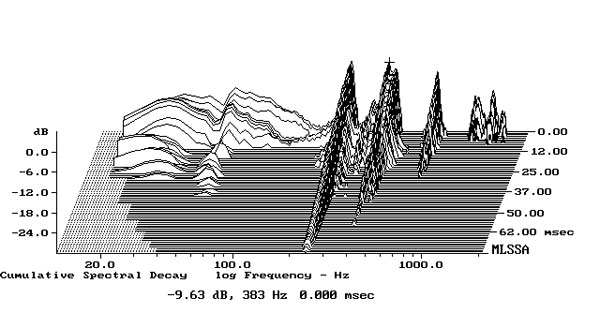
I assumed that the discontinuity between 200 and 300Hz in the traces in fig.1 was due to the crossover between the woofers and the midrange unit. However, I did find a fairly strong vibrational mode at 240Hz on the F228Be's sidewalls and top panel, as well as two other modes around 400Hz (fig.2). This behavior is high enough in Q, and sufficiently low in level, that it shouldn't give rise to any coloration. I note that Kal Rubinson doesn't mention any midrange coloration or congestion that might have resulted from the presence of these modes.
Fig.2 Revel Performa F228Be, cumulative spectral-decay plot calculated from output of accelerometer fastened to center of sidewall level with upper woofer (MLS driving voltage to speaker, 7.55V; measurement bandwidth, 2kHz).
Fig.3 Revel Performa F228Be, acoustic crossover on tweeter axis at 50", corrected for microphone response, with nearfield responses of midrange unit (green), woofers (blue), and port (red), respectively plotted below 500, 900, and 275Hz.
The green trace above 500Hz in fig.3 shows the farfield output of the F228Be's midrange unit and tweeter on the tweeter axis. Other than a couple of small peaks in the mid-treble, the Revel's response is superbly flat and even. And when the farfield response is averaged across a 30° horizontal window centered on the tweeter axis (fig.4), those small peaks are reduced even further in amplitude. The trace below 300Hz in fig.4 shows the complex sum of the midrange, woofer, and port outputs, measured in the nearfield. The peak in the upper bass will be almost entirely due to the nearfield measurement technique, which assumes that the baffle extends to infinity in both the horizontal and vertical planes. Looking at this graph, I wasn't surprised to read that KR found the F228Be's bass to sound "full, extended, and surprisingly tight."
Fig.4 Revel Performa F228Be, anechoic response on tweeter axis at 50", averaged across 30° horizontal window and corrected for microphone response, with complex sum of nearfield responses plotted below 300Hz.
The plot of the F228Be's lateral dispersion, normalized to the tweeter-axis response (fig.5), reveals textbook behavior, with no gullies or peaks developing to the speaker's sides. The contour lines in this graph are smooth and evenly spaced, with the radiation pattern narrowing in a well-controlled manner above 7.5kHz. As the tweeter's top-octave response is flat on axis, this increase in directivity in the same region might make the Revel sound a little airless in large or overdamped rooms. In the vertical plane (fig.6), the Revel's use of high-order crossover filters means that, as KR found, its neutral tweeter-axis balance is maintained across a wide window. This is a good thing, as the tweeter is a high 43" above the floor. (A mid-1990s study by Thomas J. Norton indicated that the ear heights of most listeners when seated ranged from 33" to 39", with 36" being typical.)
Fig.5 Revel Performa F228Be, lateral response family at 50", normalized to response on tweeter axis, from back to front: differences in response 90–5° off axis, reference response, differences in response 5–90° off axis.
Fig.6 Revel Performa F228Be, vertical response family at 50", normalized to response on tweeter axis, from back to front: differences in response 15–5° above axis, reference response, differences in response 5–15° below axis.
Turning to the time domain, the F228Be's step response on the tweeter axis (fig.7) indicates that all of its drive-units are connected in positive acoustic polarity, with the tweeter's output arriving at the microphone before the midrange unit's, which in turn arrives before that of the woofers. The output of each unit smoothly blends with that of the next lower in frequency, suggesting optimal crossover design. The cumulative spectral-decay plot on the tweeter axis (fig.8) is very clean, though there are some unusual ripples in the delayed energy between 800Hz and 4kHz.
Fig.7 Revel Performa F228Be, step response on tweeter axis at 50" (5ms time window, 30kHz bandwidth).
Fig.8 Revel Performa F228Be, cumulative spectral-decay plot on tweeter axis at 50" (0.15ms risetime).
As I have come to expect from Revel's design team, the Performa F228Be's measured performance reveals excellent speaker engineering.—John Atkinson















