

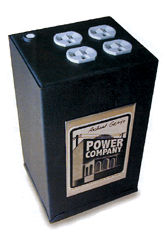
Sidebar 2: Issues The following will come as no surprise: I'm no engineer. But I've met some fascinating people and learned just enough to be dangerous. (To me, learning is like music: It keeps you alive.) With the Richard Gray's Power Station, certain issues immediately presented themselves: First, what exactly is the energy-storage capacity of the 400S? This is actually a question of relatively simple physics and mathematics, and neither subject is a forte of mine. But they are of Stereophile's Shannon Dickson, who explains it quite succinctly: "The calculations are simple equations that define many of the parameters of any parallel inductor. Using a 120V power line, a 6-Henry inductance, and a DC resistance of around 9.8 ohms (my direct measurement of the device) yields a maximum RMS current of around 53 milliamps. Then, to find the magnetizing current of the device or energy-storage potential of the magnetic field around the inductor, you apply: ½ x L x I squared (one-half times inductance times current squared), which results in a maximum of just 0.01VA per second, otherwise known as Joules.
"When you daisy-chain extra Power Companies, this stored energy value is additive, so two paralleled units would provide only 0.02 joules of energy storage, and three would provide just 0.03 joules. Compare this to the typical large current demand of a power amp during a large transient demand, which can be measured in multiple joules (footnote 1). Yes, the 400S does store some energy, but apparently not very much." And which way will that energy, of whatever magnitude, flow? If the impedance the parallel inductor sees toward the service panel is lower than that "looking" at your audio rack, back it goes into the power grid. Another issue is that of surge protection. Shannon again: "MOVs provide decent lightning protection for at least one or several nearby transient events, but the claim that the parallel inductor itself 'absorbs or shunts to ground lightning and transient surges' requires more thought. For one, since protective earth 'ground' forms part of a current loop, it is therefore not a bottomless pit into which unwanted currents can be made to disappear."
Nothin's black'n'white.—Jonathan Scull
Footnote 1: It is fair to point out that almost all that energy comes from the amplifier's reservoir capacitors. The 400S is intended to ensure that the recharging current for those capacitors not be negatively impacted by the typical AC waveform flat-topping.—John Atkinson
Footnote 1: It is fair to point out that almost all that energy comes from the amplifier's reservoir capacitors. The 400S is intended to ensure that the recharging current for those capacitors not be negatively impacted by the typical AC waveform flat-topping.—John Atkinson















