

Sidebar 3: Measurements
When I unpacked the Riviera Levante amplifier and lifted it onto the test bench, it struck me that this is actually eight amplifiers in one. It has balanced and single-ended line-level inputs. Its output stage can be operated in class-A or class-AB. It was supplied with two choices for the two input stage ECC81/12AT7 tubes: vintage Mullards or modern JJs. Add to those variations that the Levante has a headphone output and an optional phono stage (not fitted to the review sample), and it became clear that I had a lot of testing ahead of me.
I decided to focus on the Riviera amplifier's behavior with the Mullard tubes and the unbalanced inputs, performing every test in both of the output-stage modes. I then repeated some of the tests with the balanced inputs and finally looked at how the amplifier's behavior with the JJ tubes differed from how it had performed with the Mullard tubes. All the testing was performed with my Audio Precision SYS2722 system.
I first preconditioned the Riviera Levante by following the CEA's recommendation of operating it at one-eighth the specified class-AB power into 8 ohms for 30 minutes. At the end of that time, the heatsink temperature was 108.3°F (42.4°C) and that of the top and front panels was 92.5°F (33.6°C). Switching to class-A operation, the heatsink temperature had increased slightly after another 30 minutes, to 113.1°F (45.1°C). While I was preconditioning the amplifier, I measured the output device rail voltages. They were ±29V in class-A, ±50V in class-AB.
The amplifier inverted absolute polarity with all its inputs at both the loudspeaker and headphone outputs. The maximum gain into 8 ohms was lower than average for an integrated amplifier, at 36.6dB in class-A and 36.35dB in class-AB for both balanced and unbalanced inputs. The maximum gain at the headphone output was 21.6dB for both types of input. Changing to the JJ tubes reduced these gains by 1dB.
The unbalanced input impedance was 44k ohms at 20Hz and 1kHz with the Mullard tubes, dropping to 36k ohms at 20kHz. The balanced input impedance was 42k ohms across the audioband. With the JJ tubes the unbalanced input impedance was 34k ohms at 20Hz and 1kHz, 30k ohms at 20kHz.
The headphone output impedance was moderately low, at 18 ohms across the audioband. Set to class-A operation, the Levante's output impedance at the loudspeaker terminals was 0.5 ohm from 20Hz to 20kHz. In class-AB, the output impedance was slightly higher, at 0.65 ohm at all audio frequencies. (These figures include the series impedance of 6' of spaced-pair loudspeaker cable.) In class-A mode, the modulation of the amplifier's frequency response, due to the Ohm's law interaction between the source impedance and the impedance of my standard simulated loudspeaker, was ±0.4dB (fig.1, gray trace). The response into an 8 ohm resistive load (fig.1, blue and red traces) was down by 3dB at 180kHz, which correlates with the Riviera's accurate reproduction of a 10kHz squarewave into that load (fig.2). Figs.1 and 2 were taken with the unbalanced inputs, the Mullard tubes, class-A mode, and the volume control set to its maximum. The frequency and squarewave responses were identical with the JJ tubes, in class-AB, and with the balanced inputs. With the volume control set to –20dB, the high-frequency –3dB point dropped to 110kHz, but the audioband response remained flat. Measured at the headphone output, the response was down by just 1dB at 200kHz.


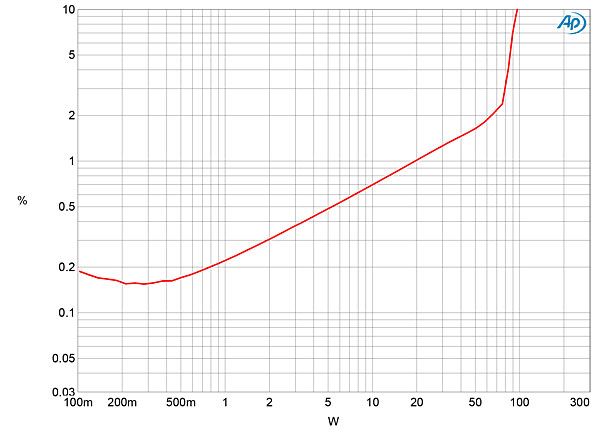
 With both channels driven, the Levante's maximum power in class-A is specified as 30Wpc into 8 ohms and 60Wpc into 4 ohms (both powers equivalent to 14.8dBW). We define clipping as when the THD+noise in an amplifier's output reaches 1%. By that standard, the Levante didn't meet its specified powers, the 1% THD+N power measuring 16Wpc into 8 ohms (12dBW, fig.4) and 21.3Wpc into 4 ohms (10.27dBW, fig.5). However, relaxing the criterion to 3% THD+N, the Riviera amplifier clipped at 49Wpc into 8 ohms (16.9dBW) and 79Wpc into 4 ohms (16dBW). The picture was similar in class-AB. The Levante delivered 12Wpc into 8 ohms (10.1dBW) at 1% THD+N, 125Wpc at 3% (21dBW, fig.6), and 18Wpc into 4 ohms (9.54dBW) at 1% and 195Wpc into 4 ohms at 3% (19.9dBW, fig.7). The AC mains voltage was 119.1V with the amplifier clipping in class-A into 4 ohms.





Footnote 1: I created tracks on Stereophile's Test CD 2 to allow listeners to hear at what percentage of second, third, and seventh harmonic they become aware of the distortion.
Fig.1 Riviera Levante, Mullard tubes, class-A, volume control set to maximum, frequency response at 2.83V into: simulated loudspeaker load (right gray), 8 ohms (left channel blue, right red) 4 ohms (left cyan, right magenta), (left green) (1dB/vertical div.).
Fig.2 Riviera Levante, Mullard tubes, class-A, small-signal 10kHz squarewave into 8 ohms.
Channel separation was okay at 70dB in both directions below 3kHz, dropping to 53dB at the top of the audioband. The Riviera's unweighted, wideband signal/noise ratio, taken with the unbalanced inputs shorted to ground but the volume control set to its maximum, was 70.6dB ref. 2.83V into 8 ohms (average of both channels) in both class-A and class-AB modes. This ratio improved to 72dB when the measurement bandwidth was restricted to the audioband, and to 80dB when A-weighted. The background noise included spuriae at 60Hz and its even- and odd-order harmonics (fig.3), the latter higher in level than the former, particularly in the left channel (blue trace). (The odd-order spuriae are probably due to magnetic interference from the massive power transformer.)
Fig.3 Riviera Levante, Mullard tubes, class-A, spectrum of 1kHz sinewave, DC–1kHz, at 1W into 8 ohms, volume control set to maximum (left channel blue, right red; linear frequency scale).
Fig.4 Riviera Levante, Mullard tubes, class-A, distortion (%) vs 1kHz continuous output power into 8 ohms.
Fig.5 Riviera Levante, Mullard tubes, class-A, distortion (%) vs 1kHz continuous output power into 4 ohms.
Fig.6 Riviera Levante, Mullard tubes, class-AB, distortion (%) vs 1kHz continuous output power into 8 ohms.
Fig.7 Riviera Levante, Mullard tubes, class-AB, distortion (%) vs 1kHz continuous output power into 4 ohms.
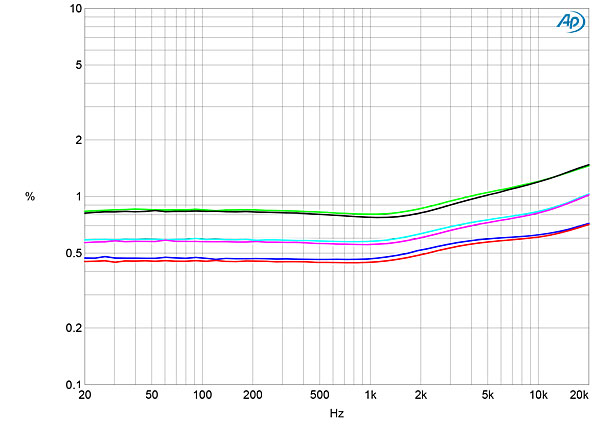
The upward slope of the traces below the actual clipping power in figs.4–7 indicates that the distortion increases in almost a linear manner with increasing power before the onset of actual waveform clipping. This will be due to what is called a "bent" transfer function. (The transfer function of an amplifier with no distortion is a straight line.) I suspect that this bent function will be due to the input tube rather than the amplifier's output stage. I examined how the THD+N percentage changed with frequency at 4.89V, which is equivalent to 3W into 8 ohms, 6W into 4 ohms, and 12W into 2 ohms. With the Mullard tubes the distortion into 8 ohms (fig.8, blue and red traces) was 0.47% at low and middle frequencies, rising slightly in the treble. It also rose into 4 ohms (cyan, magenta traces) and into 2 ohms (green, gray traces). The distortion was slightly lower with the JJ tubes (fig.9), but the behavior was otherwise identical.
Fig.8 Riviera Levante, Mullard tubes, class-A, THD+N (%) vs frequency at 4.89V into: 8 ohms (left channel blue, right red), 4 ohms (left cyan, right magenta), 2 ohms (left green, right gray).
Fig.9 Riviera Levante, JJ tubes, class-A, THD+N (%) vs frequency at 4.89V into: 8 ohms (left channel blue, right red), 4 ohms (left cyan, right magenta), 2 ohms (left green, right gray).
These levels of distortion would be very audible if they comprised the fifth and higher harmonics (footnote 1). However, fig.10 indicates that the relatively subjectively benign second harmonic was dominant in both class-A and class-AB output modes. This waveform graph was taken with the Mullard tubes. Though HR found the JJ tubes to sound different from the Mullards, the JJs produced an almost identical THD+N waveform (fig.11). This was confirmed by the spectra of the amplifier's output at moderate power into 8 ohms with the Mullard tubes (fig.12) and JJ tubes (fig.13). The second harmonic is by far the highest in level, at –40dB (1%) with the Mullards and –43dB (0.7%) with the JJs. The second was also by far the highest-level harmonic present in the headphone output, at –47dB (0.42%, fig.14) at 1V into 300 ohms. Finally, when the Levante drove an equal mix of 19 and 20kHz tones at 10W peak into 8 ohms in either class-A or class-AB with both Mullard and JJ tubes, the second-order difference product at 1kHz lay at –44dB (0.6%, fig.15), with the higher-order intermodulation products at 18kHz and 21kHz 10dB lower in level. At the same voltage into 4 ohms, the intermodulation products rose by 3dB.
Fig.10 Riviera Levante, Mullard tubes, class-A, 1kHz waveform at 10W into 8 ohms, 0.95% THD+N (top); distortion and noise waveform with fundamental notched out (bottom, not to scale).
Fig.11 Riviera Levante, JJ tubes, class-A, 1kHz waveform at 10W into 8 ohms, 0.75% THD+N (top); distortion and noise waveform with fundamental notched out (bottom, not to scale).
Fig.12 Riviera Levante, Mullard tubes, class-A, spectrum of 50Hz sinewave, DC–1kHz, at 10W into 8 ohms (left channel blue, right red; linear frequency scale).
Fig.13 Riviera Levante, JJ tubes, class-A, spectrum of 50Hz sinewave, DC–1kHz, at 10W into 8 ohms (left channel blue, right red; linear frequency scale).
Fig.14 Riviera Levante, JJ tubes, headphone output, spectrum of 50Hz sinewave, DC–1kHz, at 10W into 8 ohms (left channel blue, right red; linear frequency scale).
Fig.15 Riviera Levante, Mullard tubes, class-A, HF intermodulation spectrum, DC–30kHz, 19+20kHz at 10W peak into 8 ohms (left channel blue, right red; linear frequency scale).
With its output stage capable of being switched between class-A and class-AB operation, Riviera's Levante reminded me of the Marantz MA-5 amplifier that I reviewed for Hi-Fi News magazine in August 1983, which, like the Levante, could output 30W in class-A and 120W in class-AB. But unlike that Marantz, which featured conventional levels of negative feedback, the Levante's measured behavior is dominated by the designer's decision not to use feedback, especially around the input tubes. His reasons for doing so are discussed in the review, but my experience has been that the resultant harmonic signature will lend this amplifier a distinctive sonic character.—John Atkinson
Footnote 1: I created tracks on Stereophile's Test CD 2 to allow listeners to hear at what percentage of second, third, and seventh harmonic they become aware of the distortion.















