The day after my husband was plied with hard liquor in a desperate attempt to get me all the way into the Tidal room, I returned. (Just in case anyone accepts my words as Biblical truth, I am joshing. When you're faced with writing four days' worth of show reports in four days, you've got to have a little fun once in a while.) Truth be told, I had already intended to return, my brief visit at show's end on Saturday having been truncated by the 6pm closing time.
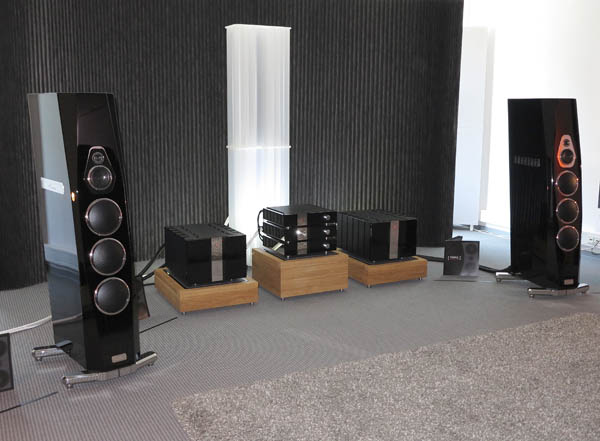
Over the sound of music booming from the adjacent exhibit, I learned that the Tidal panels on the side walls of the room were not just decorative: they were also absorbers, which were augmented by four bass traps. That's important to know, because I have a hunch—just a hunch—that there was too much absorptive material in the room.
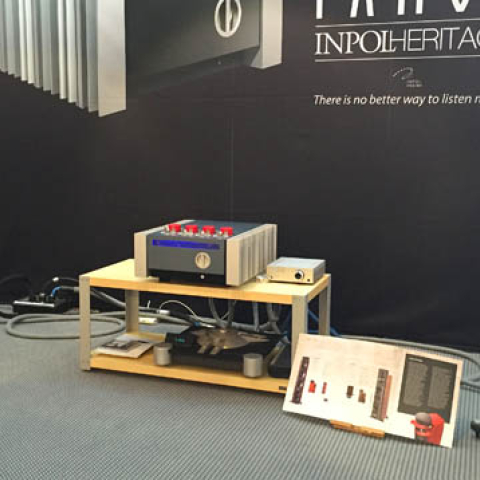
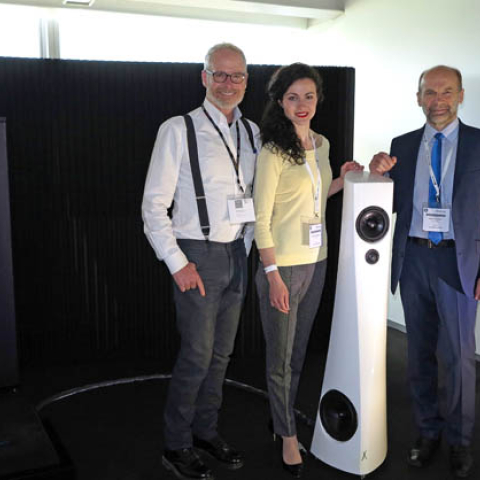
Heard in the handsome setup were three important premieres from Tidal—new Tidal Akira speakers ($215,000/pair), new Tidal Camira reference DAC w/line control ($78,600), and new Tidal Assoluta monoblock amplifiers ($148,600/pair). Holding them all together were new Argento EE (Extreme Edition) silver interconnects and speaker cabling with carbon-based noise-absorbing layers. The system did a very fine job conveying air around Carla Morrison's voice on a 44.1/16 track, "Disfruto." Everything was solid and full, but the timbres on both this track and another of music by Vivaldi sounded a bit off. There was much expertly conveyed hilarity in a track by a Polish band, and significant beauty on Norah Jones and Willie Nelson's recording of "Baby It's Cold Outside." But I kept feeling that the slightly off colorations might have been caused by excessive acoustic treatment. Just a month earlier, colors conveyed by the Tidal system I reported on at AXPONA 2016 were spot on.
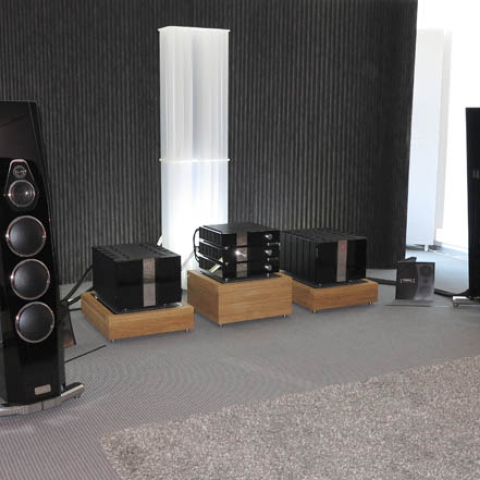
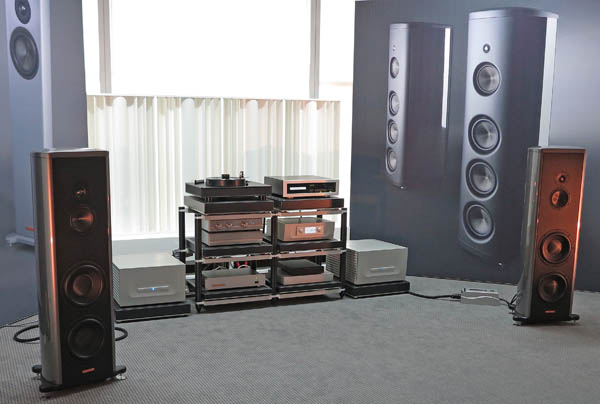 Magico paired its S5 Mk II loudspeakers ($38,000/pair in standard finish, $42,750 in M-Coat Titanium), whose premiere I missed at AXPONA, with a Dr. Feickert turntable and arm outfitted with a Lyra Etna cartridge. Other components in the chain included Constellation Audio Centaur II 500W mono amps ($80,000/pair) and Virgo II preamp ($32,000), Pass XP 25 phono preamp, Spectral SDR-4000 CD player, and the new MIT Articulation Control Console cabling discussed here. While Richard Strauss' Dance of the Seven Veils from Salome, conducted by Eiji Oue and issued on LP by Reference Recordings, exhibited the slightly muted color palette and detail I associate with Constellation gear, control in all registers was absolute.
 "Positioning of the speakers is the key, " Marantz brand ambassador Ken Ishiwata announced as he spoke of the new Fink Team loudspeaker ($40,000/pair). Designed by a team headed by consultant Karl-Heinz Fink, these will hopefully go into production. Paired with Marantz's new upsampling-to-DSD SA-10 CD/SACD player (7000), which contains Marantz's new SACD transport, and the new PM-10 integrated amplifier (8,000), the speakers delivered tremendous bass, supreme control, and somewhat dark colors that lacked ultimate transparency. Ishiwata played Peter Gabriel so loud in the big room that the sound waves were literally vibrating in my gut. Most exhibitors would have been terrified to do this, but the Fink team speakers sailed through without a hint of distortion. Very impressive indeed.
Colors were nicely saturated on a hi-res file of Joni Mitchell and Herbie Hancock's "Summertime," and images had weight. Which is how it should be. I shuddered when "Dance of the Tumblers" was put on, but I must admit that the tonal balance, while dark, was quite impressive. So was the SACD version of "O Holy Night," originally recorded for LP on another audiophile classic, Cantate Domine.
When I met up with Fink himself in the hallway, he explained that he used laser scanning and vibrometer measurement to determine where he needed to minimize resonances in his MDF-based cabinets. Those cabinets contain multiple sheets of MDF layered with polymer damping materials, as well as bracing and glue. "We try to fix distortions, but not with a sledgehammer," he said of his apparently bullet-proof design.
"Positioning of the speakers is the key, " Marantz brand ambassador Ken Ishiwata announced as he spoke of the new Fink Team loudspeaker ($40,000/pair). Designed by a team headed by consultant Karl-Heinz Fink, these will hopefully go into production. Paired with Marantz's new upsampling-to-DSD SA-10 CD/SACD player (7000), which contains Marantz's new SACD transport, and the new PM-10 integrated amplifier (8,000), the speakers delivered tremendous bass, supreme control, and somewhat dark colors that lacked ultimate transparency. Ishiwata played Peter Gabriel so loud in the big room that the sound waves were literally vibrating in my gut. Most exhibitors would have been terrified to do this, but the Fink team speakers sailed through without a hint of distortion. Very impressive indeed.
Colors were nicely saturated on a hi-res file of Joni Mitchell and Herbie Hancock's "Summertime," and images had weight. Which is how it should be. I shuddered when "Dance of the Tumblers" was put on, but I must admit that the tonal balance, while dark, was quite impressive. So was the SACD version of "O Holy Night," originally recorded for LP on another audiophile classic, Cantate Domine.
When I met up with Fink himself in the hallway, he explained that he used laser scanning and vibrometer measurement to determine where he needed to minimize resonances in his MDF-based cabinets. Those cabinets contain multiple sheets of MDF layered with polymer damping materials, as well as bracing and glue. "We try to fix distortions, but not with a sledgehammer," he said of his apparently bullet-proof design.
 The new Wilson Benesch 2.5-way Discovery II loudspeaker ($25,000/pair) replaces the company's older Odyssey model. Each Discovery II contains three Tactic II drivers, including two downward-firing Tactic II drive units in isobaric clamshell configuration, and one Semisphere silk carbon hybrid soft dome tweeter. The cabinet is made of Wilson Benesch's carbon fiber composite.
The speaker played alongside a Torus Infrasonic Generator ($12,500), which comes complete with its own 200W control amp, and works differently than a standard subwoofer. Also in the chain were a Wilson Benesch Circle 25th Anniversary turntable and tonearm with Transfiguration Proteus cartridge; Viva LF2 phono/line stage preamp; Viva Aurora single-ended class-A monoblocks; and Way solid-core silver cable from Serbia.
For some exhibitors, Daft Punk's "My Name is Giovanni Giorgi" has replaced the Eagle's "Hotel California" as the rock track of choice. Here, it sounded uncharacteristically gray. When I started to listen to my favorite recording by mezzo-soprano Lorraine Hunt Lieberson, I was impressed by the seemingly boundless soundstage, but dismayed that her voice not only seemed a bit spread, but also seemed lacking in the full palette of colors so central to her artistry. Most successful was Laurie Anderson's "Tight rope"—major points to Luke Milnes for playing it—which displayed engrossing sound effects for days.
The new Wilson Benesch 2.5-way Discovery II loudspeaker ($25,000/pair) replaces the company's older Odyssey model. Each Discovery II contains three Tactic II drivers, including two downward-firing Tactic II drive units in isobaric clamshell configuration, and one Semisphere silk carbon hybrid soft dome tweeter. The cabinet is made of Wilson Benesch's carbon fiber composite.
The speaker played alongside a Torus Infrasonic Generator ($12,500), which comes complete with its own 200W control amp, and works differently than a standard subwoofer. Also in the chain were a Wilson Benesch Circle 25th Anniversary turntable and tonearm with Transfiguration Proteus cartridge; Viva LF2 phono/line stage preamp; Viva Aurora single-ended class-A monoblocks; and Way solid-core silver cable from Serbia.
For some exhibitors, Daft Punk's "My Name is Giovanni Giorgi" has replaced the Eagle's "Hotel California" as the rock track of choice. Here, it sounded uncharacteristically gray. When I started to listen to my favorite recording by mezzo-soprano Lorraine Hunt Lieberson, I was impressed by the seemingly boundless soundstage, but dismayed that her voice not only seemed a bit spread, but also seemed lacking in the full palette of colors so central to her artistry. Most successful was Laurie Anderson's "Tight rope"—major points to Luke Milnes for playing it—which displayed engrossing sound effects for days.
 Peter Comeau of Mission Electronics displayed, in a passive line-up, Mission's new LX series of loudspeakers. Designed with the help of Karl-Heinz Fink of Fink Audio Consulting—see Marantz blog above—the LX series loudspeakers dispense with dustcaps on the bass and midrange units, and instead employ sub-cones for better control. Models include the smallest in the series, the LX1 (£150/pair), and proceed from the LX2 (£180/pair) all the way up to the biggest model (£599/pair). Not only are cabinets heavily braced, but they also contain longhaired wool, which was chosen for its excellent absorption properties. Crossovers were designed after listening to a wide range of music.
 Theory Plus Application, commonly known as T+A, showed its new ST 20 Pulsar 3-way loudspeakers (2900/pair). Using proprietary drivers with stiff aluminum cones, they are designed for bi-wiring. Frequency response is 32Hz–30kHz, impedance 4 ohms, and sensitivity 87dB. The ST 20 Pulsars weigh 38 lbs. each, and will ship to the US in a month.
T+A's new R 1000 E music server (5000) is an all-in-one music receiver that is claimed to "access anything that can deliver music," and is designed to work with virtually every source. It even includes a digital tuner alongside an aptX(r) Bluetooth module, and plays files up to 192kHz PCM or DSD64. Also new is the MP 1000 E multi source player (4700), a CD player that is designed to mate with the PA 1000 E integrated amp (3200). The MP 1000 E can process data rates up to 384/32 for PCM as well as DSD256.
Theory Plus Application, commonly known as T+A, showed its new ST 20 Pulsar 3-way loudspeakers (2900/pair). Using proprietary drivers with stiff aluminum cones, they are designed for bi-wiring. Frequency response is 32Hz–30kHz, impedance 4 ohms, and sensitivity 87dB. The ST 20 Pulsars weigh 38 lbs. each, and will ship to the US in a month.
T+A's new R 1000 E music server (5000) is an all-in-one music receiver that is claimed to "access anything that can deliver music," and is designed to work with virtually every source. It even includes a digital tuner alongside an aptX(r) Bluetooth module, and plays files up to 192kHz PCM or DSD64. Also new is the MP 1000 E multi source player (4700), a CD player that is designed to mate with the PA 1000 E integrated amp (3200). The MP 1000 E can process data rates up to 384/32 for PCM as well as DSD256.
 Jon Iverson did an excellent job covering the AudioQuest press conference at CES, where the company discussed their new, software-upgradable, 1.2V-output Dragonfly Black ($99) and 2.1V-output Dragonfly Red ($199) plug-in USB DACs. Rather than attempting to reinvent the wheel, I refer you to Jon's report.
Having heard the original Dragonfly when it came out, and being less than enthused by what I considered to be washed-out sound, I was eager to hear these new models. From the 2 minutes I was able to audition a recording of tenor Ian Bostridge singing Schubert's wonderfully expressive "Im Frühling" (In Springtime), I felt like I was floating on a cushion of lovely midrange clouds. The voice was very clear and colorful, but the piano, through AudioQuest Nighthawk headphones that had probably been dropped and yanked one too many times, tended to distort on high notes. I wanted to listen more, but the system in the back half of the room started to play too loudly to continue. Hence all I can say at this point is that the AudioQuest Dragonfly Red's sound seems light years better than the original Dragonfly's.
Jon Iverson did an excellent job covering the AudioQuest press conference at CES, where the company discussed their new, software-upgradable, 1.2V-output Dragonfly Black ($99) and 2.1V-output Dragonfly Red ($199) plug-in USB DACs. Rather than attempting to reinvent the wheel, I refer you to Jon's report.
Having heard the original Dragonfly when it came out, and being less than enthused by what I considered to be washed-out sound, I was eager to hear these new models. From the 2 minutes I was able to audition a recording of tenor Ian Bostridge singing Schubert's wonderfully expressive "Im Frühling" (In Springtime), I felt like I was floating on a cushion of lovely midrange clouds. The voice was very clear and colorful, but the piano, through AudioQuest Nighthawk headphones that had probably been dropped and yanked one too many times, tended to distort on high notes. I wanted to listen more, but the system in the back half of the room started to play too loudly to continue. Hence all I can say at this point is that the AudioQuest Dragonfly Red's sound seems light years better than the original Dragonfly's.
Magico paired its S5 Mk II loudspeakers ($38,000/pair in standard finish, $42,750 in M-Coat Titanium), whose premiere I missed at AXPONA, with a Dr. Feickert turntable and arm outfitted with a Lyra Etna cartridge. Other components in the chain included Constellation Audio Centaur II 500W mono amps ($80,000/pair) and Virgo II preamp ($32,000), Pass XP 25 phono preamp, Spectral SDR-4000 CD player, and the new MIT Articulation Control Console cabling discussed here. While Richard Strauss' Dance of the Seven Veils from Salome, conducted by Eiji Oue and issued on LP by Reference Recordings, exhibited the slightly muted color palette and detail I associate with Constellation gear, control in all registers was absolute.
"Positioning of the speakers is the key, " Marantz brand ambassador Ken Ishiwata announced as he spoke of the new Fink Team loudspeaker ($40,000/pair). Designed by a team headed by consultant Karl-Heinz Fink, these will hopefully go into production. Paired with Marantz's new upsampling-to-DSD SA-10 CD/SACD player (7000), which contains Marantz's new SACD transport, and the new PM-10 integrated amplifier (8,000), the speakers delivered tremendous bass, supreme control, and somewhat dark colors that lacked ultimate transparency. Ishiwata played Peter Gabriel so loud in the big room that the sound waves were literally vibrating in my gut. Most exhibitors would have been terrified to do this, but the Fink team speakers sailed through without a hint of distortion. Very impressive indeed.
Colors were nicely saturated on a hi-res file of Joni Mitchell and Herbie Hancock's "Summertime," and images had weight. Which is how it should be. I shuddered when "Dance of the Tumblers" was put on, but I must admit that the tonal balance, while dark, was quite impressive. So was the SACD version of "O Holy Night," originally recorded for LP on another audiophile classic, Cantate Domine.
The new Wilson Benesch 2.5-way Discovery II loudspeaker ($25,000/pair) replaces the company's older Odyssey model. Each Discovery II contains three Tactic II drivers, including two downward-firing Tactic II drive units in isobaric clamshell configuration, and one Semisphere silk carbon hybrid soft dome tweeter. The cabinet is made of Wilson Benesch's carbon fiber composite.
The speaker played alongside a Torus Infrasonic Generator ($12,500), which comes complete with its own 200W control amp, and works differently than a standard subwoofer. Also in the chain were a Wilson Benesch Circle 25th Anniversary turntable and tonearm with Transfiguration Proteus cartridge; Viva LF2 phono/line stage preamp; Viva Aurora single-ended class-A monoblocks; and Way solid-core silver cable from Serbia.
Peter Comeau of Mission Electronics displayed, in a passive line-up, Mission's new LX series of loudspeakers. Designed with the help of Karl-Heinz Fink of Fink Audio Consulting—see Marantz blog above—the LX series loudspeakers dispense with dustcaps on the bass and midrange units, and instead employ sub-cones for better control. Models include the smallest in the series, the LX1 (£150/pair), and proceed from the LX2 (£180/pair) all the way up to the biggest model (£599/pair). Not only are cabinets heavily braced, but they also contain longhaired wool, which was chosen for its excellent absorption properties. Crossovers were designed after listening to a wide range of music.
Theory Plus Application, commonly known as T+A, showed its new ST 20 Pulsar 3-way loudspeakers (2900/pair). Using proprietary drivers with stiff aluminum cones, they are designed for bi-wiring. Frequency response is 32Hz–30kHz, impedance 4 ohms, and sensitivity 87dB. The ST 20 Pulsars weigh 38 lbs. each, and will ship to the US in a month.
Jon Iverson did an excellent job covering the AudioQuest press conference at CES, where the company discussed their new, software-upgradable, 1.2V-output Dragonfly Black ($99) and 2.1V-output Dragonfly Red ($199) plug-in USB DACs. Rather than attempting to reinvent the wheel, I refer you to Jon's report.
Having heard the original Dragonfly when it came out, and being less than enthused by what I considered to be washed-out sound, I was eager to hear these new models. From the 2 minutes I was able to audition a recording of tenor Ian Bostridge singing Schubert's wonderfully expressive "Im Frühling" (In Springtime), I felt like I was floating on a cushion of lovely midrange clouds. The voice was very clear and colorful, but the piano, through AudioQuest Nighthawk headphones that had probably been dropped and yanked one too many times, tended to distort on high notes. I wanted to listen more, but the system in the back half of the room started to play too loudly to continue. Hence all I can say at this point is that the AudioQuest Dragonfly Red's sound seems light years better than the original Dragonfly's.