

Lander: Polk marketed a few audiophile products other than speakers, an undertaking you championed.
Gross: It kind of let my audiophilia run free. We marketed the Formula 4 fluid-damped unipivot tonearm, very popular in its day, and attempted to market the Oasis fluid-drive turntable. We had the first commercially successful purpose-designed speaker wire, originally called CobraCable, then SoundCable. This was 144-strand Litz wire, woven at right angles. Unfortunately, we were a little early in the cable game, and many, including the high-end publications, thought it was a farce.
Lander: You left Polk in 1988. Why?
Gross: I guess you could say it was time, and I wanted to pursue another dream—making movies.
Lander: How did you pursue it?
Gross: I was involved in the film business for about two years. I got a little house up Benedict Canyon—the Spencer Tracy–Katharine Hepburn secluded love hideaway. I worked with Don Phillips, both of us as producers, and we had several projects in development, as they say, including one with the working title Last Dance—a film about the great dancer Nijinsky and his last performance, which would have starred Mikhail Baryshnikov and Robin Wright. Nothing got made, as is typical in that business.
 Lander: Did you go to glamorous parties and glitzy restaurants?
Gross: I attended an interesting party given by Season Hubley, where I engaged Shelley Winters in a half-hour discussion of salsas. Then there was a weeklong trip to Paris—on my dime—trying to raise funding. I had the treat of taking Leslie Caron to dinner. All in all, I was lucky to escape the movie world before I was broke, as most of the players perennially are.
Lander: Don Givogue and Ed Blais, who first distributed Polk in Canada, became your partners in your next venture, Definitive Technology.
Gross: We became partners, and were able to attain a higher-end position in the market than we had at Polk, as well as take a more serious approach to industrial design, especially with our Mythos products. Our first speaker was the BP 10, a narrow, bipolar tower with speakers front and rear. It was an attempt to duplicate, in some ways, the radiation patterns of planar speakers in order to achieve a more open, boxless sound. We followed up with a whole series of bipolar speakers, and in 1995 introduced the BP 2000, which I believe was the first speaker on the market with a built-in powered subwoofer. Most people thought we were integrating a subwoofer for home theater, to eliminate separate sub boxes. In reality, we were engineering in a powered low-frequency section that went deep into the subbass, in order to better integrate it. To me, the most significant Definitive speaker, and the one I'm most proud of, was the Mythos ST.
Lander: An extremely slim columnar model.
Gross: We really let loose with the industrial design, and returned to a direct-radiating concept, which we felt could achieve better, more precise imaging with less room dependency than a bipolar speaker. And we continued with our built-in subwoofer idea.
Lander: DEI Holdings acquired Definitive in 2004, and then bought Polk. Since you'd stayed on, you and your former colleagues were together again.
Gross: I really enjoyed working with my old partners, and many of the team I had hired and worked with for many years. In 2008, the upper management of Polk all left. I left in 2009.
Lander: You considered retiring. Why didn't you?
Lander: Did you go to glamorous parties and glitzy restaurants?
Gross: I attended an interesting party given by Season Hubley, where I engaged Shelley Winters in a half-hour discussion of salsas. Then there was a weeklong trip to Paris—on my dime—trying to raise funding. I had the treat of taking Leslie Caron to dinner. All in all, I was lucky to escape the movie world before I was broke, as most of the players perennially are.
Lander: Don Givogue and Ed Blais, who first distributed Polk in Canada, became your partners in your next venture, Definitive Technology.
Gross: We became partners, and were able to attain a higher-end position in the market than we had at Polk, as well as take a more serious approach to industrial design, especially with our Mythos products. Our first speaker was the BP 10, a narrow, bipolar tower with speakers front and rear. It was an attempt to duplicate, in some ways, the radiation patterns of planar speakers in order to achieve a more open, boxless sound. We followed up with a whole series of bipolar speakers, and in 1995 introduced the BP 2000, which I believe was the first speaker on the market with a built-in powered subwoofer. Most people thought we were integrating a subwoofer for home theater, to eliminate separate sub boxes. In reality, we were engineering in a powered low-frequency section that went deep into the subbass, in order to better integrate it. To me, the most significant Definitive speaker, and the one I'm most proud of, was the Mythos ST.
Lander: An extremely slim columnar model.
Gross: We really let loose with the industrial design, and returned to a direct-radiating concept, which we felt could achieve better, more precise imaging with less room dependency than a bipolar speaker. And we continued with our built-in subwoofer idea.
Lander: DEI Holdings acquired Definitive in 2004, and then bought Polk. Since you'd stayed on, you and your former colleagues were together again.
Gross: I really enjoyed working with my old partners, and many of the team I had hired and worked with for many years. In 2008, the upper management of Polk all left. I left in 2009.
Lander: You considered retiring. Why didn't you?
 Gross: I was getting the itch to go back to work. I successfully convinced Don [Givogue] and my wife, Anne Conaway, to come out of retirement.
Lander: Before launching Definitive, you'd tried to buy Dahlquist. At this point, you explored an arrangement with Kathy Gornick, at Thiel Audio—Jim Thiel had recently died.
Gross: In the end, we decided to do something from scratch. I remember bouncing my idea for the [GoldenEar Technology] Tritons off Don after visiting Thiel, and discussing our plans in depth while we were cruising around, looking at the beautiful horse farms in Kentucky. We knew we had to dramatically surpass anything we had previously done. We also knew the Tritons had to be extraordinary for music and movies. Our speakers perform well with both, but all the development is done with music.
Lander: The development is done by your engineering group in Canada. Say a bit about that.
Gross: Our engineering group uses rigorous measurements, and we have our own anechoic chamber, which is a duplicate of the famous one at the National Research Council, in Ottawa. But they very much feel that science just gets us into the ballpark—that the real work begins with fine-tuning the speaker voicing.
Lander: What determined your choice of drivers?
Gross: Don and I had introduced the built-in powered-subwoofer concept back in 1995, and we strongly believe it allows much better integration with the rest of the system. Plus, we can achieve really terrific bass with relatively small, thin, elegant cabinets. In terms of the tweeter, domes were out, as they ring like bells and aren't as good as a properly integrated AMT [Air Motion Transformer]. I had seen AMTs popping up on some exotic European speakers, and thought it would be quite the ticket—superb performance from an easily differentiated technology. When I told Bob Johnston, our head of engineering, that I wanted to use one, he rolled his eyes and said, "Anything for marketing. We'll see what we can do with it." Ultimately, he changed his tune and said, "I absolutely love this tweeter." Although we've seen the proliferation of many exotic cone materials, our group prefers classic polypropylene.
So we set out designing drivers, electronics, etc., all in-house. And we got together with a super industrial designer, Miles Hammond. He's young, talented, and has worked on products as diverse as automobiles and surfboards. I provide him with a napkin sketch, and we work together very closely as our designs evolve. People ask me if the speakers are narrow for good looks or good sound, and I answer, "Honestly, for both. Narrow speakers image better and look better."
Gross: I was getting the itch to go back to work. I successfully convinced Don [Givogue] and my wife, Anne Conaway, to come out of retirement.
Lander: Before launching Definitive, you'd tried to buy Dahlquist. At this point, you explored an arrangement with Kathy Gornick, at Thiel Audio—Jim Thiel had recently died.
Gross: In the end, we decided to do something from scratch. I remember bouncing my idea for the [GoldenEar Technology] Tritons off Don after visiting Thiel, and discussing our plans in depth while we were cruising around, looking at the beautiful horse farms in Kentucky. We knew we had to dramatically surpass anything we had previously done. We also knew the Tritons had to be extraordinary for music and movies. Our speakers perform well with both, but all the development is done with music.
Lander: The development is done by your engineering group in Canada. Say a bit about that.
Gross: Our engineering group uses rigorous measurements, and we have our own anechoic chamber, which is a duplicate of the famous one at the National Research Council, in Ottawa. But they very much feel that science just gets us into the ballpark—that the real work begins with fine-tuning the speaker voicing.
Lander: What determined your choice of drivers?
Gross: Don and I had introduced the built-in powered-subwoofer concept back in 1995, and we strongly believe it allows much better integration with the rest of the system. Plus, we can achieve really terrific bass with relatively small, thin, elegant cabinets. In terms of the tweeter, domes were out, as they ring like bells and aren't as good as a properly integrated AMT [Air Motion Transformer]. I had seen AMTs popping up on some exotic European speakers, and thought it would be quite the ticket—superb performance from an easily differentiated technology. When I told Bob Johnston, our head of engineering, that I wanted to use one, he rolled his eyes and said, "Anything for marketing. We'll see what we can do with it." Ultimately, he changed his tune and said, "I absolutely love this tweeter." Although we've seen the proliferation of many exotic cone materials, our group prefers classic polypropylene.
So we set out designing drivers, electronics, etc., all in-house. And we got together with a super industrial designer, Miles Hammond. He's young, talented, and has worked on products as diverse as automobiles and surfboards. I provide him with a napkin sketch, and we work together very closely as our designs evolve. People ask me if the speakers are narrow for good looks or good sound, and I answer, "Honestly, for both. Narrow speakers image better and look better."
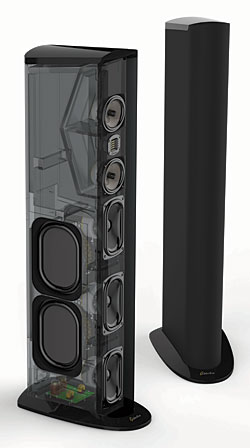 Lander: It's generally agreed that the Tritons also perform better than comparably priced speakers. Will that continue?
Gross: I certainly hope it will continue!
Lander: How have you managed to get such good sound from them?
Gross: First, you have to know what good is. Clearly, many loudspeakers sound good, but I'm always amazed at how many very expensive loudspeakers do not. In terms of the time spent in development, and the attention to detail, we approach every speaker as though we were designing a $50,000 one. Yes, time is money, but better to get it right. There are a thousand and one things in a loudspeaker that are important and contribute to the end result. The majority of these things do not cost more money—you just have to have the skill set and knowledge, and care enough to give them the time they need.
Then there are things that cost more. One area where we decided to splurge was on our tweeters. Air Motion Transformer tweeters cost eight times as much as conventional domes, but we think they're worth it. Other things, like machining our cabinets out of giant blocks of aluminum, we just can't do, though we can take the time, working with an accelerometer, to properly brace and damp our cabinets in order to minimize resonance.
Lander: Your audiophilia is obviously chronic. Your personal systems include massive output-transformerless tube amps, a 150-lb turntable, a $50,000 pair of speakers as well as GoldenEar Triton Ones, and an abundance of other exotic pieces.
Gross: As for the turntable, vinyl still rules. And a loudspeaker designer needs a reference beyond his own products.
Lander: It's generally agreed that the Tritons also perform better than comparably priced speakers. Will that continue?
Gross: I certainly hope it will continue!
Lander: How have you managed to get such good sound from them?
Gross: First, you have to know what good is. Clearly, many loudspeakers sound good, but I'm always amazed at how many very expensive loudspeakers do not. In terms of the time spent in development, and the attention to detail, we approach every speaker as though we were designing a $50,000 one. Yes, time is money, but better to get it right. There are a thousand and one things in a loudspeaker that are important and contribute to the end result. The majority of these things do not cost more money—you just have to have the skill set and knowledge, and care enough to give them the time they need.
Then there are things that cost more. One area where we decided to splurge was on our tweeters. Air Motion Transformer tweeters cost eight times as much as conventional domes, but we think they're worth it. Other things, like machining our cabinets out of giant blocks of aluminum, we just can't do, though we can take the time, working with an accelerometer, to properly brace and damp our cabinets in order to minimize resonance.
Lander: Your audiophilia is obviously chronic. Your personal systems include massive output-transformerless tube amps, a 150-lb turntable, a $50,000 pair of speakers as well as GoldenEar Triton Ones, and an abundance of other exotic pieces.
Gross: As for the turntable, vinyl still rules. And a loudspeaker designer needs a reference beyond his own products.
Lander: Did you go to glamorous parties and glitzy restaurants?
Gross: I attended an interesting party given by Season Hubley, where I engaged Shelley Winters in a half-hour discussion of salsas. Then there was a weeklong trip to Paris—on my dime—trying to raise funding. I had the treat of taking Leslie Caron to dinner. All in all, I was lucky to escape the movie world before I was broke, as most of the players perennially are.
Lander: Don Givogue and Ed Blais, who first distributed Polk in Canada, became your partners in your next venture, Definitive Technology.
Gross: We became partners, and were able to attain a higher-end position in the market than we had at Polk, as well as take a more serious approach to industrial design, especially with our Mythos products. Our first speaker was the BP 10, a narrow, bipolar tower with speakers front and rear. It was an attempt to duplicate, in some ways, the radiation patterns of planar speakers in order to achieve a more open, boxless sound. We followed up with a whole series of bipolar speakers, and in 1995 introduced the BP 2000, which I believe was the first speaker on the market with a built-in powered subwoofer. Most people thought we were integrating a subwoofer for home theater, to eliminate separate sub boxes. In reality, we were engineering in a powered low-frequency section that went deep into the subbass, in order to better integrate it. To me, the most significant Definitive speaker, and the one I'm most proud of, was the Mythos ST.
Gross: I was getting the itch to go back to work. I successfully convinced Don [Givogue] and my wife, Anne Conaway, to come out of retirement.
Lander: Before launching Definitive, you'd tried to buy Dahlquist. At this point, you explored an arrangement with Kathy Gornick, at Thiel Audio—Jim Thiel had recently died.
Gross: In the end, we decided to do something from scratch. I remember bouncing my idea for the [GoldenEar Technology] Tritons off Don after visiting Thiel, and discussing our plans in depth while we were cruising around, looking at the beautiful horse farms in Kentucky. We knew we had to dramatically surpass anything we had previously done. We also knew the Tritons had to be extraordinary for music and movies. Our speakers perform well with both, but all the development is done with music.
Lander: The development is done by your engineering group in Canada. Say a bit about that.
Lander: It's generally agreed that the Tritons also perform better than comparably priced speakers. Will that continue?
Gross: I certainly hope it will continue!
Lander: How have you managed to get such good sound from them?
Gross: First, you have to know what good is. Clearly, many loudspeakers sound good, but I'm always amazed at how many very expensive loudspeakers do not. In terms of the time spent in development, and the attention to detail, we approach every speaker as though we were designing a $50,000 one. Yes, time is money, but better to get it right. There are a thousand and one things in a loudspeaker that are important and contribute to the end result. The majority of these things do not cost more money—you just have to have the skill set and knowledge, and care enough to give them the time they need.
Then there are things that cost more. One area where we decided to splurge was on our tweeters. Air Motion Transformer tweeters cost eight times as much as conventional domes, but we think they're worth it. Other things, like machining our cabinets out of giant blocks of aluminum, we just can't do, though we can take the time, working with an accelerometer, to properly brace and damp our cabinets in order to minimize resonance.
Lander: Your audiophilia is obviously chronic. Your personal systems include massive output-transformerless tube amps, a 150-lb turntable, a $50,000 pair of speakers as well as GoldenEar Triton Ones, and an abundance of other exotic pieces.















