

Frequency Response
 Like almost all headphones of this type, variability in bass response due to variations in fit is observed in the raw data measurements of the headphones in five different positions. The performance of the PX 200-IIi is actually quite good in this regard; many small ear-pad headphones show significantly more variation.
The top graphs show the sum of the five positions for each channel, and is compensated for the acoustics of the head. Here we see an even, though somewhat bowed-up response, centered in the mid-range and falling to either side. The treble peak centered at 10kHz is not unusual for headphones, but I did hear this blip easily with pink noise.
Impulse Response
Like almost all headphones of this type, variability in bass response due to variations in fit is observed in the raw data measurements of the headphones in five different positions. The performance of the PX 200-IIi is actually quite good in this regard; many small ear-pad headphones show significantly more variation.
The top graphs show the sum of the five positions for each channel, and is compensated for the acoustics of the head. Here we see an even, though somewhat bowed-up response, centered in the mid-range and falling to either side. The treble peak centered at 10kHz is not unusual for headphones, but I did hear this blip easily with pink noise.
Impulse Response
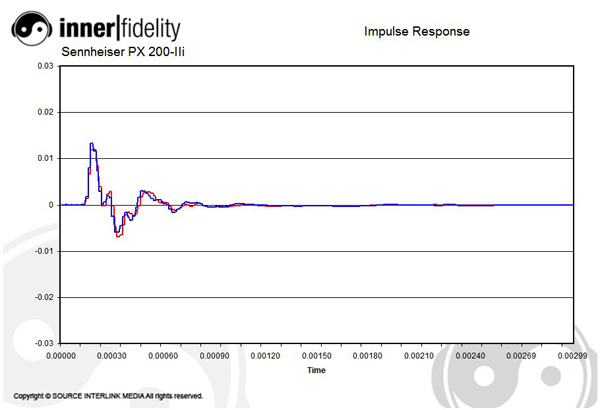 The impulse response goes positive initially, showing the headphone drivers are in correct polarity with the electrical drive signal, and displays a nicely quick first pulse damped within 1mSec. Though not perfect, this is a very good impulse response for a headphone of this type.
Electrical Impedance and Phase
The impulse response goes positive initially, showing the headphone drivers are in correct polarity with the electrical drive signal, and displays a nicely quick first pulse damped within 1mSec. Though not perfect, this is a very good impulse response for a headphone of this type.
Electrical Impedance and Phase
 The PX 200-IIi is a 40 ohm impedance headphone. The impedance curve shows a mild fundamental driver resonance at 40Hz. The smoothly varying impedance and phase curves show a very well behaved headphone.
Distortion
The PX 200-IIi is a 40 ohm impedance headphone. The impedance curve shows a mild fundamental driver resonance at 40Hz. The smoothly varying impedance and phase curves show a very well behaved headphone.
Distortion
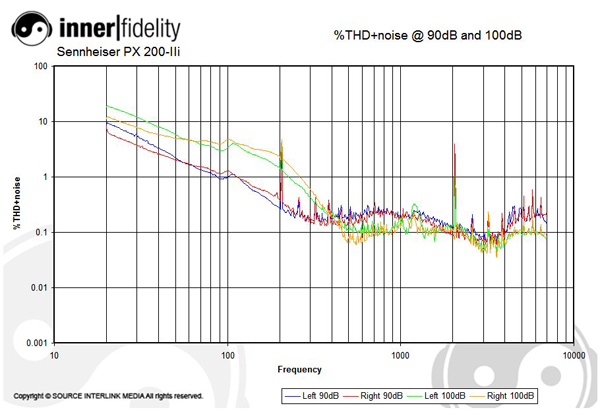 For both 90dB and 100dB measurements, a rising slope of increasing distortion as frequency goes down can be observed. Most of this is due to air beginning to leak in and out of the chamber between the ear and headphone. Because this leak is non-linear with pressure (it contains the pressure for a while, then breaks the seal), it deforms the low frequency sin wave producing distortion. This is common for a headphone of this type, though because of the very small pad and cup size of the PX 200-IIi it extends farther up in frequency than most.
Other than the low frequency distortion, the headphones performed well, clocking in at between 0.1% and 0.5% THD+noise. These data, and the smooth impedance and phase curves, indicate a driver that is performing very well and not exhibiting any cone break-up.
Isolation
For both 90dB and 100dB measurements, a rising slope of increasing distortion as frequency goes down can be observed. Most of this is due to air beginning to leak in and out of the chamber between the ear and headphone. Because this leak is non-linear with pressure (it contains the pressure for a while, then breaks the seal), it deforms the low frequency sin wave producing distortion. This is common for a headphone of this type, though because of the very small pad and cup size of the PX 200-IIi it extends farther up in frequency than most.
Other than the low frequency distortion, the headphones performed well, clocking in at between 0.1% and 0.5% THD+noise. These data, and the smooth impedance and phase curves, indicate a driver that is performing very well and not exhibiting any cone break-up.
Isolation
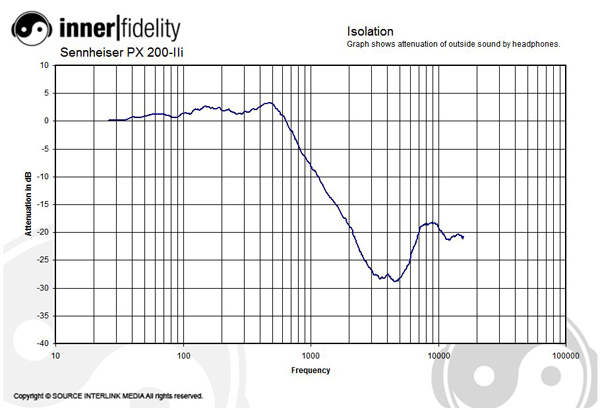 The isolation of these headphones is pretty poor. Pads and earpieces are extremely small and very light, making them somewhat more transparent to outside sound than larger headphones of this type. For better isolation applications try larger ear-pad and full-size sealed cans. For better isolation use in-ear monitors and noise cancelers.
30 Hz Square Wave Response
The isolation of these headphones is pretty poor. Pads and earpieces are extremely small and very light, making them somewhat more transparent to outside sound than larger headphones of this type. For better isolation applications try larger ear-pad and full-size sealed cans. For better isolation use in-ear monitors and noise cancelers.
30 Hz Square Wave Response
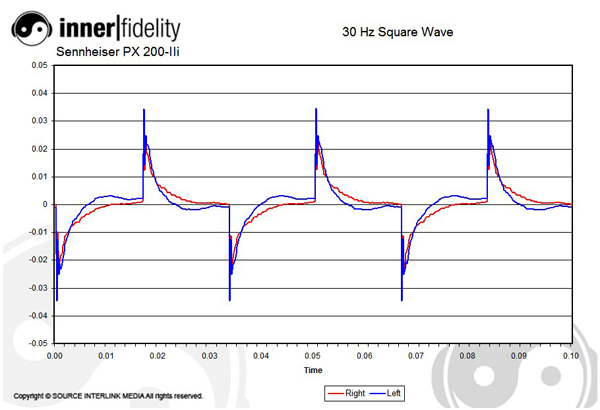 As expected, these headphones have a hard time compressing air long enough to produce a good square wave at this low frequency. The strong downward curvature of the top of the square wave indicates the humped-up frequency response seen above. Unevenness of the two channels indicates the difference in seal between the two ears.
300Hz Square Wave Response
As expected, these headphones have a hard time compressing air long enough to produce a good square wave at this low frequency. The strong downward curvature of the top of the square wave indicates the humped-up frequency response seen above. Unevenness of the two channels indicates the difference in seal between the two ears.
300Hz Square Wave Response
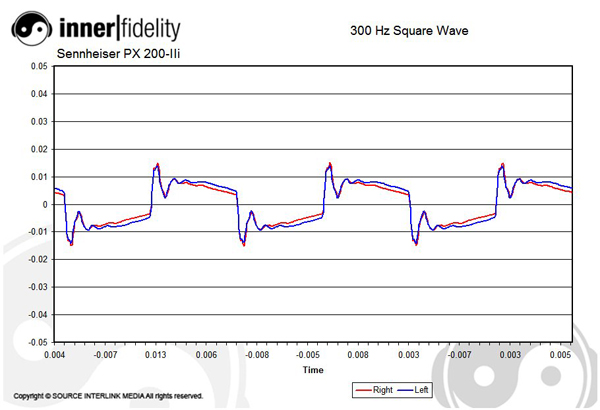 The rise, overshoot, one ring, and damp with a relatively flat top indicates good time alignment between the low and high frequencies. The slightly slow rise, lack of noise, and longish period of the ring indicate a lack of very high frequency response as seen in the frequency response curves. This is a pretty good, though a tad sluggish, 300hZ square wave response.
Measurement Summary
Overall, these headphones measure quite well for a headphone of this type. They fell a bit short of the norm in isolation and bass control due to the difficult-to-seal small ear-pads, and the frequency response was not well extended. On the other hand, the smoothness of frequency response, electrical impedance and phase, and low distortion measurements in the mids and above, are among the better in the category. These measurements demonstrate, in my view, Sennheiser's exception skill in navigating the compromises needed to produce a headphone that both sounds good and is extraordinarily compact and functional.
Download .pdf of the measurement sheet for the Sennheiser PX 200-IIi.
The rise, overshoot, one ring, and damp with a relatively flat top indicates good time alignment between the low and high frequencies. The slightly slow rise, lack of noise, and longish period of the ring indicate a lack of very high frequency response as seen in the frequency response curves. This is a pretty good, though a tad sluggish, 300hZ square wave response.
Measurement Summary
Overall, these headphones measure quite well for a headphone of this type. They fell a bit short of the norm in isolation and bass control due to the difficult-to-seal small ear-pads, and the frequency response was not well extended. On the other hand, the smoothness of frequency response, electrical impedance and phase, and low distortion measurements in the mids and above, are among the better in the category. These measurements demonstrate, in my view, Sennheiser's exception skill in navigating the compromises needed to produce a headphone that both sounds good and is extraordinarily compact and functional.
Download .pdf of the measurement sheet for the Sennheiser PX 200-IIi.
Like almost all headphones of this type, variability in bass response due to variations in fit is observed in the raw data measurements of the headphones in five different positions. The performance of the PX 200-IIi is actually quite good in this regard; many small ear-pad headphones show significantly more variation.
The top graphs show the sum of the five positions for each channel, and is compensated for the acoustics of the head. Here we see an even, though somewhat bowed-up response, centered in the mid-range and falling to either side. The treble peak centered at 10kHz is not unusual for headphones, but I did hear this blip easily with pink noise.
Impulse Response
The impulse response goes positive initially, showing the headphone drivers are in correct polarity with the electrical drive signal, and displays a nicely quick first pulse damped within 1mSec. Though not perfect, this is a very good impulse response for a headphone of this type.
The PX 200-IIi is a 40 ohm impedance headphone. The impedance curve shows a mild fundamental driver resonance at 40Hz. The smoothly varying impedance and phase curves show a very well behaved headphone.
Distortion
For both 90dB and 100dB measurements, a rising slope of increasing distortion as frequency goes down can be observed. Most of this is due to air beginning to leak in and out of the chamber between the ear and headphone. Because this leak is non-linear with pressure (it contains the pressure for a while, then breaks the seal), it deforms the low frequency sin wave producing distortion. This is common for a headphone of this type, though because of the very small pad and cup size of the PX 200-IIi it extends farther up in frequency than most.
Other than the low frequency distortion, the headphones performed well, clocking in at between 0.1% and 0.5% THD+noise. These data, and the smooth impedance and phase curves, indicate a driver that is performing very well and not exhibiting any cone break-up.
The isolation of these headphones is pretty poor. Pads and earpieces are extremely small and very light, making them somewhat more transparent to outside sound than larger headphones of this type. For better isolation applications try larger ear-pad and full-size sealed cans. For better isolation use in-ear monitors and noise cancelers.
30 Hz Square Wave Response
As expected, these headphones have a hard time compressing air long enough to produce a good square wave at this low frequency. The strong downward curvature of the top of the square wave indicates the humped-up frequency response seen above. Unevenness of the two channels indicates the difference in seal between the two ears.
300Hz Square Wave Response
The rise, overshoot, one ring, and damp with a relatively flat top indicates good time alignment between the low and high frequencies. The slightly slow rise, lack of noise, and longish period of the ring indicate a lack of very high frequency response as seen in the frequency response curves. This is a pretty good, though a tad sluggish, 300hZ square wave response.















