

Sidebar 3: Measurements
I used DRA Labs' MLSSA system and a calibrated DPA 4006 microphone to measure the Sjöfn Clue's frequency response in the farfield, and an Earthworks QTC-40 for the nearfield responses. My estimate of the Clue's B-weighted voltage sensitivity confirmed the specification of 87dB/2.83V/m. The minimum impedance is specified as 4.2 ohms; the solid trace in fig.1 shows that our samples went a little lower than that, reaching 3.7 ohms at 270Hz and 2.67 ohms at 4.7kHz. However, as the electrical phase angle is never high when the impedance is low, a good, 4 ohm–rated amplifier should have no problem driving the Clue.

 The saddle at 36Hz in the impedance-magnitude trace suggests that the port is tuned to this frequency; the port's output, measured in the nearfield (fig.3, red trace), does indeed peak between 30 and 40Hz. However, the corresponding minimum-motion notch in the woofer's nearfield response (blue trace) occurs a little lower in frequency, at 33Hz. This is a low tuning frequency for a relatively small speaker, and the Clue's overall low-frequency response (black trace) actually starts to shelve down two octaves above the port's peak output. It must be remembered that the Clue is intended to be used when placed flush with the wall behind it. However, as the nearfield measurement technique assumes just such a condition, this graph therefore correlates with HR's finding the speaker's low frequencies to sound lean. And note the high-Q resonance in the port's output at 800Hz.
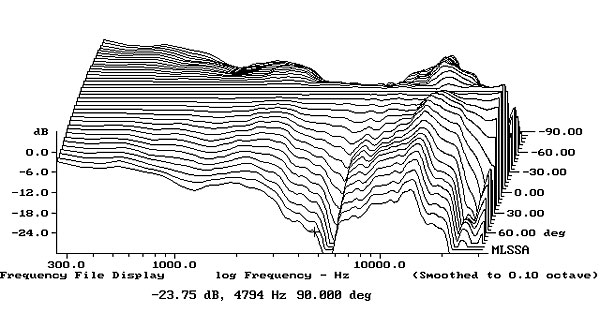
 In rooms of small to medium size, the balance will also strongly depend on the speaker's radiation patterns in the horizontal and vertical planes. Fig.4 shows the Sjöfn's horizontal radiation pattern, normalized to the response on the tweeter axis. The contour lines in this graph are smooth and evenly spaced in the midrange and low treble; however, the woofer becomes quite directional at the top of its passband, which results in a significant lack of off-axis energy in the region where the on-axis peak in the mid-treble begins to develop. In the top octave, where the trace in fig.3 has a severe suckout, there is actually a lot more energy off axis, which in a small room like HR's will probably give enough output in the top two octaves. Note that HR did write that the Clue's "high frequencies were extended and well dispersed." In the vertical plane (fig.5), the Sjöfn's radiation pattern suffers from severe suckouts at 5kHz above and below the tweeter axis, which will also work against the audibility of that mid-treble peak in the tweeter-axis response.
 The Clue's step response on the tweeter axis (fig.6) indicates that both drive-units are connected in inverted acoustic polarity. The small height of the tweeter's step implies a high crossover frequency, most likely the same 5kHz as the off-axis suckouts in the plot of vertical dispersion. There is a strange double arrival in the woofer's step. Finally, the cumulative spectral-decay plot on the tweeter axis (fig.7) reveals a clean decay throughout the treble, but with some delayed energy associated with the on-axis peaks centered on 1 and 6kHz.
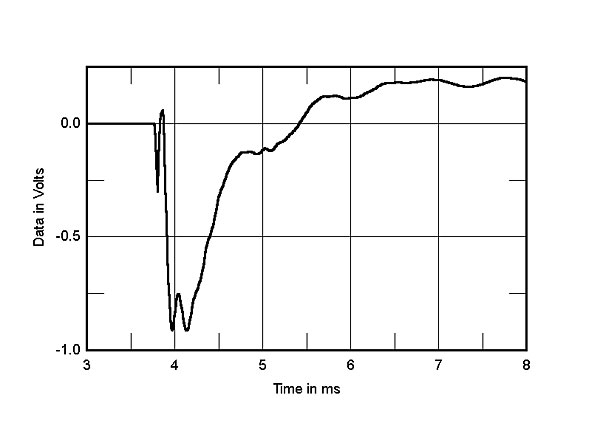

Fig.1 Sjöfn Clue, electrical impedance (solid) and phase (dashed) (2 ohms/vertical div.).
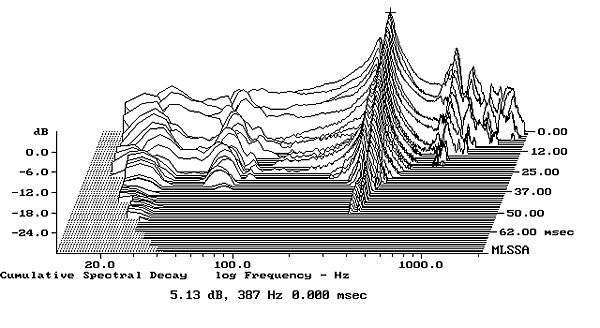
There is a small discontinuity in the impedance traces just below 400Hz; when I investigated the cabinet's vibrational behavior with a plastic-tape accelerometer, I found a very strong resonant mode at 387Hz on all surfaces (fig.2). This resonance is high enough in amplitude and low enough in frequency that I would be surprised if it didn't give rise to audible coloration. However, it's fair to note that Herb Reichert didn't comment on any midrange congestion that might have resulted from this behavior.
Fig.2 Sjöfn Clue, cumulative spectral-decay plot calculated from output of accelerometer fastened to center of side panel (MLS driving voltage to speaker, 7.55V; measurement bandwidth, 2kHz).
Fig.3 Sjöfn Clue, anechoic response on tweeter axis at 50", averaged across 30° horizontal window and corrected for microphone response, with nearfield responses of woofer (blue) and port (red) and their complex sum (black), respectively plotted below 300Hz, 1kHz, 300Hz.
The right portion of fig.3 shows the Clue's farfield response, averaged across a 30° horizontal window on the tweeter axis. It is not all flat, but discussing the implications is not easy, as it depends on which frequency region(s) the listener's ear/brain takes as a reference. If the peaks in the high midrange and mid-treble are heard as correct, the lows will be shelved down, the presence region will sound way too polite, and the top octave will be lifeless. But if the midrange and presence regions are heard as being correct, then the aforementioned peaks will be heard as colorations.
Fig.4 Sjöfn Clue, lateral response family at 50", normalized to response on tweeter axis, from back to front: differences in response 90–5° off axis, reference response, differences in response 5–90° off axis.
Fig.5 Sjöfn Clue, vertical response family at 50", normalized to response on tweeter axis, from back to front: differences in response 45–5° above axis, reference response, differences in response 5–45° below axis.
Fig.6 Sjöfn Clue, step response on tweeter axis at 50" (5ms time window, 30kHz bandwidth).
Fig.7 Sjöfn Clue, cumulative spectral-decay plot on tweeter axis at 50" (0.15ms risetime).
Overall, to judge from HR's comments on the Clue's sound, the speaker's balance is dominated by that shelved-down bass region. And while the Sjöfn's on-axis problems will be to some extent balanced by the off-axis behavior, especially in smaller rooms, I'm not surprised that when HR set up his Rogers LS3/5As, he found that even with that vintage speaker's own departure from a flat response, their octave-to-octave tonal balance was "significantly more realistic," and their soundstage was "more open and naturally proportioned."—John Atkinson















