Sony MDR-1R Measurements
 THD+noise is at appropriately low levels other than the rising distortion in the bass mentioned above.
Impedance and phase plots show a fairly clean acoustic design without and excess bumps and wiggles in the higher frequencies. This is a nominally 30 Ohm headphone with a strong primary resonance at 100Hz at 40 Ohms.
Isolation from outside noise is about average for a headphone of this type at -11dB broadband. With 24mVrms to reach 90dBspl at the ear this is a fairly efficient headphone and will reach strong listening levels from portable devices.
This headphone measures fairly well, but sounds better than it measures to my ears.
Sony MDR-1RBT Measurements
THD+noise is at appropriately low levels other than the rising distortion in the bass mentioned above.
Impedance and phase plots show a fairly clean acoustic design without and excess bumps and wiggles in the higher frequencies. This is a nominally 30 Ohm headphone with a strong primary resonance at 100Hz at 40 Ohms.
Isolation from outside noise is about average for a headphone of this type at -11dB broadband. With 24mVrms to reach 90dBspl at the ear this is a fairly efficient headphone and will reach strong listening levels from portable devices.
This headphone measures fairly well, but sounds better than it measures to my ears.
Sony MDR-1RBT Measurements
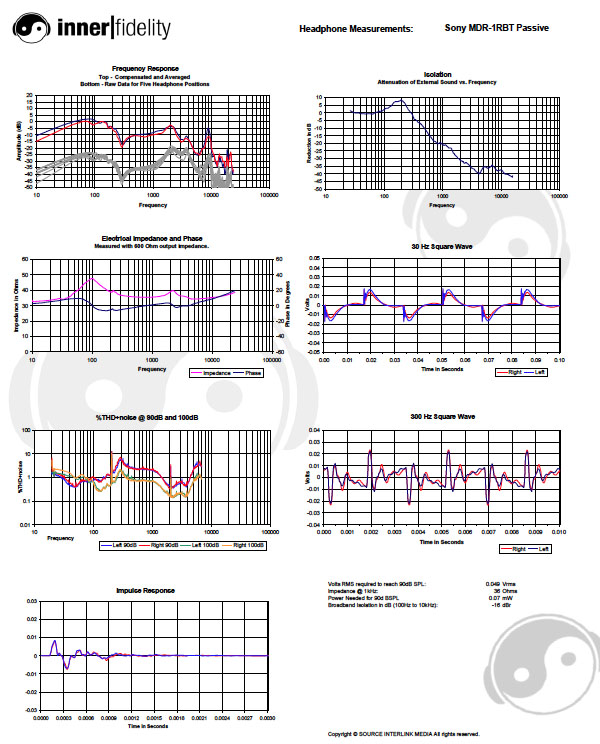
 The big surprise for me with these cans was how similarly they measured between passive and active modes. Obviously Sony engineers were unable to design these cans with the acoustics of the 1R due to the extra room taken up by the electronics. They did do a pretty good job of matching left and right ears, though. It has me wondering if there is any opportunity to do what Parrot did with the Zik and add a little DSP to flatten out the response when in active mode.
THD+noise plots are rather high overall, but bass distortion is less than the 1R.
Isolation is better than the 1R with -15dBspl broadband isolation. These should work well as a mobile heads.
Sony MDR-1RNC Measurements
The big surprise for me with these cans was how similarly they measured between passive and active modes. Obviously Sony engineers were unable to design these cans with the acoustics of the 1R due to the extra room taken up by the electronics. They did do a pretty good job of matching left and right ears, though. It has me wondering if there is any opportunity to do what Parrot did with the Zik and add a little DSP to flatten out the response when in active mode.
THD+noise plots are rather high overall, but bass distortion is less than the 1R.
Isolation is better than the 1R with -15dBspl broadband isolation. These should work well as a mobile heads.
Sony MDR-1RNC Measurements
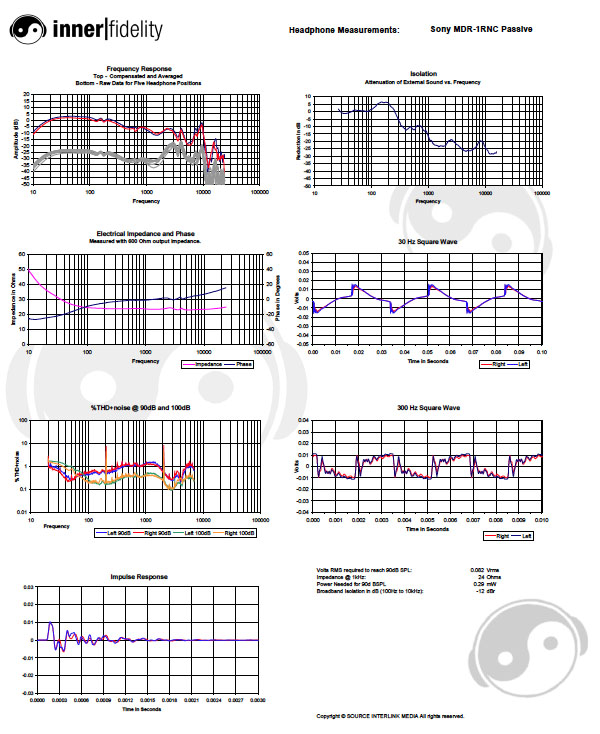
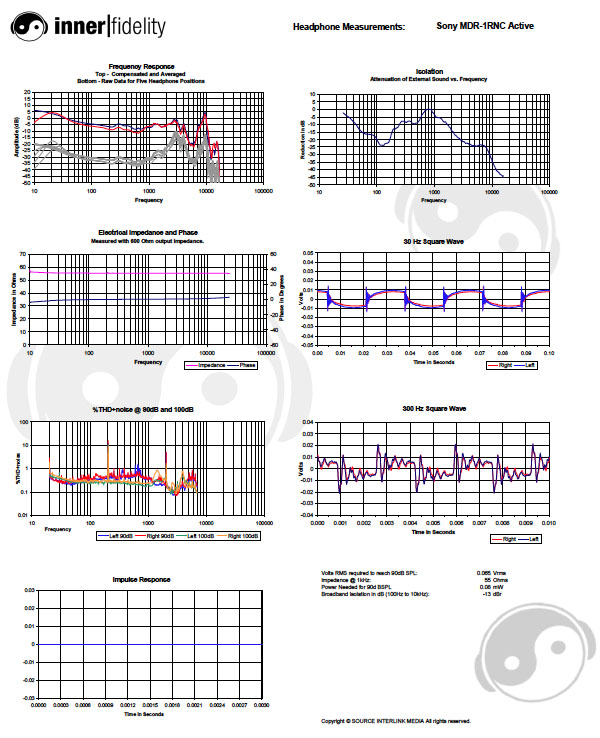 Both compensated frequency response plots show a headphone with a strong warm tilt. The passive plot is a bit "n" shaped, and the active plot a bit "u" shaped relative to each other however. I really would have expected the passive mode to sound better than it does given the relatively straight, though tilted, frequency response. (The Philips X1 for example is similar, but sounds much, much better.) In active mode bass extension is improved, but it's at such a high level relative to the rest of the spectrum that it does get distracting while listening. For example, I was watching a movie where there were footfalls on a wooden floor, and the low frequency "thump" of the steps were remarkably loud and rather annoying.
Fairly good 30Hz square wave shape and modestly rising THD+noise in the bass would indicate fairly tight bass response, but in listening it was so out of balance with the top end I just couldn't enjoy it.
Passive mode delivered an okay 300Hz squarewave, but significant noise and ringing is seen after the initial edge. This is also seen in the impulse response which is quite noisy and takes quite a while to settle down. The 300Hz square wave in active mode is a ragged mess. I would expect the treble to sound harsh and sibilant...and it did.
Strongly rising impedance in passive mode leads me to think the audio is capacitively coupled to the drivers in this mode.
Surprisingly, distortion is significantly reduced in active mode. That may be audible, but I just couldn't get passed the harsh treble to see if I heard any improvements in the mids.
Isolation does improve in the low frequencies as expected for a noise canceling headphone, but is only -13dB broadband compared to -26dB broadband isolation of the Bose Quiet Comfort 15.
This headphone sounds worse than it measures.
Both compensated frequency response plots show a headphone with a strong warm tilt. The passive plot is a bit "n" shaped, and the active plot a bit "u" shaped relative to each other however. I really would have expected the passive mode to sound better than it does given the relatively straight, though tilted, frequency response. (The Philips X1 for example is similar, but sounds much, much better.) In active mode bass extension is improved, but it's at such a high level relative to the rest of the spectrum that it does get distracting while listening. For example, I was watching a movie where there were footfalls on a wooden floor, and the low frequency "thump" of the steps were remarkably loud and rather annoying.
Fairly good 30Hz square wave shape and modestly rising THD+noise in the bass would indicate fairly tight bass response, but in listening it was so out of balance with the top end I just couldn't enjoy it.
Passive mode delivered an okay 300Hz squarewave, but significant noise and ringing is seen after the initial edge. This is also seen in the impulse response which is quite noisy and takes quite a while to settle down. The 300Hz square wave in active mode is a ragged mess. I would expect the treble to sound harsh and sibilant...and it did.
Strongly rising impedance in passive mode leads me to think the audio is capacitively coupled to the drivers in this mode.
Surprisingly, distortion is significantly reduced in active mode. That may be audible, but I just couldn't get passed the harsh treble to see if I heard any improvements in the mids.
Isolation does improve in the low frequencies as expected for a noise canceling headphone, but is only -13dB broadband compared to -26dB broadband isolation of the Bose Quiet Comfort 15.
This headphone sounds worse than it measures.
Click on graphs image to download .pdf for closer inspection.
Raw frequency response plots show a headphone that is positionally insensitive, and has pads that seal reliably quite well. Compensated plot shows falling response below 100Hz, with a broad upper-bass/low mid-range hump and another centered at 1-2kHz. The broad hump centered at 100-200Hz coupled with the strong downward curve of the 30Hz square wave top and rising THD+noise curve in the bass (especially the 100dB plot) are indicators of a somewhat loose bass response heard in listening tests that was especially strong at higher listening levels.
The strong upper-mid presence heard as strong female vocals might be due to the hump at 1kHz. Treble response drops dramatically after 2kHz, and treble above 10kHz is probably 5-10dB lower than ideal. The strong peak at 10kHz usually indicates a strident top end, but that was not heard in listening. This plot is somewhat similar to the V-Moda M-100 (though not as much bass), which also seemed somehow to be very pleasant sounding. Not sure why, but this curve seems to work fairly well, and sounds better than what one would expect from looking at measurements alone.
The 300Hz square wave seems a bit slow to respond after the leading edge, but is otherwise fairly clean and free from ringing. The impulse response is likewise slightly slow and some ringing is evident, but it settles out fairly quickly. I expect the good imaging of these cans is evidenced by the clean, single leading edge of the 300Hz square wave.
Click on graphs image to download .pdf for closer inspection.
I've purchased a small Bluetooth transmitter for my testing system and this is the first BT headset that I've measure in wireless mode. The top graphs were done wired with the electronics off; the bottom graph is measurements done wirelessly through a Bluetooth connection. There is no impedance and phase plot in wireless mode as I'd just be measuring the transmitter, and for some reason the system was unable to lock in on the Maximum Length Sequence (MLS) signal used for the impulse response, so no plot is available.
Compensated frequency response plots show a very large, broad bass/mids hump centered at 100Hz and ending at 300Hz in a fairly severe dip. Response then rises to 2kHz and falls rapidly afterward. This curve, coupled with the strong downward bend of the 30Hz square wave top, would lead one to believe these cans would have a big, thick bass and a rather peaky sounding mid, which is indeed what I heard in listening.
The 300Hz square wave is a train wreck, and I would have thought the highs in these cans would have been unbearable, but I didn't find that to be the case. In listening the treble was more artificial sounding than the 1R, but it wasn't harsh or etched.
Click on graphs image to download .pdf for closer inspection.
I measured the 1RNC in both active and passive modes, again there was some problem with MLS sync so no impulse response in active mode was available.