

Sidebar 4: Measurements
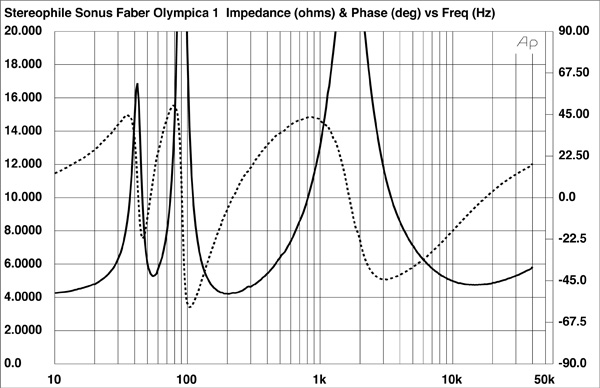
I used DRA Labs' MLSSA system to measure the Sonus Faber Olympica Nova 1's farfield behavior with a calibrated DPA 4006 microphone. For the speaker's nearfield response, I used an Earthworks QTC-40 mike, as its ¼" capsule won't obstruct the radiated sound. The Olympica Nova 1's specified sensitivity is 87dB/2.83V/m. My estimated sensitivity was very close to that figure, at 86.7dB(B)/2.83V/m. Although the Olympica Nova 1's nominal impedance is specified as 4 ohms, the solid trace in fig.1 reveals that the impedance remains above 4 ohms for the entire audioband. The minimum value is 4.2 ohms at 205Hz, and while the electrical phase angle (dashed trace) is high at some frequencies, this will be ameliorated by the high impedance magnitude at those frequencies. The Olympica Nova 1 will be easy to drive.
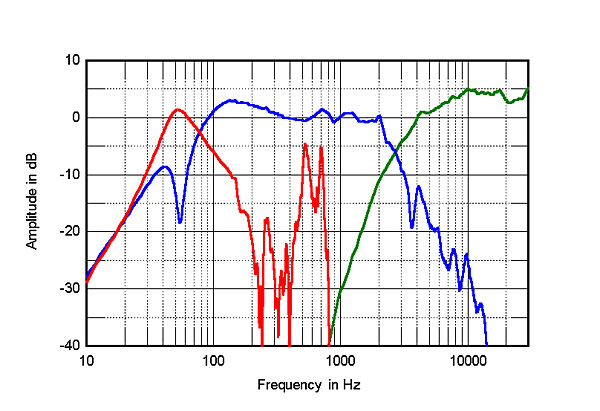
 The Sonus Faber's slot-shaped port is tuned to 55Hz, this indicated by the fact that the nearfield response of the woofer (fig.3, blue trace) has its minimum-motion notch at that frequency. (The back pressure from the port resonance holds the cone stationary at this frequency.) The nearfield response of the port (red trace) peaks between 38Hz and 90Hz, but its upper-frequency rolloff is disturbed by peaks at the frequencies of the enclosure's resonant modes. The woofer's output is relatively even and it crosses over to the tweeter (green trace) close to the specified 2.5kHz. The tweeter appears to be 5dB too high in level, however, which can also be seen in the Olympica Nova 1's farfield response, averaged across a 30° horizontal window centered on the tweeter axis (fig.4, black trace above 300Hz). The other speaker's tweeter was about 1dB lower in level, but the responses of the two samples otherwise closely matched. A slight lack of energy in the crossover region can be seen in this graph.
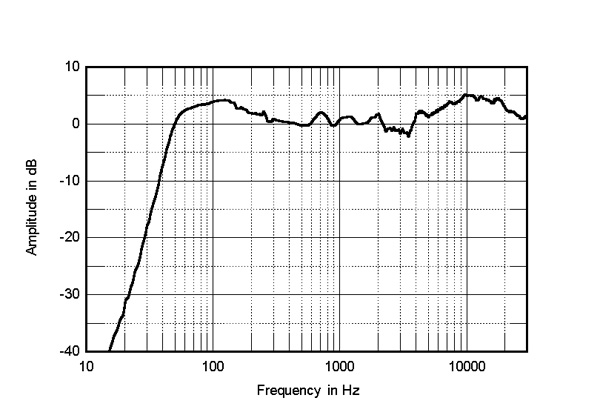 The black trace below 300Hz in fig.4 shows the sum of the Sonus Faber's nearfield woofer and port outputs, taking into account acoustic phase and the different distance of each radiator from a nominal farfield microphone position. The small excess of upper-bass energy will be due to the nearfield measurement technique, which assumes that the radiators are mounted on a true infinite baffle, ie, one that extends indefinitely in both horizontal and vertical planes.
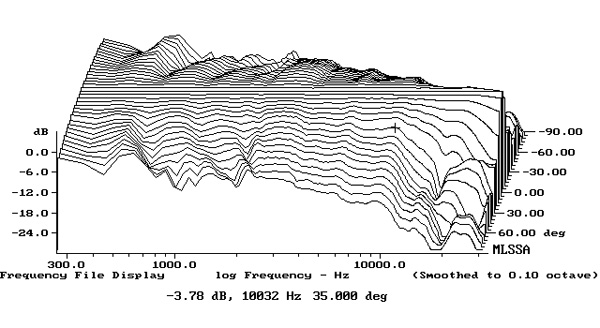
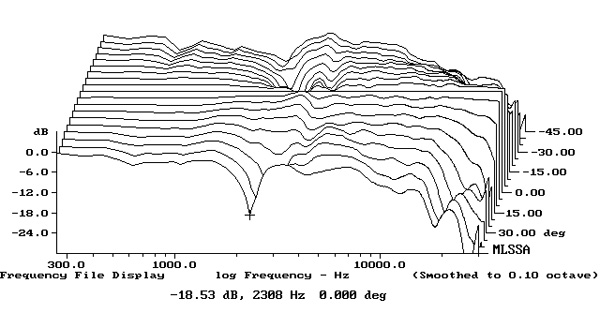
The plot of the Olympica Nova 1's horizontal dispersion, referenced to the response on the tweeter axis (fig.5), indicates that the speaker's output drops off to the sides above 10kHz. This will tend to balance some of the on-axis high-treble excess in medium-sized and large rooms, though the sound might still be rather bright in small rooms. Other than some small disturbances in the midrange at off-axis angles greater than 60°, the contour lines in this graph are relatively even throughout the midrange and treble. This will correlate with stable stereo imaging. In the vertical plane (fig.6), a suckout develops in the crossover region 5° above the tweeter axis. Sonus Faber's dedicated stand, which is just under 30" tall with spikes, will place the tweeter sufficiently high for this suckout not to affect the Sonus Faber's tonal balance (footnote 1).
The black trace below 300Hz in fig.4 shows the sum of the Sonus Faber's nearfield woofer and port outputs, taking into account acoustic phase and the different distance of each radiator from a nominal farfield microphone position. The small excess of upper-bass energy will be due to the nearfield measurement technique, which assumes that the radiators are mounted on a true infinite baffle, ie, one that extends indefinitely in both horizontal and vertical planes.
The plot of the Olympica Nova 1's horizontal dispersion, referenced to the response on the tweeter axis (fig.5), indicates that the speaker's output drops off to the sides above 10kHz. This will tend to balance some of the on-axis high-treble excess in medium-sized and large rooms, though the sound might still be rather bright in small rooms. Other than some small disturbances in the midrange at off-axis angles greater than 60°, the contour lines in this graph are relatively even throughout the midrange and treble. This will correlate with stable stereo imaging. In the vertical plane (fig.6), a suckout develops in the crossover region 5° above the tweeter axis. Sonus Faber's dedicated stand, which is just under 30" tall with spikes, will place the tweeter sufficiently high for this suckout not to affect the Sonus Faber's tonal balance (footnote 1).
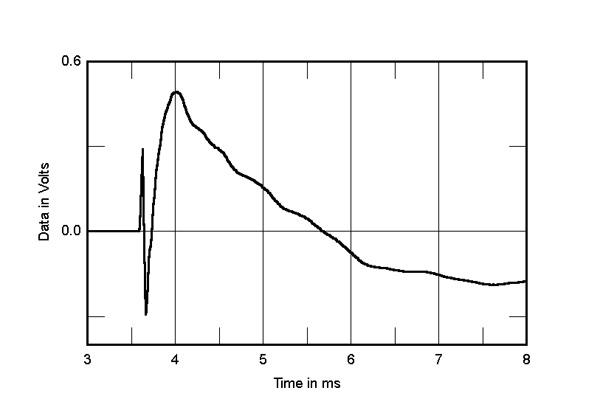
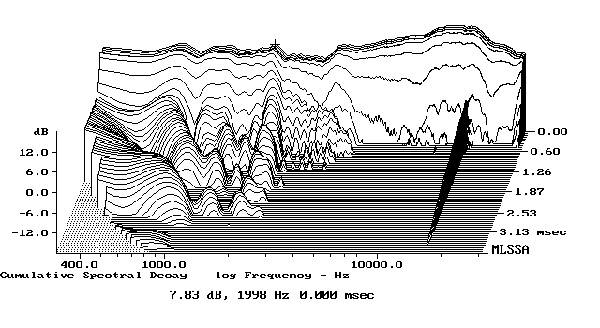
 In the time domain, the Olympica Nova 1's step response on the tweeter axis (fig.7) indicates that the tweeter and woofer are both connected in positive acoustic polarity. The decay of the tweeter's step, which arrives first at the microphone, smoothly blends with the start of the woofer's step. The Sonus Faber's cumulative spectral-decay plot (fig.8) is very clean throughout the treble. However, a ridge of decayed energy is evident at 2kHz, which could possibly be due to a surround termination problem with the woofer. (As always with my CSD plots, ignore the small ridge just below 17kHz, which is due to interference from the computer monitor's line-scan frequency.)
Footnote 1: According to Sonus Faber's Paulo Tezzon, when they received the preprint of this review, "The best measurement axis in every Sonus Faber speaker is not the tweeter axis but it is the upper point of the midrange/midwoofer's circumference, below the tweeter." It does look from the vertical dispersion plot that the anechoic response would be less elevated—flatter overall—at the top of the mid/woofer cone.—John Atkinson
Fig.1 Sonus Faber Olympica Nova 1, electrical impedance (solid) and phase (dashed) (2 ohms/vertical div.).
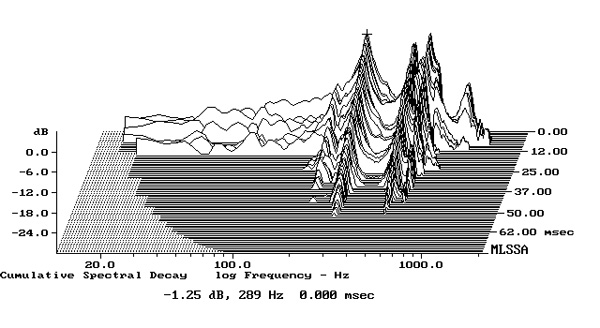
Although the enclosure doesn't have any parallel walls, which should minimize internal standing waves, it didn't appear to be as well-damped as I was expecting from the multi-layer construction. When I listened to the panels of both loudspeakers with a stethoscope while I swept a sinewave tone up and down, I found a strong resonant mode just below 300Hz on the sidewalls and the top panel. (Although it will be difficult to see at the scale that graphs are printed, there is a small wrinkle in the impedance traces in this region.) When I investigated the enclosure's vibrational behavior with a plastic-tape accelerometer, this mode was very strong on the sidewalls (fig.2), and modes were also present at 550Hz and 630Hz. This behavior might correlate with the slight midrange coloration Larry heard on Richard Lehnert's speaking voice on the Stereophile Editor's Choice CD.
Fig.2 Sonus Faber Olympica Nova 1, cumulative spectral-decay plot calculated from output of accelerometer fastened to center of sidewall (MLS driving voltage to speaker, 7.55V; measurement bandwidth, 2kHz).
Fig.3 Sonus Faber Olympica Nova 1, acoustic crossover on tweeter axis at 50", corrected for microphone response, with the nearfield responses of the woofer (blue) and port (red), respectively plotted below 350Hz and 800Hz.
Fig.4 Sonus Faber Olympica Nova 1, anechoic response on tweeter axis at 50", averaged across 30° horizontal window and corrected for microphone response, with the complex sum of the nearfield woofer and port responses plotted below 300Hz.
Fig.5 Sonus Faber Olympica Nova 1, lateral response family at 50", normalized to response on tweeter axis, from back to front: differences in response 90–5° off axis, reference response, differences in response 5–90° off axis.
Fig.6 Sonus Faber Olympica Nova 1, vertical response family at 50", normalized to response on tweeter axis, from back to front: differences in response 45–5° above axis, reference response, differences in response 5–45° below axis.
The red trace in fig.7 shows the Sonus Fabers' spatially averaged response in my room. (This is generated by averaging 20 1/6-octave–smoothed spectra, taken for the left and right speakers individually using a 96kHz sample rate, in a vertical rectangular grid 36" wide by 18" high and centered on the positions of my ears.) For reference, the blue trace shows the spatially averaged response of my KEF LS50s when placed in the same positions. The in-room response of the two models is very similar in the upper bass and midrange, and while the Olympica Nova 1s have more mid-bass energy and low-frequency extension, the KEFs have more output in the presence region. More importantly, while the sloped-down response above 5kHz of the LS50s is due both to the increased absorptivity of the room's furnishings in this region and the increasing directivity of the tweeter, the Sonus Faber speakers have up to 4dB greater output between 5kHz and 20kHz. This correlates with the high tweeter level that can be seen in the quasi-anechoic behavior (figs.3 and 4).
Fig.7 Sonus Faber Olympica Nova 1, spatially averaged, 1/6-octave response in JA's listening room (red) and of the KEF LS50 (blue).
Fig.8 Sonus Faber Olympica Nova 1, step response on tweeter axis at 50" (5ms time window, 30kHz bandwidth).
Fig.9 Sonus Faber Olympica Nova 1, cumulative spectral-decay plot on tweeter axis at 50" (0.15ms risetime).
Other than the resonant mode at 2kHz in fig.8 and the midrange peaks in the port's output, the Sonus Faber Olympica Nova 1 did well on the test bench.—John Atkinson
Footnote 1: According to Sonus Faber's Paulo Tezzon, when they received the preprint of this review, "The best measurement axis in every Sonus Faber speaker is not the tweeter axis but it is the upper point of the midrange/midwoofer's circumference, below the tweeter." It does look from the vertical dispersion plot that the anechoic response would be less elevated—flatter overall—at the top of the mid/woofer cone.—John Atkinson















