

Sidebar 3: Measurements
I used DRA Labs' MLSSA system and a calibrated DPA 4006 microphone to measure the Sonus Faber Venere 2.5's frequency response in the farfield, and an Earthworks QTC-40 for the nearfield responses. The Sonus Faber's voltage sensitivity is specified as 89dB/2.83V/m; my estimate was a little lower than that, at 87.7dB(B)/2.83V/m. The impedance is specified as 6 ohms; the Venere 2.5's impedance magnitude and electrical phase, plotted against frequency, are shown in fig.1. There is quite a large variation of impedance with frequency, the magnitude remaining below 6 ohms for most of the midrange and bass but staying above 9 ohms for the entire treble region. Though there is a minimum value of 3.45 ohms at 111Hz, the phase angle is extreme only when the magnitude is high. The Venere 2.5 will not be hard to drive.

 There is a stronger discontinuity at 135Hz in the impedance traces; while I didn't find a mechanical resonance at this frequency, there is a peak at 135Hz in the rectangular port's nearfield output (fig.3, red trace). This disturbs what would otherwise be a smooth rolloff above 80Hz; the port's output covers a wider range than usual. At the nominal port tuning frequency, the outputs of the upper woofer (blue trace) and the lower woofer (green) show only vestigial minimum-motion notches. The lower woofer rolls off rapidly above 120Hz, leaving the upper to cross over to the tweeter (black trace) at 2.5kHz. (All farfield responses were taken on the Venere 2.5's tweeter axis but with the speaker correctly tilted back by the stand.)


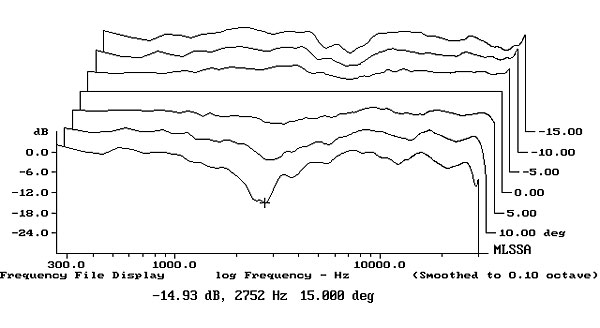

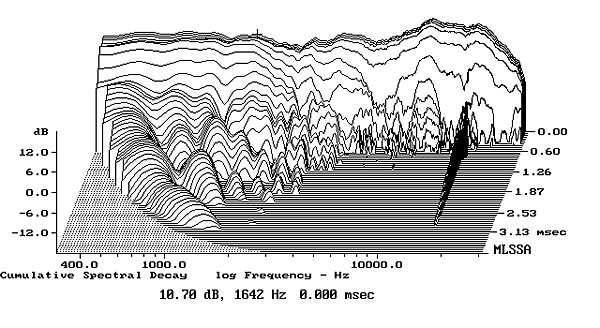
Fig.1 Sonus Faber Venere 2.5, electrical impedance (solid) and phase (dashed) (2 ohms/vertical div.).
Just visible in the traces are a couple of small discontinuities that suggest the presence of resonances of some kind. Investigating the vibrational behavior of the enclosure panels with a plastic-tape accelerometer (fig.2), I found present on all surfaces a strong mode at 227Hz, the frequency of one of the impedance glitches.
Fig.2 Sonus Faber Venere 2.5, cumulative spectral-decay plot calculated from output of accelerometer fastened to center of side panel level with lower woofer (MLS driving voltage to speaker, 7.55V; measurement bandwidth, 2kHz).
Fig.3 Sonus Faber Venere 2.5, acoustic crossover on listening axis at 50", corrected for microphone response, with nearfield responses of upper woofer (blue), lower woofer (green), port (red), respectively plotted below 355Hz, 1kHz, 750Hz.
The upper woofer's farfield response (fig.3, blue trace) is impressively even, though a small peak can be seen at 4kHz in its low-pass rolloff. The tweeter's farfield output is a bit peaky, though with a flat trend overall. This top-octave peakiness is also apparent in the Venere 2.5's overall farfield response (fig.4), though the speaker's output is basically flat. Though some of the large peak in the bass will be an artifact of the nearfield measurement technique, it is also due to the lower woofer's output reinforcing the upper woofer's. Kal Rubinson wrote that he was aware of "excessive midbass emphasis," and I must admit that I don't grasp the benefit of a 2.5-way design such as this. In theory, the lower woofer's output will compensate for the design's baffle step, but in practice, there is often too much energy in the region where the woofers' outputs overlap. On the other hand, with the doubled radiating area in the bass, there should be lower distortion than with a single woofer at a given sound pressure level.
Fig.4 Sonus Faber Venere 2.5, anechoic response on listening axis at 50", averaged across 30° horizontal window and corrected for microphone response, with complex sum of nearfield responses plotted below 300Hz.
The farfield traces in figs. 3 and 4 were taken without the vestigial grille. The effect of the grille was to accentuate the small suckouts at 6 and 15kHz in the on-axis response. The lateral dispersion without the grille (fig.5) is impressively smooth and even, though there is a slight lack of energy to the speaker's sides between 3 and 5kHz. In the vertical plane (fig.6), the Venere 2.5's balance doesn't change appreciably over quite a wide angle, though the beginnings of a suckout at the upper crossover frequency appear 15° below the listening axis.
Fig.5 Sonus Faber Venere 2.5, lateral response family at 50", normalized to response on listening axis, from back to front: differences in response 90–5° off axis, reference response, differences in response 5–90° off axis.
Fig.6 Sonus Faber Venere 2.5, vertical response family at 50", normalized to response on listening axis, from back to front: differences in response 15–5° above axis, reference response, differences in response 5–15° below axis.
The Venere 2.5's step response on the listening axis (fig.7) indicates that all three drive-units are connected in positive acoustic polarity. However, the slight discontinuity in the decay of the tweeter's step suggests that the speaker's backtilt needs to be slightly greater than I had set it, to optimize the integration of the upper woofer's and tweeter's outputs. Finally, the Venere 2.5's cumulative spectral-decay plot (fig.8) is very clean in the region covered by the tweeter.
Fig.7 Sonus Faber Venere 2.5, step response on listening axis at 50" (5ms time window, 30kHz bandwidth).
Fig.8 Sonus Faber Venere 2.5, cumulative spectral-decay plot on listening axis at 50" (0.15ms risetime).
Other than that exaggerated midbass, Sonus Faber's Venere 2.5 offers respectable measured performance. I am not surprised that KR liked this speaker as much as he did.—John Atkinson















