

 Sound Quality
The sound quality of both the EX600 and EX1000 is quite good. Other than the EX1000 being slightly faster and brighter sounding, both headphones sounded and measured very similarly. Boy, it's such a pleasure to put on a pair of dynamic IEMs and not be flooded with a far-too-overemphasized bass. It's a fine line, however, and in-ear headphones that strive for neutrality can fail by seeming a bit too thin (Etymotic ER4S/P, Audeo PFE w/gray filter). The Sonys seem to strike a pretty good balance ... though I could have done with little more bass, these were among the most neutral IEMs I've heard, leaning only slightly toward analytical. Both these headphones were a little grainy sounding. Coupled with slightly more emphasized treble, the MDR-EX1000 could be overly strident at times, especially when driven by a poor source. Some tracks were almost unlistenable when played from my iPod Touch. It was better from my iPhone; better yet with my TTVJ Slim attached to the iPhone; and downright yummy driven from the dandy DAC in my HeadRoom Max.
Click on graphs image to download .pdf for closer inspection.
Click on graphs image to download .pdf for closer inspection.
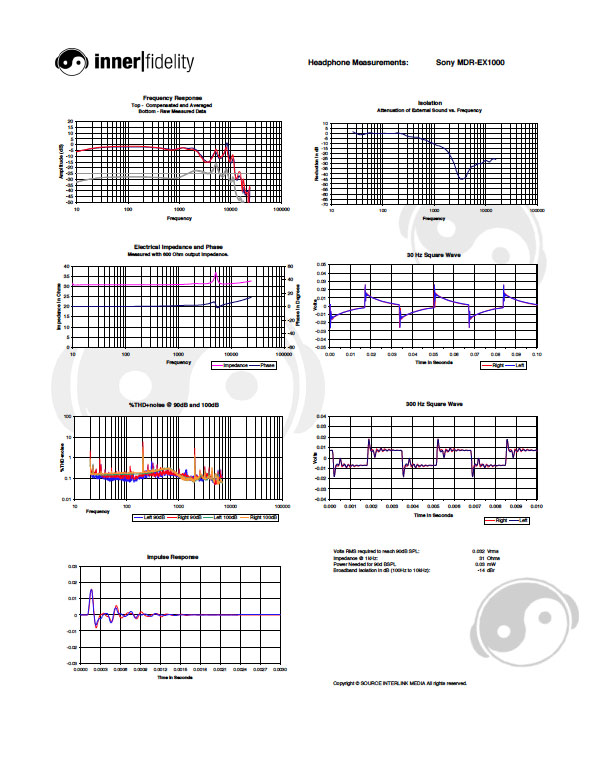
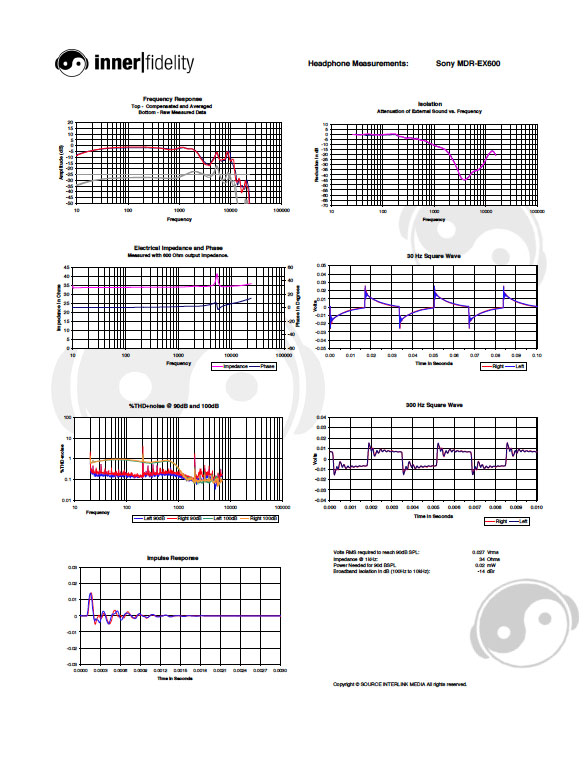
The frequency response of both headphones is very flat from 10Hz to 2kHz, and then starts a bit of a humpty bump ride through the treble. Both cans have peaks at 5kz and 9kHz, with the EX1000 9kHz peak about 5dB louder than its sibling. Both roll off fairly strongly over 12kHz. It is interesting to compare the bump between 1kHz and 2kHz of both Sony IEMs with a similar feature on the Audeo PFE w/grey filter and the Etymotic ER4PT, which seems to indicate the Sony cans as a bit less mid-forward and more neutral. I did listen to the Audeo and Etymotic during listening tests and did think I preferred the Sony in terms of its mid to bass balance. The Audeo and Etymotic were cleaner sounding with less grain, however.
A good neutral IEM is hard to find, and these two Sony IEMs certainly fill that spot fairly well. Their only sonic downfall is some grain in the treble, and some edginess with the EX1000 on poor sources. Poor isolation of these cans may be a plus for those wanting to keep a little situational awareness in busy urban environs.
 I ended up really liking the MDR-EX600 for its balanced character and ability to play well directly from portable sources. The Sony MDR-EX600 is a very good, general purpose in-ear headphone for computer and portable player use both at home and on the move. I'm happy to give these a strong recommendation.
The MDR-EX1000 is a better sounding headphone ... but not by twice and a half as the price would suggest. Yes, the materials of construction are better, but they don't sound much different, and actually often sound worse directly out of a portable. If you've got an iPhone with a good amp they may be worthwhile, but personally I'd go with a Shure SE535 or one of the lower end JH audio custom in-ear headphones. However, if you've got a sweet portable rig, and want a very neutral headphone, as opposed to the somewhat elevated bass of the Shure or JH Audio, they're probable a good choice. So, I'll give them a guarded recommendation --- they'll be worth it for the right ears if you've got a healthy wallet.
Resources after the video!
Resources
I ended up really liking the MDR-EX600 for its balanced character and ability to play well directly from portable sources. The Sony MDR-EX600 is a very good, general purpose in-ear headphone for computer and portable player use both at home and on the move. I'm happy to give these a strong recommendation.
The MDR-EX1000 is a better sounding headphone ... but not by twice and a half as the price would suggest. Yes, the materials of construction are better, but they don't sound much different, and actually often sound worse directly out of a portable. If you've got an iPhone with a good amp they may be worthwhile, but personally I'd go with a Shure SE535 or one of the lower end JH audio custom in-ear headphones. However, if you've got a sweet portable rig, and want a very neutral headphone, as opposed to the somewhat elevated bass of the Shure or JH Audio, they're probable a good choice. So, I'll give them a guarded recommendation --- they'll be worth it for the right ears if you've got a healthy wallet.
Resources after the video!
ResourcesSony store pages for the MDR-EX1000 and MDR-EX600.
Head-Fi threads on the MDR-EX600 here, here, and here.
Head-Fi threads on the MDR-EX1000 here, here, and here.















