

Sidebar 3: Measurements
I used DRA Labs' MLSSA system and a calibrated DPA 4006 microphone to measure the loudspeaker's frequency response in the farfield and an Earthworks QTC-40 mike for the nearfield responses, using the Sony SA-Z1's single-ended analog inputs. I also used the Earthworks microphone to measure the Sony speaker's farfield responses with the TosLink digital input.
Looking first at the digital inputs, the TosLink optical input accepted S/PDIF data sampled at rates up to 96kHz. The USB port operated in the optimal isochronous asynchronous mode, and Apple's USB Prober identified the system as "SA-Z1" from "Sony Corporation." The Mac's AudioMIDI utility revealed that the SA-Z1's USB input accepts 16-, 24-, and 32-bit integer data sampled at all rates from 44.1kHz to 768kHz.
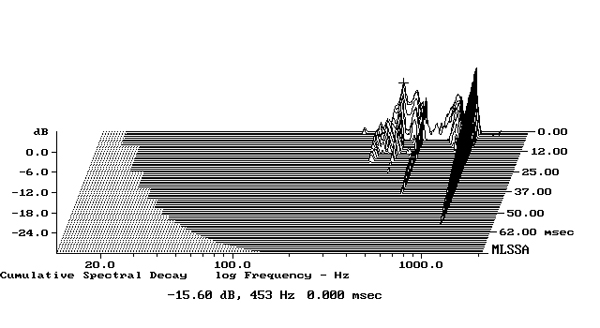
When I investigated the enclosure's vibrational behavior with a plastic-tape accelerometer, I found two resonant modes, one at 453Hz and the other at 1102Hz, on the top panel midway between the front baffle and the step up to the display and controls (fig.1). Only the higher-frequency mode was present on the sidewalls. Because of the low level and very high Q (Quality Factor), these modes should not affect sound quality.
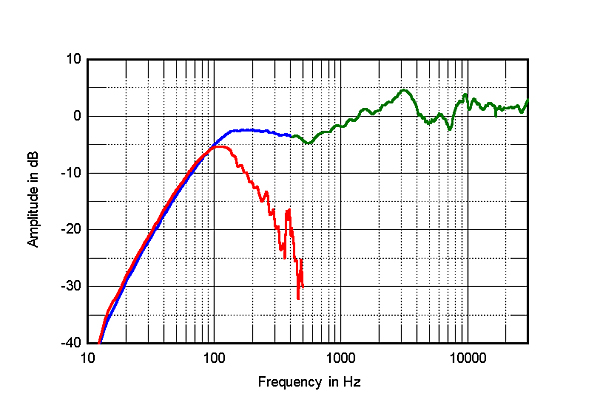
 The Sony's farfield response, taken from the unbalanced analog input and averaged across a 30° horizontal window centered on the central tweeter axis, is shown as the green trace above 500Hz in fig.2. The tilt upward from the midrange through to the low treble is due to the freefield placement. With the reinforcement from the nearby boundaries in typical use, the SA-Z1's lower midrange and low frequencies will be boosted to better match the treble. (If it didn't have that upward tilt, the Sony would sound too warm sitting on top of a desk.) The mid- and high-treble regions are even, although, all things being equal, that peak in the presence region will be audible (footnote 1).
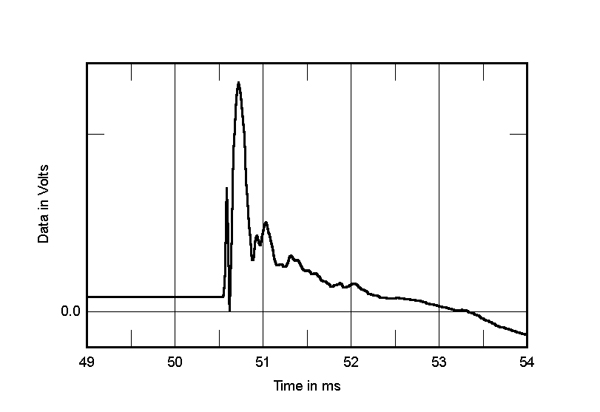
 In the time domain, the Sony SA-Z1's step response on the central tweeter axis (fig.7), taken with the unbalanced analog input, indicates that all the drive-units are connected in positive acoustic polarity. Note the horizontal scale in this graph: The latency of the SA-Z1's digital circuitry means that the signal doesn't arrive at the microphone until 50.5ms rather than the usual 3.5ms (footnote 2). The tweeters' step arrives first at the microphone, followed by the woofer's step. While switching to "Delay" and "Advance" didn't change the shape of the step response for the analog inputs, with the TosLink digital input, the tweeters' output moves forward or back in time a little with the "Advance" and "Delay" settings.
Footnote 1: Interference between the tweeters' direct sound and sound reflected from a desktop will alter the response in the kHz range.—Editor Footnote 2: I average 64 individual captures to calculate a loudspeaker's step response in order to minimize the effect of ambient noise. Nevertheless, the apparent DC offset in this graph is due to the build up of low-frequency noise during the very long time window used for this measurement.
Footnote 3: See, for example, my September 2013 review of the Sony SS-NA2ES.
Fig.1 Sony SA-Z1, analog input, volume control set to –6.0dB, cumulative spectral-decay plot calculated from output of accelerometer fastened to center of side panel (MLS driving voltage to speaker, 230mV; measurement bandwidth, 2kHz).
Sony's SA-Z1 system is intended to be placed on a desktop, with at least one room boundary close by. Given the arbitrary implications of this placement—How big is the desk? How far away are the walls?—I performed my usual freefield measurements with one of the speakers sitting on a high stand so that its central tweeter was 52" high, midway between the room's floor and ceiling.
With an analog signal of white noise at 500mV and the SA-Z1's volume control set to its maximum, the Sony produced a B-weighted SPL of 83.4dB at my usual 50" microphone distance. As a typical CD player's maximum input signal is 12dB higher (2V), the Sony's analog inputs have sufficient headroom for its intended use.
Fig.2 Sony SA-Z1, analog input, anechoic response on central tweeter axis at 50", averaged across 30° horizontal window and corrected for microphone response (green), with the nearfield responses of the front woofer (blue) and slot-loaded rear woofer (red) plotted below 500Hz.
The blue trace below 500Hz in fig.2 shows the nearfield response of the front woofer, with its level matched to the speaker's farfield output at that frequency. The usual boost in the response in the upper bass, due to the nearfield measurement technique, is absent, and the woofer rolls off below 100Hz with a sealed-box slope of 12dB/octave. Again, the low frequencies will be extended somewhat with the expected boundary reinforcement. The red trace in fig.3 shows the nearfield response of the rear-facing woofer, which fires through the 4" high × 0.75" wide slots on the speaker's sidewalls. It reinforces the front woofer's output below 120Hz or so but rolls off above that frequency.
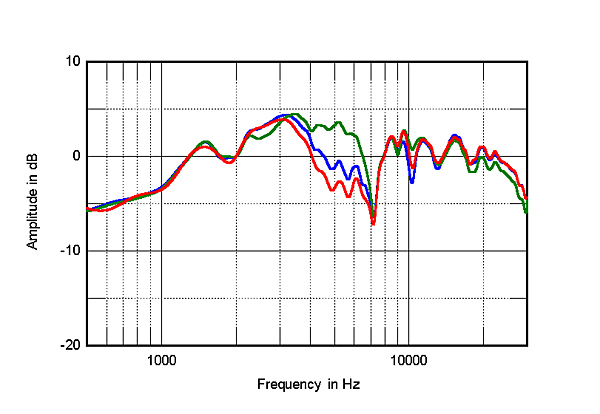
Fig.3 Sony SA-Z1, TosLink digital input, anechoic response on central tweeter axis at 1m, with A.TW ALI knob set to "Sync" (blue), "Advance" (green), and "Delay" (red) (5dB/vertical div.).
All the measurements so far were taken with the unbalanced analog inputs. The SA-Z1's DSP functions are accessible for the S/PDIF and USB digital inputs. Fig.3 shows the effect from 500Hz to 30kHz of the A.TW ALI knob set to "Sync" (blue trace), "Advance" (green), and "Delay" (red), taken with the TosLink input. (Note the expanded vertical scale in this graph.) The sharply defined suckout at 7.1kHz is consistent in all three conditions, as it was with the analog input. The "Delay" setting increases the level between 4kHz and 7kHz by up to 5dB. Conversely, the "Advance" setting depresses the same region by 2dB or so.
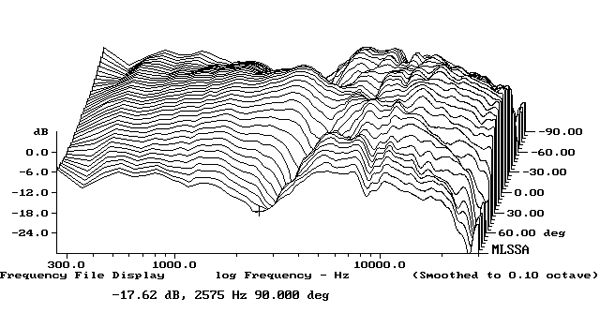
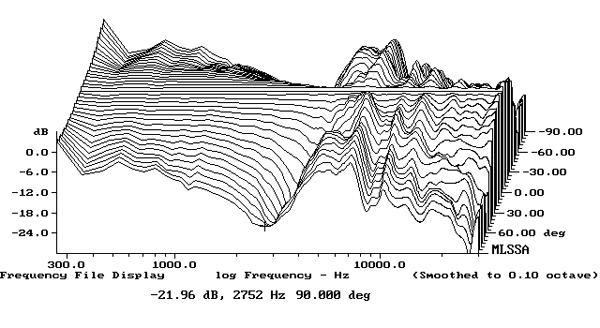
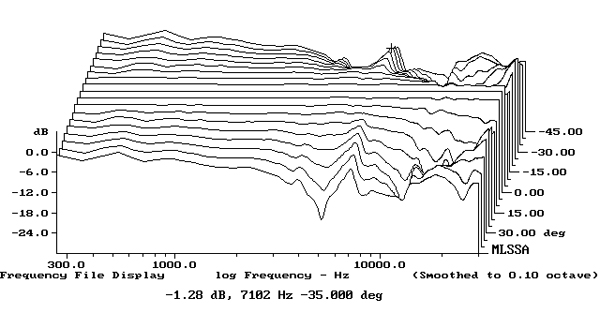
Figs.4 and 5 reveal the Sony's horizontal radiation pattern. The actual responses are shown in fig.4; the off-axis responses normalized to the response on the central tweeter axis, which thus appears as a straight line in the center of the graph, are shown in fig.5. Interpreting these two graphs is difficult, but the on-axis peak in the presence region does diminish to the speaker's sides, while the suckout just above 7kHz fills in to some extent. These two graphs suggest that experimenting with toe-in will optimize the SA-Z1's treble balance. The Sony's vertical dispersion is shown in fig.6, with the differences in the off-axis responses shown up to 45° above and below the response on the central tweeter axis. Despite its use of a vertical array of three tweeters, the SA-Z1 maintains its top-octave balance almost over a ±10° window. You shouldn't worry if your home-office chair places you a little above the Sony's central tweeter.
Fig.4 Sony SA-Z1, analog input, lateral response family at 50", from back to front: responses 90–5° off axis, response, on central tweeter axis, responses 5–90° off axis.
Fig.5 Sony SA-Z1, analog input, lateral response family at 50", normalized to response on central tweeter axis, from back to front: differences in response 90–5° off axis, reference response, differences in response 5–90° off axis.
Fig.6 Sony SA-Z1, analog input, vertical response family at 50", normalized to response on central tweeter axis, from back to front: responses 45–5° above axis, reference response, responses 5–45° below axis.
Fig.7 Sony SA-Z1, analog input, step response on central tweeter axis at 50" (5ms time window, 30kHz bandwidth).
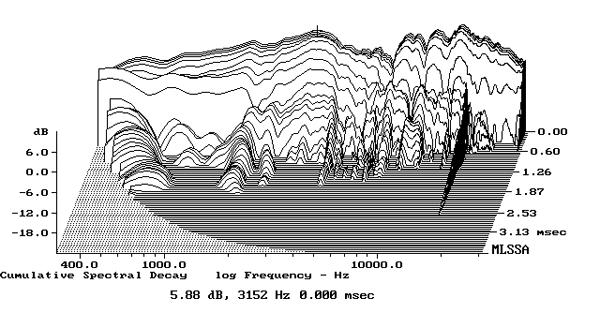
Finally, the Sony SA-Z1's cumulative spectral-decay plot, taken with the analog input (fig.8), is relatively clean in the midrange but a little hashy in the treble. The latter might be due to the use of three tweeters and the possible interference between their outputs and that of the woofer behind them. (As always with my CSD plots, ignore the small ridge just below 17kHz, which is due to interference from the computer's video card.)
Fig.8 Sony SA-Z1, analog input, cumulative spectral-decay plot on central tweeter axis at 50" (0.15ms risetime).
Sony has an impressive pedigree in conventional loudspeaker design (footnote 3), so I was intrigued to see how a specialized design like the SA-Z1 would perform in the test lab.—John Atkinson
Footnote 1: Interference between the tweeters' direct sound and sound reflected from a desktop will alter the response in the kHz range.—Editor Footnote 2: I average 64 individual captures to calculate a loudspeaker's step response in order to minimize the effect of ambient noise. Nevertheless, the apparent DC offset in this graph is due to the build up of low-frequency noise during the very long time window used for this measurement.















