

Sidebar 3: Measurements
I used DRA Labs' MLSSA system and a calibrated DPA 4006 microphone to measure the Sony SS-NA5ES's frequency response in the farfield, and an Earthworks QTC-40 for the nearfield. My estimate of the Sony's voltage sensitivity was 86.7dB(B)/2.83V/m, which is very slightly higher than the specified 86dB. The SS-NA5ES's electrical impedance is specified as 4 ohms, but, as can be seen in fig.1 (solid trace), the impedance remains above 4 ohms at all audio frequencies other than the lower midrange, where it reaches a minimum value of 3.4 ohms at 220Hz. However, the electrical phase angle (dotted trace) is extreme at some frequencies—there is a combination of 5 ohms and –40° at 130Hz—and the speaker will thus sound best when used with amplifiers that are comfortable driving 4 ohms.

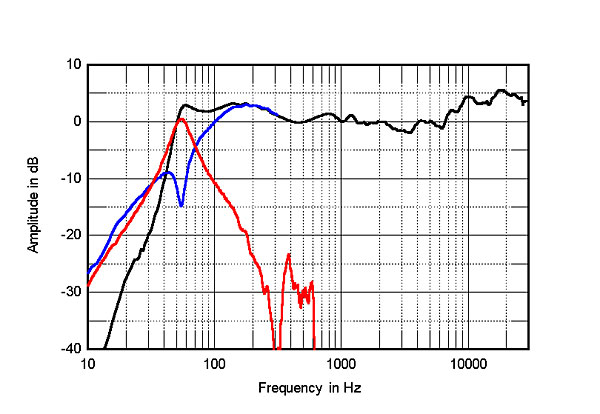
 The saddle centered on 55Hz in the impedance-magnitude plot (fig.1, solid trace) suggests that this is the tuning frequency of the twin 1.5"-diameter reflex ports on the Sony's rear panel. The blue trace in fig.3 shows the woofer's output, measured in the nearfield, and it does indeed have a sharply defined notch at 55Hz, where the back pressure from the port resonance holds the cone still. The port's output (red trace) peaks sharply between 40 and 70Hz, suggesting that the woofer alignment is of fairly high Q; and the black trace, which shows the complex sum of the woofer and port outputs, scaled in the ratio of the square roots of their radiating areas and taking into account the time delay caused by the ports being mounted on the cabinet's rear, does have a slight residual peak. Though there are a couple of peaks in the ports' midrange output, these are well down in level.
The underdamped woofer alignment presumably gives the impression that the SS-NA5ES has more bass than its 55Hz tuning frequency would suggest; I suspect that the excess of energy above 8kHz in fig.3 is intended to balance the low frequencies. But other than that, the Sony's farfield response on the central tweeter axis is superbly flat from 300Hz to 8kHz. This graph was taken without the grille, which introduced a 4dB peak between 4 and 5kHz, and a 6dB suckout centered at 6.5kHz; for serious listening, the grilles are best discarded.
The saddle centered on 55Hz in the impedance-magnitude plot (fig.1, solid trace) suggests that this is the tuning frequency of the twin 1.5"-diameter reflex ports on the Sony's rear panel. The blue trace in fig.3 shows the woofer's output, measured in the nearfield, and it does indeed have a sharply defined notch at 55Hz, where the back pressure from the port resonance holds the cone still. The port's output (red trace) peaks sharply between 40 and 70Hz, suggesting that the woofer alignment is of fairly high Q; and the black trace, which shows the complex sum of the woofer and port outputs, scaled in the ratio of the square roots of their radiating areas and taking into account the time delay caused by the ports being mounted on the cabinet's rear, does have a slight residual peak. Though there are a couple of peaks in the ports' midrange output, these are well down in level.
The underdamped woofer alignment presumably gives the impression that the SS-NA5ES has more bass than its 55Hz tuning frequency would suggest; I suspect that the excess of energy above 8kHz in fig.3 is intended to balance the low frequencies. But other than that, the Sony's farfield response on the central tweeter axis is superbly flat from 300Hz to 8kHz. This graph was taken without the grille, which introduced a 4dB peak between 4 and 5kHz, and a 6dB suckout centered at 6.5kHz; for serious listening, the grilles are best discarded.
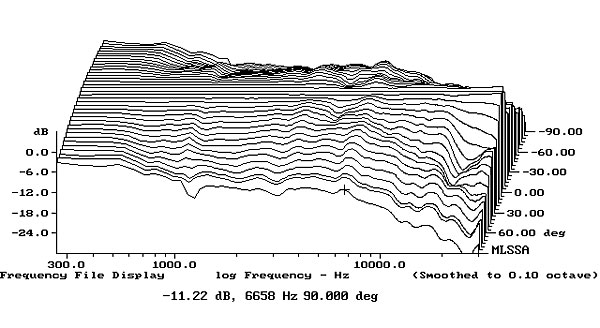
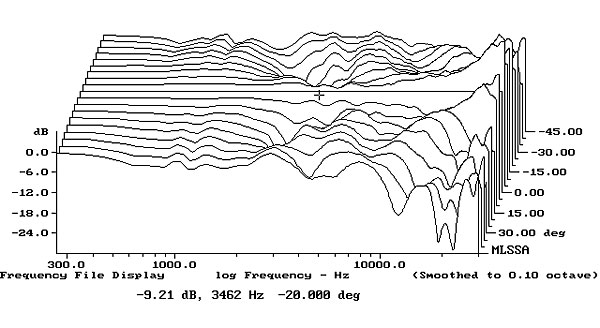
 The SS-NA5ES's lateral dispersion (fig.4) is superbly evenly balanced—something that correlates with precise, stable stereo imaging—with no off-axis flares or suckouts evident. The speaker does become more directional above 7kHz, which, in rooms that are not too small or dry, will tend to work against the top-octave boost on-axis becoming too audible, as AD found. In the vertical plane (fig.5), suckouts develop in the crossover region more than 10° above and below the central tweeter axis, and the use of multiple tweeters does give rise to a complex radiation pattern above 4kHz.
 In the time domain, the Sony's step response (fig.6) indicates that all four drive-units are connected in positive acoustic polarity. While the combined outputs of the three tweeters—the sharp up/down spike at the 3.7ms mark—leads that of the woofer, the delay of the tweeters' step smoothly blends into the start of the woofer's step, indicating optimal crossover design. The SS-NA5ES's cumulative spectral-decay plot (fig.7) reveals a superbly clean decay throughout the midrange and treble. While the cursor indicates a small ridge of delayed energy at 1200Hz, this is well down in level.


Fig.1 Sony SS-NA5ES, electrical impedance (solid) and phase (dashed) (5 ohms/vertical div.).
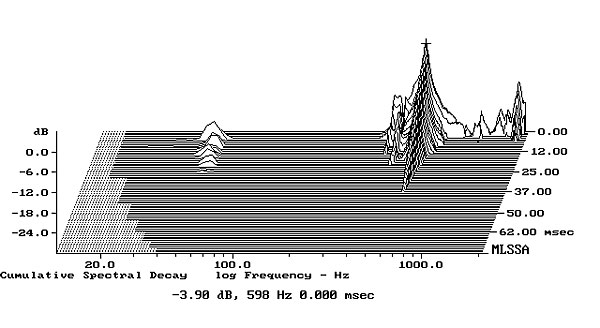
The impedance traces are free from the small wrinkles that would imply the presence of enclosure resonances of various kinds. When I investigated the cabinet walls' vibrational behavior with an accelerometer, I did find a relatively strong resonant mode at close to 600Hz on both sidewalls (fig.2). However, this resonance is of sufficiently high frequency and Quality factor (Q) that it shouldn't affect the speaker's midrange character.
Fig.2 Sony SS-NA5ES, cumulative spectral-decay plot calculated from output of accelerometer fastened to center of side panel (MLS driving voltage to speaker, 7.55V; measurement bandwidth, 2kHz).
Fig.3 Sony SS-NA5ES, anechoic response on central tweeter axis at 50", averaged across 30° horizontal window and corrected for microphone response, with nearfield responses of woofer (blue), port (red), and their complex sum (black), respectively plotted below 300Hz, 625Hz, and 300Hz.
Fig.4 Sony SS-NA5ES, lateral response family at 50", normalized to response on central tweeter axis, from back to front: differences in response 90–5° off axis, reference response, differences in response 5–90° off axis.
Fig.5 Sony SS-NA5ES, vertical response family at 50", normalized to response on central tweeter axis, from back to front: differences in response 45–5° above axis, reference response, differences in response 5–45° below axis.
Fig.6 Sony SS-NA5ES, step response on central tweeter axis at 50" (5ms time window, 30kHz bandwidth).
Fig.7 Sony SS-NA5ES, cumulative spectral-decay plot on central tweeter axis at 50" (0.15ms risetime).
Like Sony's more expensive, floorstanding SS-NA2ES, which I reviewed in September 2013, the SS-NA5ES is a well-engineered loudspeaker.—John Atkinson















