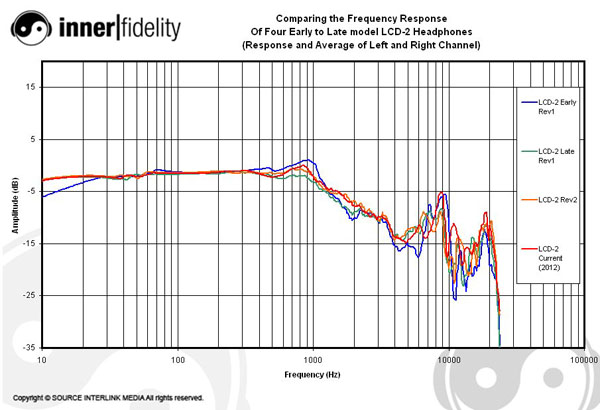
LCD-2 measurements taken of the various iterations over last couple of years.
Before we get to the current headphone measurements, I thought it would be interesting to have a look at the evolution of these headphones over time. In the graph above you'll see the measurements of the various iterations of the LCD-2. The blue trace is the original LCD-2. You'll note that it falls off at the very lowest frequencies a bit more then the others, this is likely the somewhat stiffer pads not providing the quality seal of the softer subsequent pads.
In the region around 1kHz you can see the original LCD-2 had a bit of a presence bump. The Rev. 2 reduced this bump, but probably by a bit too much. The later revisions shoot right down the middle and remain more linear on their way down to 5kHz. (This sloping response from ~2kHz to ~5kHz is desired) From 5kHz to 11kHz, the Rev. 1 headphone exhibits a strong peak, the remaining cans tend to perform a little more linearly in this area. In the very top octave between 10kHz and 20kHz you can see the overall amount of energy slowly rising over time in the various revisions, likely in response to customers comments of "shelved" highs. The overall trend over time is toward a better behaved headphone and to me indicates a fairly good grip on the part of Audeze of the physics and workings of their headphones.
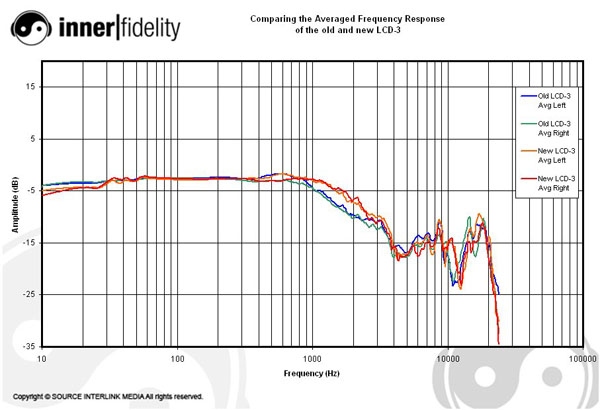
This graph shows the frequency response of the average of four LCD-3s from the initial release plotted next to the average of three different LCD-3s in the current iteration of the product.
The release of the LCD-3 was greeted with much fanfare at the 2011 CanJam at RMAF. The new cans were clearly faster and more lively sounding than the LCD-2, while keeping and improving on the yummy lushness of the breed. However, subsequent experience of customers and vigorous dialog on Head-Fi drew out the conclusion that the sound of the new LCD-3 was varying substantially and drivers were suffering from reliability issues. The gents at Audeze were quick to respond: driver problems were solved; customers who had problems had their headphones quickly replaced; and then they took their responsibilities a giant step further and retroactively increased the warranty on all Audeze headphones to three years.
What the nature of the problem was is known only to the folks at Audeze, but I did get the chance to measure numerous early LCD-3s and have measured three of the current versions. In the graph above, I've averaged all the early LCD-3s together and plotted that against the average of three current LCD-3s. You can see there is now a bit of a wiggle in the lowest octave or two. I suspect this comes from either a change in the compliance of the pads, or a change in the damping materials behind the driver. I'm finding more and more that I like headphones that extend a little flatter to about 2kHz before rolling off into the treble octaves. It seems to me the voices are more present and natural sounding. The current LCD-3 does a substantially better job than the initial version in this regard being a few dB louder between 1kHz and 3kHz. Details in the frequency response curve above 5kHz can be quite noisy and erratic, but because these curves are averages of many headphones they may be reliable enough to believe the notch at about 11kHz is narrower with the later headphones.
Again, these data show Audeze working to improve the product, and demonstrate they have developed a significant degree of mastery in the design of their planar magnetic headphones.
Measurements of Current Audeze Headphones
Audeze LCD-2
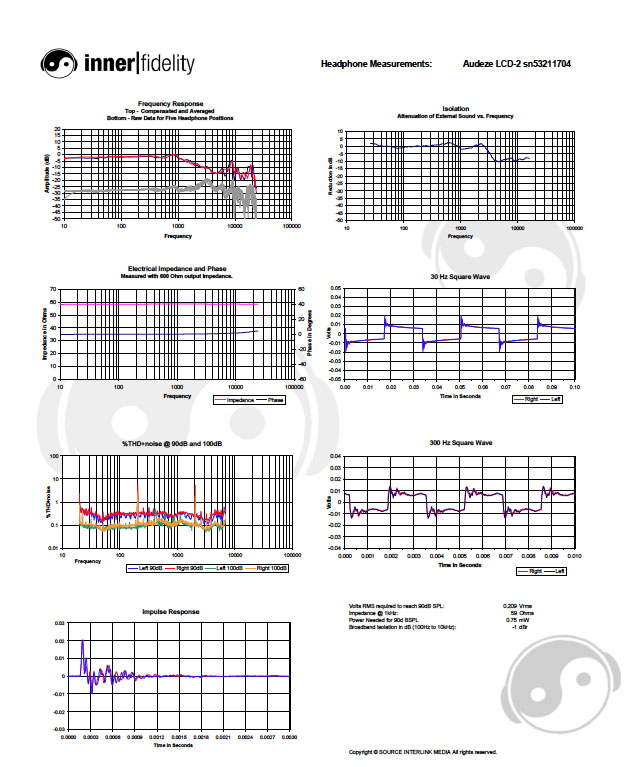
Click on graphs image to download .pdf for closer inspection.
Audeze LCD-3
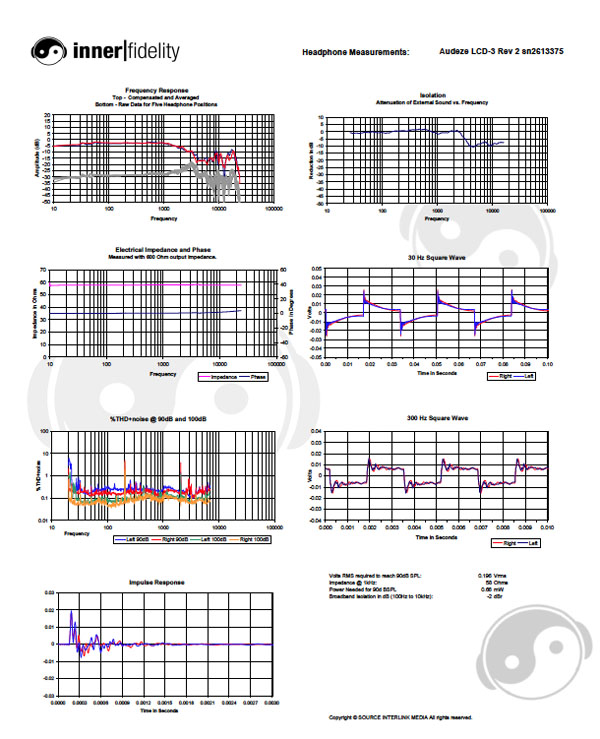
Click on graphs image to download .pdf for closer inspection.
Good stability on the lowest octaves in the raw frequency response measurements of the LCD-2 and LCD-3 show earpads seal reliably. Small variations in raw frequency response with position changes begin at about 300Hz with the LCD-2 and at about 1kHz with the LCD-3 indicating there may be slightly less positional sensitivity with the LCD-3.
Compensated frequency response of the LCD-2 shows a small presence bump at about 900Hz where the LCD-3 turns the corner at a slightly higher frequency and with a smoother response. The LCD-2 also has a larger peak at 9kHz than the LCD-3. These may be indicative of the slightly dryer and grainier sound I heard with the LCD-2 in listening tests. However, both headphones have lower peaks at 9kHz than most headphones and are heard to me as smooth and liquid when compared to many other cans.
After looking at this 9kHz bump and lack thereof with other planar headphone designs, I'm beginning to think the closer to a point source a driver is, the more likely it will exhibit this bump. I'm thinking this artifact comes from changes in the magnification of these frequencies in the concha bowl of the ear. Pure speculation, but I'm gonna keep an eye on it.
The slight bowing of the 30Hz square wave and slight drop-off in the lows of the LCD-3 when compared with the LCD-2 would indicate tighter bass performance of the latter. I didn't hear it that way in the listening tests, and both exhibit very good performance in the low frequencies of the THD+noise plots. (The LCD-3 THD+noise plot is a little noisy down low, but I think that was probably due to some environmental noise during tests and should be discounted.) I came to the conclusion that the bass in the LCD-3 was slightly more articulate and textured, but I think we'll find many who like the bass of the LCD-2 better. Either way, the measured low frequency performance of both these cans is stunning.
The THD+noise plots also show very low levels of distortion. Some of the Stax and HiFiMAN headphones came close, but these are the best (lowest) distortion plots I've seen. Also worth noting is that the 100dBspl THD+noise plot remains entirely below the 90dBspl plot indicating these headphones can handle power very well, which was clearly heard during listening tests.
The double bump of the leading edge of the 300Hz square wave of the LCD-2 is typical of the new generation of planar magnetic headphones, and my assumption is that it's related to the sound getting through the rather large magnet structure that surrounds the diaphragm. I think this double-bump feature leads to a reduction in the ability of the headphones to image well due to the ear not having a clear leading edge from which to extract timing information. This seems to have been significantly reduced in the LCD-3 where the second bump is significantly reduced. I've come to the conclusion that a slight overshoot of the leading edge is desirable, and I think the LCD-3 comes very close to what I'd like to see in a 300Hz square wave response.
Impulse responses look speedy but somewhat noisy. This rather surprises me as the 300Hz square wave is fairly clean. So I checked out Head-Fi member
Purrin's LCD-3 cumulative spectral decay plots that should have shown some ringing given what the impulse response looks like, and he observes very little.
But, oddly enough, he, too, commented on significant ringing in the impulse response, but little evidence of the problem in the CSD plots. A perfect example of measurements not being able to tell the whole story, or even be internally consistent, at times.
Impedance and phase plots are essentially ruler flat--like all planar magnetics. At about 60 Ohms impedance and 200mVrms required to drive these cans to 90dBspl, these are not headphones to drive out of your iPhone or iPad. Isolation is very low. No, these are not commuter headphones.
Take a good look at these measurements, you're not going to see many better.
Resources
Audeze
website and
LCD-2 and
LCD-3 product pages.
Head-Fi has dozens of threads on these two headphones, here's a couple for the latest
LCD-2 and
LCD-3,
let me Google the rest for you.
Steve Guttenberg thinks they're great, too.