

40 years ago—"is the English way"...
The TDA 1034 is as asymmetrical as most op-amps, and there wasn't any symmetrical or bridged circuitry in the Pro4's myriad signal paths. Even the coupling capacitors were DC-biased, which like synth pads in deep ambient house music, and the Hammond B3 before, inject warm harmonics dynamically—a discovery made about biased capacitors, but possibly misunderstood, 25 years later, by Cyril Bateman.
Soon, big consoles could be more compact and might need a smaller crew to move them. But the use of dual and quad op-amps that helped enable this, we now know cannot have helped music purity. With the Floyd shows, audiences were often ear/awe-struck into silence—low-level details like reverb tails were as audible as in high-end home listening. Being also a recording console, a vinyl detective could track down which studios used this later TDA-based Midas Pro4, and figure which albums were recorded through it.
A decade later, Pink Floyd serially toured the world with seismic diva Durga McBroom on backing vocals and advanced English Turbosound horn speakers on PA, driven by EPC-780 amplifiers designed by genius Stan Gould (who also disappeared), guided by the author. The maker, BSS, was an offshoot of Midas. Inside was an Asymmetric bridge...aha!, operating in progressive class-A, then rich class-A/B then -G/H. With MOSFETs.
With pleasant sonics and orgasmic dynamics to match. "High Fidelity/first class" defines 40 years of Pink Floyd live shows.—Ben Duncan
The Author

Electronics for the greatest hi-fi show on earth
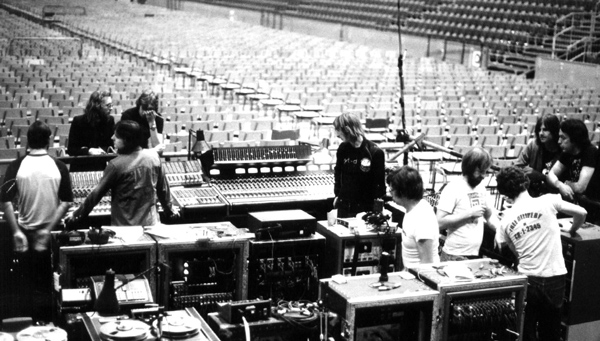
It's the 8th of August 1980 and Ben Duncan (top left), hand resting on his famous investigative clipboard, is leaning against the Pink Floyd The Wall concerts' huge front-of-house mixing setup, inside Earls Court, West London. The crew are getting ready for sound-check. It's the second night of a world tour, and there have been some teething problems. In front of the alleyway of racked outboard equipment, are an amazing 105 channels made with joined-up English Midas Pro4 consoles. These were built like tanks, lit like Las Vegas on tranquilizers (yellow illuminated meters, red and green LEDs galore, and UV-sensitive legend), with perfectionist metalwork and electronics engineering.
The heroic main designer, burnt-out by the feat, vanished. Like an echo of Syd Barrett.
Looking at the vast and inspiring schematics, gifted to the author in a Surrey country pub's yard a few months later by Midas's CEO Dave Solari, the Pro4 was years ahead of others, designed mid-1970s and updated in '78 with the new Mullard TDA 1034 single op-amp, an English/Dutch secret weapon, being the first op-amp made for serious audio. At about $80 a pop, today. Later cased in plastic and renamed NE5534 when production moved to Signetics' factory in US, which Mullard/Philips had acquired.
Millions of humans worldwide can attest to the sonic quality of a Pink Floyd show. Even Iron Maiden (who were doing their first tour at the time) cannot come close for dynamics and bombast.
40 years on—Ben Duncan busy working on a new product.
Ben Duncan began inventing, designing, making, modifying and mending electrical, electronic and audio equipment at age 9. This has not stopped. At boarding school, he took over the physics lab. Skip to 1978, BD was projected into the vanguard of pro-audio, publishing articles in magazines, designing a giant road-going tractrix horn, and making sonically superior equipment using TDA1034 ICs—aided by colleague Harry Day, bespoke mixing console maker, who imported them from the factory in Holland.
Ben Duncan soon met and worked with London's topnotch (read: audiophile) PA system operators and their sound engineers—them on never-ending tours across England, Europe or the US/the World, with an A–Z of UK and US artists. This lead to designing and contributing to, many of Britain's best-regarded professional power amplifiers, working with Jerry Mead, Stan Gould, and others.















