

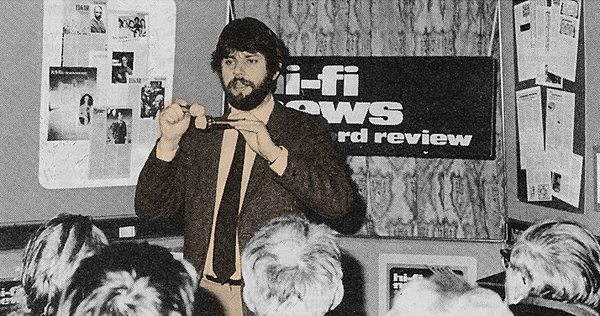
The author demonstrating stereo microphone techniques at an English audio show in 1981.
For most people the terms hi-fi and stereo are synonymous, and yet it is clear that there is still a great deal of confusion over what the word "stereo" actually means. There isn't even a consensus of opinion amongst producers of records, designers of hi-fi equipment, audio critics and music lovers as to the purpose of stereo, and considering that the arguments show no sign of diminishing in intensity, it is instructive to realise that 1981 sees both the 100th anniversary of Clement Ader's first stereo experiments and the 50th anniversary of Alan Blumlein's classic patent on stereo.
Ader placed telephone microphones in two groups, left and right, on the stage of the Paris Opera and subscribers listened on headphones to the twin signal which was transmitted over telephone lines. Blumlein's work was still experimental, but more theoretical in that it examined exactly what directional information needs to be preserved on a two-channel system in order that an accurate aural picture can be recreated using two loudspeakers.
Sound-Source LocationBefore wading deeper into the morass of conflicting opinion, it is worth a look at how a human being perceives the direction of real-life sound-sources. Although the eyes undoubtedly play a major role in determining such directions, the ears provide an essential and evolutionary desirable backup. Any caveman out of his cave on a dark night, and incapable of hearing where that quiet lip-smacking noise (curiously like that made by a hungry sabre-toothed tiger) was coming from, wouldn't stand much chance of passing his genes on to future generations. And so the sabre-toothed tiger, having encouraged the existence of a human hearing mechanism to determine direction, could pass happily into extinction, its destiny fulfilled.
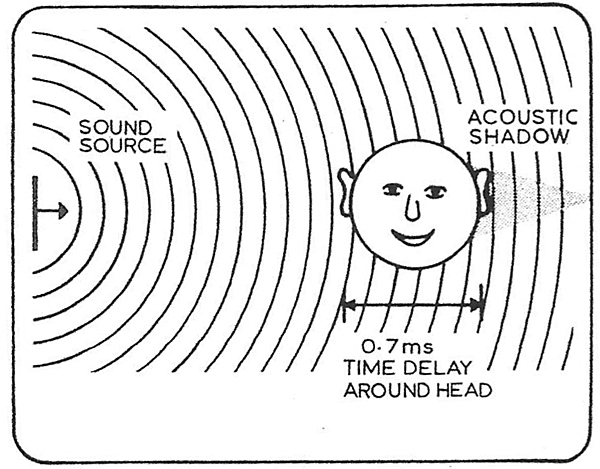
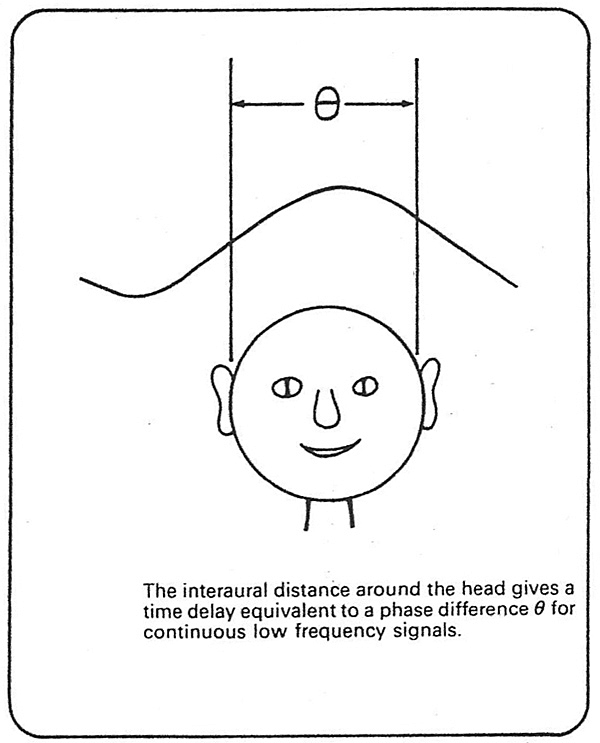
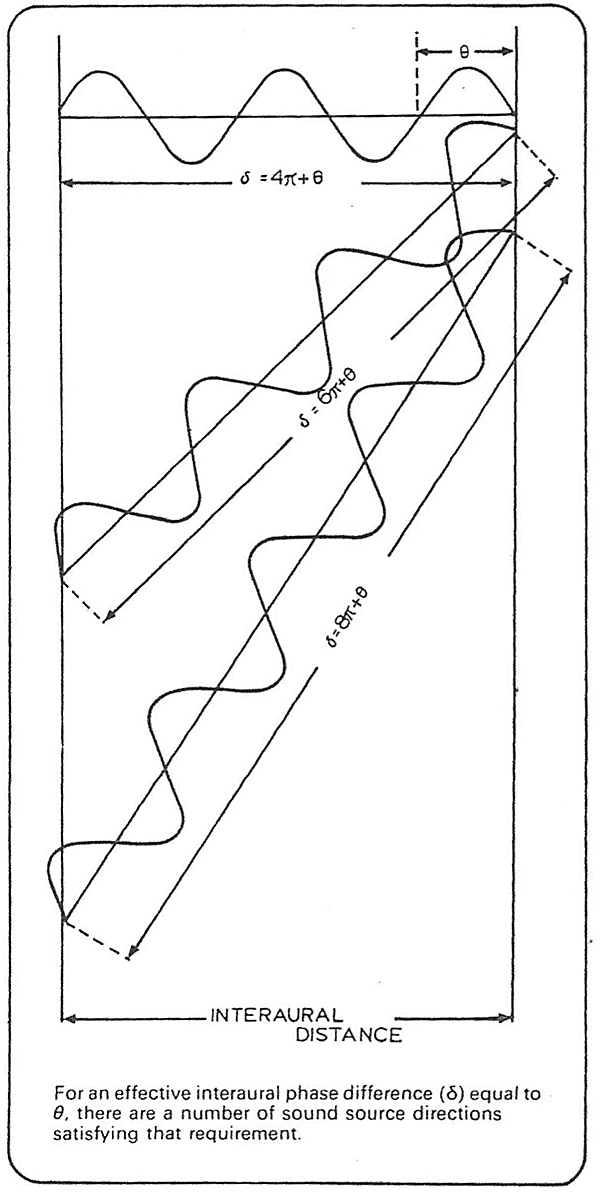 Above this critical frequency, fortunately, another mechanism starts to take over: the head increasingly casts an acoustic "shadow" when its size becomes of the order of, or larger, than the wavelength of the sound. The presence of this shadow means that an amplitude difference is introduced between the sounds perceived by the ears, enabling the brain to deduce the sound-source direction from the ratio of the two amplitudes. The pinnae further modify this amplitude difference with frequency, giving a direction-dependent spectral change which "sharpens up" the mechanism.
Obviously the amplitude and phase mechanisms will overlap over a range of frequencies dependent on head size, and reinforce each other until the frequency is such that the phase difference becomes totally ambiguous, apparently at around 1.2kHz for an average head. Above this frequency one has to rely on the amplitude mechanism alone for steady-state sounds, which has been shown to be less precise. However, if a transient occurs in an otherwise continuous high frequency waveform, then this is equivalent to dropping in an audio "marker" to give the brain some additional time delay information. The tiger treads on a stick and our caveman immediately has an unambiguous clue as to the tiger's direction, and lives to pass on the relevant hearing mechanism to his descendants. Without the transients, the brain has to try somehow to reinforce the weak amplitude difference clues and in fact the head is in constant slight motion, its side-to-side scanning enabling the brain to superimpose information about the rate-of-change of amplitude differences upon those same differences.
Above this critical frequency, fortunately, another mechanism starts to take over: the head increasingly casts an acoustic "shadow" when its size becomes of the order of, or larger, than the wavelength of the sound. The presence of this shadow means that an amplitude difference is introduced between the sounds perceived by the ears, enabling the brain to deduce the sound-source direction from the ratio of the two amplitudes. The pinnae further modify this amplitude difference with frequency, giving a direction-dependent spectral change which "sharpens up" the mechanism.
Obviously the amplitude and phase mechanisms will overlap over a range of frequencies dependent on head size, and reinforce each other until the frequency is such that the phase difference becomes totally ambiguous, apparently at around 1.2kHz for an average head. Above this frequency one has to rely on the amplitude mechanism alone for steady-state sounds, which has been shown to be less precise. However, if a transient occurs in an otherwise continuous high frequency waveform, then this is equivalent to dropping in an audio "marker" to give the brain some additional time delay information. The tiger treads on a stick and our caveman immediately has an unambiguous clue as to the tiger's direction, and lives to pass on the relevant hearing mechanism to his descendants. Without the transients, the brain has to try somehow to reinforce the weak amplitude difference clues and in fact the head is in constant slight motion, its side-to-side scanning enabling the brain to superimpose information about the rate-of-change of amplitude differences upon those same differences.
The genius of Alan Blumlein lay in his recognition that if the interaural phase differences are reproduced as amplitude differences between the signals fed to two loudspeakers, this alone is sufficient to define direction completely, provided the listener is equidistant from the two loudspeakers. If the listener is not equidistant the resulting additional time delay give conflicting information, with confusing and ambiguous results. John Crabbe covered the subject of off-centre stereo listening in great detail in his series of "Broadening the Stereo Seat" articles (HFN/RR, June/July/September 1979), and to avoid unnecessary complexity the use of the word "stereo" throughout this article will imply "central listener" exclusively. So, to precis Blumlein, for a central listener the perceived position of any sound-source can be represented by a precise ratio of the voltages fed to the two (identical) loudspeakers. If the voltages are equal, then we have the "double-mono" situation where the sound should appear to come from a point halfway between the two speakers. As a ratio is a dimensionless entity, the image produced by any such voltage-ratio should not occupy any space, but should be perceived as a point-source situated somewhere on the line joining the acoustic centres of the two speakers. Ideally, ignoring room effects, there would be no reason for the position of this point, or its lack of width, to change with frequency. As long as the program has been recorded in such a fashion that positions are faithfully represented by inter-channel voltage ratios—and there lies the rub—a central listener will perceive discrete images correctly positioned all the way along the line (actually an arc centred on the listener) joining the speakers.
Take, for instance, the argument put forward by Julian Hirsch in the October 1979 issue of Stereo Review. While agreeing that if a sound originates from a certain direction in space, then an ideal stereo recording would reserve that direction, he writes: "I do not experience this sort of definite localisation of sound when I attend a concert...I can usually tell if the source is at the right or left of the stage, or perhaps in the centre...Even when I have spotted the soloist visually, closing my eyes blurs his physical relationship to the rest of the orchestra."















