

"I want to redo that painting," the spouse declared. "It's too dark."
"What's wrong with dark?" I responded. "Rembrandt's portraits are often dark. So are the paintings of Courbet and Hobbema. Your color palette represents how you were feeling at the moment. If it's true to you and speaks strongly, why change it?"
Granted, depending upon how dark a painting is, a lack of bright areas may translate into less detail, hazy backgrounds, and a lack of vibrancy. But that doesn't mean that the painting will be less engaging or of less aesthetic value. It all depends upon what the artist is trying to achieve and how well they succeed.
The same holds true for the sonic pictures painted by audio equipment. Some of us may have specific preferences that attract us to certain palettes more than others. I, for example, who as a classical music critic have had the good fortune to sit in excellent seats at live performances, have grown accustomed to the direct, brightly illumined yet resonant sound afforded by first-bloom areas that are usually close to the stage. Farther from the stage, the highs drop off but the bass remains strong; for those used to such a presentation, more muted colors and less air and detail may more accurately reflect their experience.
A very different set of likes may exist for amplified music, where preferences are equally determined by the quality of the sound system, the choices and position of the engineer, and your distance from the speakers. As my friend Yvonne is wont to say, "It's all good." Depending upon what's coming down, that may very well be the case.
The T+A's PA 3100 HV
Let us contemplate T+A's PA 3100 HV class-AB integrated amplifier ($23,500). A solid, hefty, dual meter–adorned integrated amplifier whose high voltage configuration requires a 20A power cable, it includes a headphone amplifier designed for stereo headphones with a minimum impedance of 50 ohms. The PA 3100 HV can be ordered with three options: either an MM/MC phono stage ($1600); a field-installable "Analog Processor Module" ($2900), which offers room EQ and precision tone controls; and T+A's PS 3000 external power supply ($14,500). The latter, which is discussed below, requires a second 20A power cable and connects to the integrated via a supplied 1.5m umbilical cord long enough to enable optimal placement on a separate shelf. The only option included in my review sample was the MC phono board, which I was not equipped to review.
To get the skinny on the PA 3100 HV, I communicated frequently with T+A's James "Jim" Shannon. Shannon, whose title—export sales manager—offers little hint of his role interfacing with US audio magazines, joined the 43-year-old German company 16 years ago when its reputation had yet to spread beyond Europe.
Shannon told me early on that T+A—pronounced "T plus A"—stands for "Theorie und Anwendung," or, in English, "Theory plus Application." That sorted, Shannon noted that the PA 3100 HV is part of the company's top-of-the-line HV (for "high-voltage") series. A consequence of T+A's long history designing tube amplifiers, the HV series is an attempt to offer what Shannon described as "most of the benefits and sonic attributes of tubes while using solid-state devices." The impetus for the series grew out of T+A engineers' frustration with tubes that didn't last long enough and/or lacked the performance consistency essential for "serious and expensive" audio products, quoting Shannon.
"The HV series literally started out of an effort to replicate the tube performance of T+A's prior V (for valve) series," Shannon said. "One of the biggest factors that our engineers felt contributed to 'tube sound' was that valves require very, very high voltage power supply rails, which allow the tubes to operate in a much narrower, more linear, lower-distortion, lower-noise portion of their total transfer function. This is why T+A believes tubes can sound so dynamic and harmonically interesting. By utilizing solid state devices that also use very high-voltage power supply rails, T+A was able to get solid state components to operate in a similar, far more linear part of their transfer function." All HV-series products have high-voltage power supply rails that, Shannon claims, operate at up to three times the voltage level in "most similar solid state products."
The PA 3100 HV is a very wide–bandwidth, dual-mono design with minimal global feedback. Completely balanced from input to output, the unit is specified to deliver 300Wpc into 8 ohms and 500Wpc into 4 ohms. Depending upon the speaker load, the first 10–20W is delivered in pure class-A mode. With speakers of typical sensitivity, that's enough watts to cover almost all the music.
"We always have much wider bandwidth than many solid state amplifiers," Shannon said. "The PA 3100 HV's preamp section is neutral and flat up to approximately 300kHz, and the amplifier section is flat out to 150kHz. We believe very wide bandwidth is necessary so that the phase effects of high-frequency rolloff do not change the harmonic structure of the audible frequencies. Rolloff in the very high overtones of musical information has phase effects, which can change the harmonic character of much, much lower fundamental frequencies within the audio band.
"We also very carefully thermally manage each internal section of every HV product. Once a product warms up, since we know the perfect thermal environment for each particular gain stage, we manage bias voltages in such a way to keep each section at the absolute optimum operating temperature. That's not so often done in products of this type." After explaining that keeping the unit on 24/7 produced the most stable sound, and that the integrated had not been played much since it was manufactured, Shannon urged me to warm it up for a full week before listening. He also suggested that I keep it on all the time—and if I were to turn it off, to let it warm up for at least 20–30 minutes so it could reach and stabilize at its ideal operating temperature.
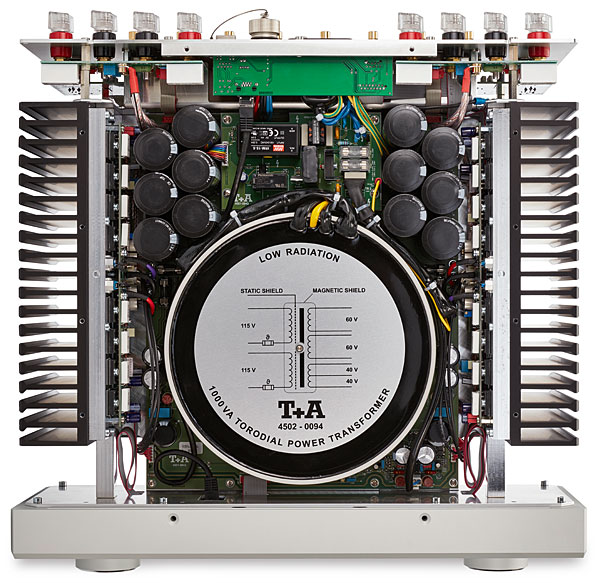 The PA 3100 HV's chassis is constructed of "massive" aluminum plate. Various subsections isolate each section from the others and enable, for example, the isolation of power output and power supply sections from the preamp section. T+A strives to distance all magnetic materials from the active gain stages. "There's a big toroid with a magnet in it that's on the bottom of the chassis and fully shielded from the actual gain stages by a ¼" thick piece of aluminum," Shannon said. "All components and connectors down to the screws, output connectors, and leads on resistors and capacitors in the signal path are custom-made to be completely nonmagnetic so that there's no effect of magnetism on sonic character. Our volume control is executed with precision resistor ladders, which guarantees that at any volume level, channel-to-channel tracking is identical as well as noise and distortion-free. Compared to the older style volume pots, our ladder control has far greater consistency and less noise and distortion at every volume setting. In addition, its hermetically sealed gold-contact relays ensure long-lasting operation."
The preamp section has its own, separate, fully regulated power supply, and the amplifier section has separate power supplies for its input and output stages. The input and output stage supplies can be further isolated from each other by using the optional PS 3000 power supply, whose umbilical cord attaches to a large Powerlink connector on the PA 3100 HV's rear panel.
"When connected to the PA 3100 HV, the PS 3000 supplies only the unit's output stage, leaving its internal power supply to handle the amplifier's voltage gain and input stages," Shannon declared. "This completely separates each power supply and makes it even less likely that a particular speaker load will affect the sonic character that is created in the input and voltage gain stages. The output stage simply delivers current to the loudspeaker. Separating the output and input stages can make an audible difference, especially with more challenging speaker loads. Your Wilson Alexia 2's are not a problem in this respect.
The PA 3100 HV's chassis is constructed of "massive" aluminum plate. Various subsections isolate each section from the others and enable, for example, the isolation of power output and power supply sections from the preamp section. T+A strives to distance all magnetic materials from the active gain stages. "There's a big toroid with a magnet in it that's on the bottom of the chassis and fully shielded from the actual gain stages by a ¼" thick piece of aluminum," Shannon said. "All components and connectors down to the screws, output connectors, and leads on resistors and capacitors in the signal path are custom-made to be completely nonmagnetic so that there's no effect of magnetism on sonic character. Our volume control is executed with precision resistor ladders, which guarantees that at any volume level, channel-to-channel tracking is identical as well as noise and distortion-free. Compared to the older style volume pots, our ladder control has far greater consistency and less noise and distortion at every volume setting. In addition, its hermetically sealed gold-contact relays ensure long-lasting operation."
The preamp section has its own, separate, fully regulated power supply, and the amplifier section has separate power supplies for its input and output stages. The input and output stage supplies can be further isolated from each other by using the optional PS 3000 power supply, whose umbilical cord attaches to a large Powerlink connector on the PA 3100 HV's rear panel.
"When connected to the PA 3100 HV, the PS 3000 supplies only the unit's output stage, leaving its internal power supply to handle the amplifier's voltage gain and input stages," Shannon declared. "This completely separates each power supply and makes it even less likely that a particular speaker load will affect the sonic character that is created in the input and voltage gain stages. The output stage simply delivers current to the loudspeaker. Separating the output and input stages can make an audible difference, especially with more challenging speaker loads. Your Wilson Alexia 2's are not a problem in this respect.
 "By very carefully isolating the PA 3100 HV's input and output stages, we can ensure a very consistent tonal character of the amplifier, regardless of speaker load. The PS 3000 will not make a significant tonal or harmonic change to the sound, but it will offer higher current and a greater sense of dynamic control. T+A doubts you're going to run into a situation where you'd think that the PA 3100 HV doesn't produce enough current or drive for most of today's loudspeakers, including your own. But if your room was big enough, the speaker load was extremely challenging, and the music was extremely dynamic, the upgraded power supply would allow greater control and deliver more dynamic performance."
Front, back, and beyond
"By very carefully isolating the PA 3100 HV's input and output stages, we can ensure a very consistent tonal character of the amplifier, regardless of speaker load. The PS 3000 will not make a significant tonal or harmonic change to the sound, but it will offer higher current and a greater sense of dynamic control. T+A doubts you're going to run into a situation where you'd think that the PA 3100 HV doesn't produce enough current or drive for most of today's loudspeakers, including your own. But if your room was big enough, the speaker load was extremely challenging, and the music was extremely dynamic, the upgraded power supply would allow greater control and deliver more dynamic performance."
Front, back, and beyond
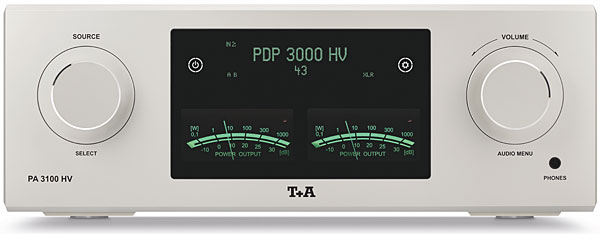
Given that the T+A PA 3100 HV's user manual is available online, as are very clear photos of the component outside and in, let's stick to what's most important about the unit's layout and operation. The front is dominated by left- and right-channel VU meters that display average, weighted RMS power. The meters flank source, volume, and audio-menu knobs and a central graphic display. The headphone jack is on the lower right. You can easily view volume level and source name from afar, but choice of input and speaker output are discernible only up close. If you engage the Monitor function, it appears in a separate box and flashes lest you select it accidentally and panic (as I did) when you can't figure out why there's no sound. Other small symbols indicate functions that are available when the optional modules are installed. Source and volume level can be set either by the two corresponding knobs and system configuration button on the unit's front or by the rationally laid out, easily operated remote control. Some audio settings can be chosen at the unit itself; the rest are accessible only by remote. Carrying the remote to the unit when you adjust settings brings the entire T+A universe within reach. You can adjust everything from source names and balance to panel illumination level—you can turn illumination off entirely—and configure it for use with surround decoders. You can also turn off headphone and speaker outputs that you're not using. All this makes the PA 3100 HV au courant in its range of settings and options.
Let us contemplate T+A's PA 3100 HV class-AB integrated amplifier ($23,500). A solid, hefty, dual meter–adorned integrated amplifier whose high voltage configuration requires a 20A power cable, it includes a headphone amplifier designed for stereo headphones with a minimum impedance of 50 ohms. The PA 3100 HV can be ordered with three options: either an MM/MC phono stage ($1600); a field-installable "Analog Processor Module" ($2900), which offers room EQ and precision tone controls; and T+A's PS 3000 external power supply ($14,500). The latter, which is discussed below, requires a second 20A power cable and connects to the integrated via a supplied 1.5m umbilical cord long enough to enable optimal placement on a separate shelf. The only option included in my review sample was the MC phono board, which I was not equipped to review.
The PA 3100 HV's chassis is constructed of "massive" aluminum plate. Various subsections isolate each section from the others and enable, for example, the isolation of power output and power supply sections from the preamp section. T+A strives to distance all magnetic materials from the active gain stages. "There's a big toroid with a magnet in it that's on the bottom of the chassis and fully shielded from the actual gain stages by a ¼" thick piece of aluminum," Shannon said. "All components and connectors down to the screws, output connectors, and leads on resistors and capacitors in the signal path are custom-made to be completely nonmagnetic so that there's no effect of magnetism on sonic character. Our volume control is executed with precision resistor ladders, which guarantees that at any volume level, channel-to-channel tracking is identical as well as noise and distortion-free. Compared to the older style volume pots, our ladder control has far greater consistency and less noise and distortion at every volume setting. In addition, its hermetically sealed gold-contact relays ensure long-lasting operation."
The preamp section has its own, separate, fully regulated power supply, and the amplifier section has separate power supplies for its input and output stages. The input and output stage supplies can be further isolated from each other by using the optional PS 3000 power supply, whose umbilical cord attaches to a large Powerlink connector on the PA 3100 HV's rear panel.
"When connected to the PA 3100 HV, the PS 3000 supplies only the unit's output stage, leaving its internal power supply to handle the amplifier's voltage gain and input stages," Shannon declared. "This completely separates each power supply and makes it even less likely that a particular speaker load will affect the sonic character that is created in the input and voltage gain stages. The output stage simply delivers current to the loudspeaker. Separating the output and input stages can make an audible difference, especially with more challenging speaker loads. Your Wilson Alexia 2's are not a problem in this respect.
"By very carefully isolating the PA 3100 HV's input and output stages, we can ensure a very consistent tonal character of the amplifier, regardless of speaker load. The PS 3000 will not make a significant tonal or harmonic change to the sound, but it will offer higher current and a greater sense of dynamic control. T+A doubts you're going to run into a situation where you'd think that the PA 3100 HV doesn't produce enough current or drive for most of today's loudspeakers, including your own. But if your room was big enough, the speaker load was extremely challenging, and the music was extremely dynamic, the upgraded power supply would allow greater control and deliver more dynamic performance."
Front, back, and beyondGiven that the T+A PA 3100 HV's user manual is available online, as are very clear photos of the component outside and in, let's stick to what's most important about the unit's layout and operation. The front is dominated by left- and right-channel VU meters that display average, weighted RMS power. The meters flank source, volume, and audio-menu knobs and a central graphic display. The headphone jack is on the lower right. You can easily view volume level and source name from afar, but choice of input and speaker output are discernible only up close. If you engage the Monitor function, it appears in a separate box and flashes lest you select it accidentally and panic (as I did) when you can't figure out why there's no sound. Other small symbols indicate functions that are available when the optional modules are installed. Source and volume level can be set either by the two corresponding knobs and system configuration button on the unit's front or by the rationally laid out, easily operated remote control. Some audio settings can be chosen at the unit itself; the rest are accessible only by remote. Carrying the remote to the unit when you adjust settings brings the entire T+A universe within reach. You can adjust everything from source names and balance to panel illumination level—you can turn illumination off entirely—and configure it for use with surround decoders. You can also turn off headphone and speaker outputs that you're not using. All this makes the PA 3100 HV au courant in its range of settings and options.















