Sidebar 3: Measurements
I used DRA Labs' MLSSA system and a calibrated DPA 4006 microphone to measure the TAD Compact Reference CR1's frequency response in the farfield, and an Earthworks QTC-40 for the nearfield and spatially averaged room responses. My estimate of the CR1's voltage sensitivity was 87.5dB(B)/2.83V/m, which is both about average and slightly above the specified 86dB. The CR1 is specified as being a 4 ohm load, but the speaker's impedance remains above 7.5 ohms throughout the upper midrange and treble, dropping to 4 ohms only between 40 and 225Hz (fig.1). Though there are some swings in the value of the electrical phase angle, the extreme values occur, as usual, when the magnitude is high, mitigating the effect of the increased current demand. There is one exception, at 34Hz, where there is a value of 5 ohms and –48° capacitive phase angle, which will put strain on an amplifier with limited current delivery.

 Below the region where the midrange cone starts to affect the tweeter's radiation pattern, the TAD's horizontal dispersion is textbook (fig.4), being wide and even, with no off-axis hot spots or troughs. This behavior always correlates with stable, precise stereo imaging, the early reflections of the speaker's output from the room's sidewalls not having a different character from the direct sound. Despite its relatively large diameter, the tweeter has wider-than-usual top-octave dispersion. In the vertical plane (fig.5), the TAD maintains its response over a wide window centered on the tweeter height of 40.5", confirming my subjective impression that the CR1's balance didn't change appreciably as I moved up and down in my chair.

 Fig.6 shows how this anechoic behavior translates to the measured spatially averaged response in my listening room. I perform this measurement by averaging twenty 1/6-octave–smoothed responses taken for each speaker individually in a rectangular grid measuring 36" by 18" and centered on the positions of my ears in my listening chair. (I use an Earthworks omni microphone and a Metric Halo ULN-2 FireWire audio interface, in conjunction with SMUGSoftware's Fuzzmeasure 2.0 running on my Apple laptop.) The CR1's treble is smooth and extended—perhaps too extended, considering that this response ideally should slope down a little with increasing frequency, due to the increasing absorptivity of the room's furnishings at high frequencies. The low midrange shelves down slightly, presumably due to the interference from the floor bounce of the sound in this region, which leaves the upper midrange a little emphasized. At the other end of the spectrum, the small peaks in the 32 and 63Hz regions are due to room modes that haven't been completely eliminated by the spatial averaging, but the TAD's output extends down to 30Hz before rolling off sharply.


Fig.1 TAD Compact Reference CR1, electrical impedance (solid) and phase (dashed). (2 ohms/vertical div.)
Other than a small wrinkle at 42kHz, which is presumably the fundamental "oil-can" resonance of the tweeter's beryllium dome, the traces in fig.1 are free from any discontinuities that would imply the existence of resonances of some kind. Indeed, when I investigated the vibrational behavior of the enclosure's panels with an accelerometer, I found nothing untoward!
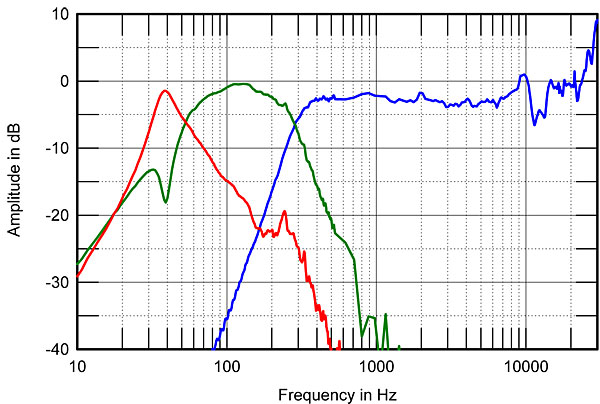
Fig.2 shows the individual responses of the port (red trace), the woofer (green), and the coaxial upper-frequency drive-unit (blue). Below 350Hz, the latter two traces were taken with the microphone in the nearfield; above that frequency, the traces show the drive-units' farfield responses on the tweeter axis. The saddle centered on 38Hz in the impedance-magnitude trace suggests that this is the tuning frequency of the port; this is confirmed by the minimum-motion notch in the woofer's nearfield output in fig.2 occurring at the same frequency. The port's output is a tidy bandpass covering the octave between 30 and 60Hz, with only a slight hint of a resonant peak at 250Hz disturbing its upper-frequency rolloff. The woofer's output crosses over to the coaxial driver at pretty much the specified 250Hz, with what appear to be 18dB/octave filter slopes. The woofer's behavior above its passband is smooth, and the coaxial drive-unit's response is astonishingly flat, up to the region where the tweeter's output starts to be affected by the fact that it is symmetrically surrounded by the midrange cone. This gives rise to a small peak at 9kHz, followed by an equally small dip in the response at 12kHz. Above that frequency, the tweeter's output continues smoothly until it starts to rise just below the 30kHz limit of this graph.
Fig.2 TAD Compact Reference CR1, acoustic crossover on tweeter axis at 50", corrected for microphone response, with nearfield woofer (green trace) and port (red) responses, plotted below 1200 and 600Hz, respectively.
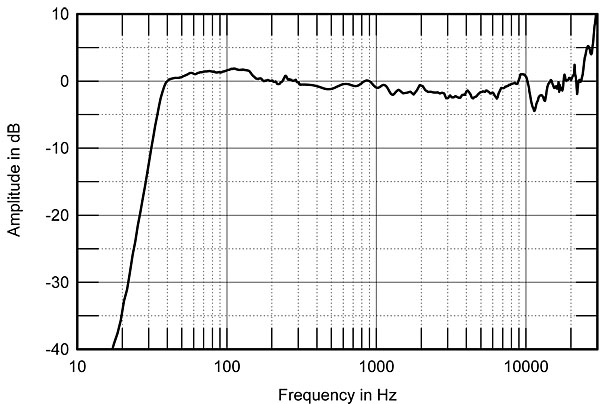
The 6dB boost in the upper bass that results from the nearfield measurement is absent in this graph, suggesting that the TAD Compact Reference's woofer alignment is on the overdamped side. The rolloffs of the woofer and port below the port tuning frequency in fig.3 conform to the usual 12dB/octave. When the woofer and port outputs are summed, taking acoustic phase angle into account, the CR1's calculated low-frequency nearfield response drops 24dB/octave (fig.3 below 300Hz). The CR1's farfield response, averaged across a 30° horizontal window centered on the tweeter axis, is again superbly flat from the midrange through to the high treble.
Fig.3 TAD Compact Reference CR1, anechoic response on tweeter axis at 50", averaged across 30° horizontal window and corrected for microphone response, with complex sum of nearfield responses, plotted below 300Hz.
Fig.4 TAD Compact Reference CR1, lateral response family at 50", normalized to response on tweeter axis, from back to front: differences in response 90–5° off axis, reference response, differences in response 5–90° off axis.
Fig.5 TAD Compact Reference CR1, vertical response family at 50", normalized to response on tweeter axis, from back to front: differences in response 15–5° above axis, reference response, differences in response 5–10° below axis.
Fig.6 TAD Compact Reference CR1, spatially averaged, 1/6-octave response in JA's listening room.
Turning to the time domain, the CR1's step response on its tweeter axis (fig.7) suggests that all three drive-units are connected in positive acoustic polarity, which I confirmed by looking at the individual drive-unit steps (not shown). The speaker's output is not time-coincident, but it is time-coherent, in that the decay of each unit's step on the tweeter axis blends smoothly with that of the next lower in frequency. The result is that, as you could see in the CR1's on-axis frequency response (fig.3), the drive-units' outputs smoothly add in the frequency domain to give a flat response through the two crossover regions. The TAD's cumulative spectral-decay plot (fig.8) has an initially clean decay, but with some low-level hash visible in the midrange. I am not sure where this stems from, and, of course, this is the frequency region where quasi-anechoic measurements have limited resolution.
Fig.7 TAD Compact Reference CR1, step response on tweeter axis at 50" (5ms time window, 30kHz bandwidth).
Fig.8 TAD Compact Reference CR1, cumulative spectral-decay plot on tweeter axis at 50" (0.15ms risetime).
Summing up the measured performance of the TAD Compact Reference CR1 is easy: This is textbook behavior!—John Atkinson