


A comment by "cgh" in an online reprint of a Stereophile review caught my attention: "The [1990s] were probably the last real decade that we could reasonably bend the truth. Everything since is verifiable electronically."
Everything? After a quarter century of measuring the performance of audio components for this magazine, I'm not so sure that we have a firm handle on what makes audio products sound different from one another. Even when it comes to measuring loudspeakers, it can be difficult to characterize their performance in an objective manner. For a case in point, see my review of the Nola Metro Grand Reference Gold loudspeaker last September, in which even evaluating something as basic as its frequency response proved far from straightforward.
The Nola is a complex, idiosyncratic design. But what about more conventional designs, like two-way, stand-mounted speakers? Consider, for example, the Revel Performa3 M106 (footnote 1), which Robert J. Reina reviewed in September 2014. Bob had nothing but praise for this $2000/pair speaker: "Revel's Performa3 M106 is an extraordinary bookshelf loudspeaker," he summed up. "Its strengths impressed me across the board, especially for a speaker of its size and price. . . . I've reviewed several dozen bookshelf speakers since . . . 1985, and I don't think I've enjoyed music of all genres through any of them as much as have through the M106."
Following the review, I set up the Revels in my listening room, both to audition them for myself and to compare them with the two-way, stand-mounted KEF LS50 ($1500/pair, footnote 2), which was our 2013 "Loudspeaker of the Year" and "Overall Product of the Year." I reviewed the KEF LS50 in December 2012, with Follow-Ups from Stephen Mejias in May 2014 and Sam Tellig in June 2014. (All this coverage can be found here.)
Both the Revel and KEF come from companies that are heavily based in engineering. KEF, headquartered in England but with production in its Chinese factory, was the first speaker manufacturer to make use of FFT measurement techniques. Revel, based in southern California but having its Performa3 models, including the M106, assembled in Indonesia, has access to Harman's R&D facilities. These labs were set up by the renowned Dr. Floyd Toole, whose series of papers on loudspeaker performance in the 1980s defined which factors were of primary importance. KEF's design team is led by Jack Oclee-Brown, Revel's by Kevin Voecks and Mark Glazer, all well-respected engineers.
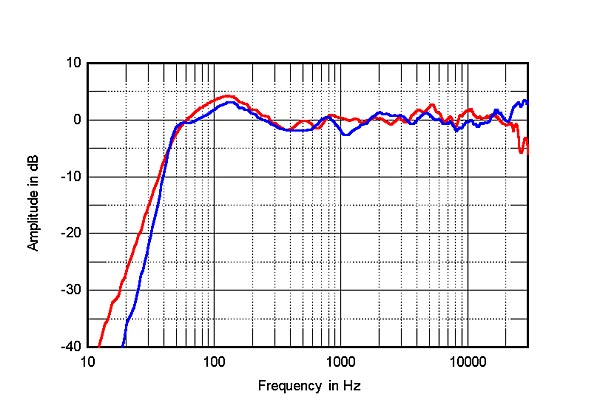
Before I discuss my auditioning of these two speakers, fig.1 compares their anechoic responses on the tweeter axis at 50", averaged across a 30° horizontal window and with the complex sum of the woofer and port nearfield responses plotted below 300Hz. (I used DRA Labs' MLSSA system and a calibrated DPA 4006 microphone.) The blue trace is the KEF, the red trace the Revel. Despite their differences in design—the Revel is a conventional two-way with the tweeter mounted above the woofer, while the KEF has a coaxial Uni-Q driver, in which the tweeter is mounted on the front of the woofer magnet's pole-piece—the two speakers measure very similarly. Both have a very flat, even response, though the M106 has 1–2dB more energy apparent above 4kHz. Both have an apparent peak in the upper bass that is almost entirely an artifact of the nearfield measurement technique. And both have a port tuned to just above 50Hz, though the KEF appears to roll off a little more quickly than the Revel below the midbass region.
 The two traces match extremely closely in the upper bass and lower midrange, which is perhaps not surprising given that both pairs of speakers were positioned in the same places in the room and their horizontal radiation patterns are identical in these frequency regions. But what is surprising is that the Revel M106 excites the lowest-frequency room mode, around 32Hz, to a much greater extent than the KEF LS50, with a concomitant increase in effective bass extension. Higher in frequency, the KEF has a couple of small peaks evident, centered on 800Hz and 2.1kHz, and the Revel 1–2dB more energy from 3 to 16kHz. But other than those matters, both speakers offer smooth, even in-room responses.
It is not unreasonable, therefore, to think that these two speakers would sound more alike than different. Not unreasonable, but incorrect. The Revel's more extended low frequencies in the in-room response were audible—I didn't use the optional port plugs—but not significantly so with most recordings, at least at reasonable levels. The Revels could play louder than the KEFs without strain, and with my recording of organist Jonas Nordwall playing the Toccata of Widor's Organ Symphony 5 in the First United Methodist Church of Portland, Oregon (24-bit/88.2kHz AIFF file), the LS50s couldn't keep up with the M106es when it came to high levels of low bass. The KEFs did present a little more upper-bass energy than I was expecting from the in-room measurements. But although the speakers' midranges sounded similar, their treble sounds were surprisingly different.
Both speakers reproduced male voices of all types with convincingly natural tonal colors: Bill Medley's phlegmy baritone, for example, in his singing, with Phil Everly and Brian Wilson, of the latter's "In My Room," from Medley's Damn Near Righteous (256kbps AAC downloaded from a YouTube link that seems to have disappeared, though the CD is now available); Jimmy Webb's tenor on the bayon-rhythmed "Campo de Encino," from his Letters (ALAC file ripped from CD, Reprise); and Aaron Neville's haunting alto in "Amazing Grace," from our January 1990 "Recording of the Month," Daniel Lanois's Acadie (ALAC rip from CD, Opal/Warner Bros. 25969-2). I could live with either speaker for these tracks, and the Revels had a slight advantage when it came to decoding the overcompressed historical document that is the Medley-Everly-Wilson collaboration. Similarly, the M106es did a little better when it came to separating the strands in the dense mix of the title track of our June 2013 "Recording of the Month," Aidan Baker's Already Drowning (ALAC file ripped from CD, Gizeh GZH 043CD).
But as much as I appreciated the Revel's transparency to recorded detail, its treble was a little unforgiving. The cymbals in "Almost Drowning" had too much sizzle, for example, though it's fair to point out that Bob Reina loved how the Revel handled the high frequencies. "The percussion transients were lightning-fast and clean, but also relaxed and natural, with a 'rightness' that made transients through other speakers sound mechanical or artificial," he wrote, and mentioned the speaker's "extended and airy highs." Yes, the Revel's top octaves were extended and airy, but too much so in my room and system. Women's voices didn't fare as well as men's, acquiring a bit of a hard edge, and when the recording was of doubtful quality—much as I love Chrissie Hynde, there's no pretending that the Pretenders' singles are anything like audiophile quality—I wanted to turn down the volume a tad. Overall, the Revel's top two octaves seemed slightly disconnected from the lower-frequency body of instrumental and vocal tones.
By contrast, the KEF LS50s presented the treble region of Hynde's voice more in the correct proportion to the body of her tone in the midrange. So while, in "Talk of the Town," there was still a touch of "spitch" to her sibilants in the words sky, sit, some, and shots, this didn't detract from the overall experience. In fact, although it had been two years since I'd last listened to the KEF LS50 at home, getting a new pair reminded me why I had so highly recommended them. "It is rare to find a loudspeaker that offers this combination of clarity and neutrality," I wrote in my 2012 review, adding that "the LS50 is one of the finest speakers at reproducing female voices that I have heard." My experience of this second pair didn't change that opinion. The KEF LS50 gave a sound that was evenly balanced from the upper bass through the high treble, with superbly defined imaging.
The Revels' imaging was also superb, with excellent stability of central sound sources. But I kept coming back to its treble balance. It's fair to point out that the Triangle Signature Delta speaker, which I reviewed last September (footnote 3), had as much treble energy in-room as the Revel M106, though with a less even balance. However, that large, three-way tower has an octave more low-frequency extension than the stand-mounted Revel, which better balances its treble.
Looking again at fig.2, although the Revel M106 has just 1–2dB more energy in-room above 3kHz than the KEF, this excess covers two-and-a-half octaves. There is therefore a large "area under the curve," making this excess, compared with the KEF, more audible than the difference in level would imply. I remember setting up a pair of Revel Ultima Salon2s in my room in 2009 (footnote 4). The Salon2 has a level switch for the tweeter that operates in 0.5dB steps, and it turned out that the optimal treble balance would have been between two of those steps. With the switch affecting the entire range covered by the tweeter, a level difference of just 0.25dB turned out to be significant.
In rooms that are larger than mine and/or more damped in the treble, therefore, the Revel M106's treble would tend to sound in better balance with the midrange, while the LS50 might sound too mellow. (My room is not overdamped, with a reverb time that averages around 250ms in the midrange and low treble, reducing in the top two octaves.) But the Revel would be a less-optimal choice than the KEF for small, lively rooms, especially if the electronics in the system tended toward the overanalytical—such as MBL's Corona C15 monoblocks, which I reviewed last June.
That two such well-engineered loudspeakers with broadly similar measurements can sound so different reinforces our long-term advice: While reviews are a useful guide to which products you might consider buying, an audition in your home with your system is still of primary importance.—John Atkinson
The two traces match extremely closely in the upper bass and lower midrange, which is perhaps not surprising given that both pairs of speakers were positioned in the same places in the room and their horizontal radiation patterns are identical in these frequency regions. But what is surprising is that the Revel M106 excites the lowest-frequency room mode, around 32Hz, to a much greater extent than the KEF LS50, with a concomitant increase in effective bass extension. Higher in frequency, the KEF has a couple of small peaks evident, centered on 800Hz and 2.1kHz, and the Revel 1–2dB more energy from 3 to 16kHz. But other than those matters, both speakers offer smooth, even in-room responses.
It is not unreasonable, therefore, to think that these two speakers would sound more alike than different. Not unreasonable, but incorrect. The Revel's more extended low frequencies in the in-room response were audible—I didn't use the optional port plugs—but not significantly so with most recordings, at least at reasonable levels. The Revels could play louder than the KEFs without strain, and with my recording of organist Jonas Nordwall playing the Toccata of Widor's Organ Symphony 5 in the First United Methodist Church of Portland, Oregon (24-bit/88.2kHz AIFF file), the LS50s couldn't keep up with the M106es when it came to high levels of low bass. The KEFs did present a little more upper-bass energy than I was expecting from the in-room measurements. But although the speakers' midranges sounded similar, their treble sounds were surprisingly different.
Both speakers reproduced male voices of all types with convincingly natural tonal colors: Bill Medley's phlegmy baritone, for example, in his singing, with Phil Everly and Brian Wilson, of the latter's "In My Room," from Medley's Damn Near Righteous (256kbps AAC downloaded from a YouTube link that seems to have disappeared, though the CD is now available); Jimmy Webb's tenor on the bayon-rhythmed "Campo de Encino," from his Letters (ALAC file ripped from CD, Reprise); and Aaron Neville's haunting alto in "Amazing Grace," from our January 1990 "Recording of the Month," Daniel Lanois's Acadie (ALAC rip from CD, Opal/Warner Bros. 25969-2). I could live with either speaker for these tracks, and the Revels had a slight advantage when it came to decoding the overcompressed historical document that is the Medley-Everly-Wilson collaboration. Similarly, the M106es did a little better when it came to separating the strands in the dense mix of the title track of our June 2013 "Recording of the Month," Aidan Baker's Already Drowning (ALAC file ripped from CD, Gizeh GZH 043CD).
But as much as I appreciated the Revel's transparency to recorded detail, its treble was a little unforgiving. The cymbals in "Almost Drowning" had too much sizzle, for example, though it's fair to point out that Bob Reina loved how the Revel handled the high frequencies. "The percussion transients were lightning-fast and clean, but also relaxed and natural, with a 'rightness' that made transients through other speakers sound mechanical or artificial," he wrote, and mentioned the speaker's "extended and airy highs." Yes, the Revel's top octaves were extended and airy, but too much so in my room and system. Women's voices didn't fare as well as men's, acquiring a bit of a hard edge, and when the recording was of doubtful quality—much as I love Chrissie Hynde, there's no pretending that the Pretenders' singles are anything like audiophile quality—I wanted to turn down the volume a tad. Overall, the Revel's top two octaves seemed slightly disconnected from the lower-frequency body of instrumental and vocal tones.
By contrast, the KEF LS50s presented the treble region of Hynde's voice more in the correct proportion to the body of her tone in the midrange. So while, in "Talk of the Town," there was still a touch of "spitch" to her sibilants in the words sky, sit, some, and shots, this didn't detract from the overall experience. In fact, although it had been two years since I'd last listened to the KEF LS50 at home, getting a new pair reminded me why I had so highly recommended them. "It is rare to find a loudspeaker that offers this combination of clarity and neutrality," I wrote in my 2012 review, adding that "the LS50 is one of the finest speakers at reproducing female voices that I have heard." My experience of this second pair didn't change that opinion. The KEF LS50 gave a sound that was evenly balanced from the upper bass through the high treble, with superbly defined imaging.
The Revels' imaging was also superb, with excellent stability of central sound sources. But I kept coming back to its treble balance. It's fair to point out that the Triangle Signature Delta speaker, which I reviewed last September (footnote 3), had as much treble energy in-room as the Revel M106, though with a less even balance. However, that large, three-way tower has an octave more low-frequency extension than the stand-mounted Revel, which better balances its treble.
Looking again at fig.2, although the Revel M106 has just 1–2dB more energy in-room above 3kHz than the KEF, this excess covers two-and-a-half octaves. There is therefore a large "area under the curve," making this excess, compared with the KEF, more audible than the difference in level would imply. I remember setting up a pair of Revel Ultima Salon2s in my room in 2009 (footnote 4). The Salon2 has a level switch for the tweeter that operates in 0.5dB steps, and it turned out that the optimal treble balance would have been between two of those steps. With the switch affecting the entire range covered by the tweeter, a level difference of just 0.25dB turned out to be significant.
In rooms that are larger than mine and/or more damped in the treble, therefore, the Revel M106's treble would tend to sound in better balance with the midrange, while the LS50 might sound too mellow. (My room is not overdamped, with a reverb time that averages around 250ms in the midrange and low treble, reducing in the top two octaves.) But the Revel would be a less-optimal choice than the KEF for small, lively rooms, especially if the electronics in the system tended toward the overanalytical—such as MBL's Corona C15 monoblocks, which I reviewed last June.
That two such well-engineered loudspeakers with broadly similar measurements can sound so different reinforces our long-term advice: While reviews are a useful guide to which products you might consider buying, an audition in your home with your system is still of primary importance.—John Atkinson
Footnote 1: The Performa3 M106 costs $2000/pair. Revel, Harman Luxury Audio Group, 8500 Balboa Blvd., Northridge, CA 91329. Tel: (888) 691-4171. Web: www.revelspeakers.com. Footnote 2: The LS50 costs $1500/pair. GP Acoustics (UK) Ltd., Eccleston Road, Tovil, Maidstone, Kent ME15 6QP, England, UK. US distributor: GP Acoustics (US) Inc., 10 Timber Lane, Marlboro, NJ 07746. Tel: (732) 683-2356. Fax: (732) 683-2358. Web: www.kef.com. Footnote 3: See fig.7 here. Footnote 4: With their treble controls set to Flat, the Salons2s had perhaps the smoothest spatially averaged response any speaker has had in my current room.
Fig.1 Revel Performa3 M106 (red) and KEF LS50 (blue), anechoic response on tweeter axis at 50", averaged across 30° horizontal window and corrected for microphone response, with complex sum of nearfield responses plotted below 300Hz.
Fig.2 shows the spatially averaged, 1/6-octave response of the two speakers in my listening room. (Using an Earthworks QTC-40 microphone, I average 20 1/6-octave–smoothed spectra, taken for the left and right speakers individually using SMUGSoftware's FuzzMeasure 3.0 program and a 96kHz sample rate, in a rectangular grid 36" wide by 18" high and centered on the positions of my ears.) Again the Revel Performa3 M106 is the red trace, the KEF LS50 the blue trace; and while the Revel is 2dB more sensitive than the KEF, I have equalized the levels at 1kHz to make the differences stand out.
Fig.2 Revel Performa3 M106 (red) and KEF LS50 (blue), spatially averaged, 1/6-octave response in JA's listening room.
Footnote 1: The Performa3 M106 costs $2000/pair. Revel, Harman Luxury Audio Group, 8500 Balboa Blvd., Northridge, CA 91329. Tel: (888) 691-4171. Web: www.revelspeakers.com. Footnote 2: The LS50 costs $1500/pair. GP Acoustics (UK) Ltd., Eccleston Road, Tovil, Maidstone, Kent ME15 6QP, England, UK. US distributor: GP Acoustics (US) Inc., 10 Timber Lane, Marlboro, NJ 07746. Tel: (732) 683-2356. Fax: (732) 683-2358. Web: www.kef.com. Footnote 3: See fig.7 here. Footnote 4: With their treble controls set to Flat, the Salons2s had perhaps the smoothest spatially averaged response any speaker has had in my current room.















