

 Editor's note: After my review of the LCD-4, Audeze emailed me concerning discrepancies between my measurements and theirs. Numerous fairly technical emails were exchanged, I sent a number of Excel spreadsheets of my measurements for their use in comparisons, and there certainly does seem to be a discrepancy between measurements.
The folks at Audeze asked if they could write an article about these measurement observations and their response to my LCD-4 review. I said, "Of course, I've got plenty to learn on this subject." This article is Audeze's response.
How much do you trust measurements to determine how a headphone will sound? What if measurements from different systems vary significantly, which set of measurement would you use to judge how a headphone will sound?
Editor's note: After my review of the LCD-4, Audeze emailed me concerning discrepancies between my measurements and theirs. Numerous fairly technical emails were exchanged, I sent a number of Excel spreadsheets of my measurements for their use in comparisons, and there certainly does seem to be a discrepancy between measurements.
The folks at Audeze asked if they could write an article about these measurement observations and their response to my LCD-4 review. I said, "Of course, I've got plenty to learn on this subject." This article is Audeze's response.
How much do you trust measurements to determine how a headphone will sound? What if measurements from different systems vary significantly, which set of measurement would you use to judge how a headphone will sound?
 The differences we see in measurements -- not just on Tyll's system but across multiple systems -- are due to many factors, including how the inner ear is modeled, the differences in pinna and concha geometry, and how the headphone and earpad interact with the pinna. Adding to the confusion are measurements published by different users.
Audeze designs its headphones to sound as natural and as close to the original performance as possible. We always strive to accurately reproduce instruments and vocals, each in their own space. Our goal is to make them sound like a good pair of speakers in a well treated room.
- Our engineers have their own set of measurements made with probe microphones near the eardrum and we measure the response of our headphones and our reference stereo speakers. Then we measure using dummy heads and ear simulators. Over time we've accumulated tens of thousands of these measurements in our database.
- We compare test tracks played through our headphones to those played through a pair of reference stereo speakers in a well-treated room.
- We conducted dozens of live recording sessions with a grammy award winning recording engineer and recorded vocals and instruments in controlled environments including position of the artists, microphone orientation, etc. We listen carefully to how our headphones reproduce the music. We're proud of the accurate imaging and natural tonal balance of our headphones.
- We have developed DSP tools that allow us to modify the frequency response and impulse response of our headphones without introducing artifacts and without the need to physically modify our headphones. These tools help us evaluate how changes and tweaks to the headphone's response affect what we ultimately hear.
- We use several sound engineers to beta test them in studios.
The LCD-4 is the results of years of research and development to ensure the most natural and transparent sound possible. That's why it was a shock to read Tyll's LCD-4 review. We respect Tyll's subjective opinions about the sound and we'll leave it at that. But the measurements published on Innerfidelity and their interpretation contradicts our own. After Tyll's comments on the measurements, we reviewed everything objectively; the summary of our findings and our view of the measurements are provided below. We also measured the LCD-4 at a third-party facility and shared this information with Tyll.
Here's what Tyll's article said about the frequency response of the LCD-4 he reviewed: (Quote: A) "Most all LCD headphones I've measured in the past have a distinct drop in treble response starting at 4kHz and going up to about 8kHz." (Quote: B) "You can see that the LCD-4 is essentially flat from 4kHz to 20kHz when it should be a falling response."
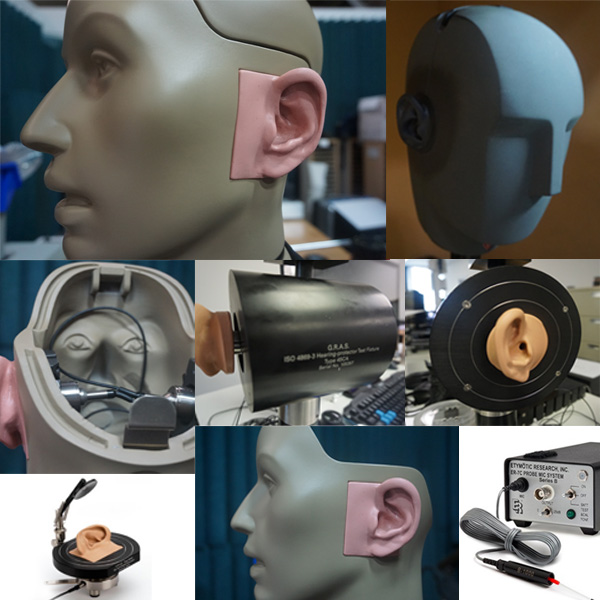
We measured the LCD-4 on: a. Artificial head: GRAS KEMAR RA0045 Ear Simulator, KB0066 and KB0065 Pinnae in IEC 60318-4 (previously 60711) configuration. b. Ear and Cheek Simulator: GRAS 43AG in IEC 60318-4 configuration. c. Headphone test fixture: GRAS 45CA, KB0071 pinnae, IEC 60711 Ear Simulator. (This setup is similar to the one used in in this paper on Listener Preferences for Different Headphone Target Response Curves by Sean Olive et al. We also used a Sennheiser HD800 as a control to verify that they measured similarly in this setup to those shown in Seal Olive et al paper.
An average of 10 measurements were used and a 12th-octave smoothing was applied. All measurements are raw and no compensation curve was applied. Measurements were at DRP (Drum Reference Point).

Graph of LCD-4 on various setups at Audeze vs Tyll's HATS
As you can see from the different graphs, there is significant variation in measurements after 2kHz. You can also see around 6kHz, there is almost a 5dB difference. After 6kHz, you can see the response slanting downwards.
The characteristic dip between in the 4kHz-5kHz region is due to the earpad shape and prevents our LCD series from appearing bright.
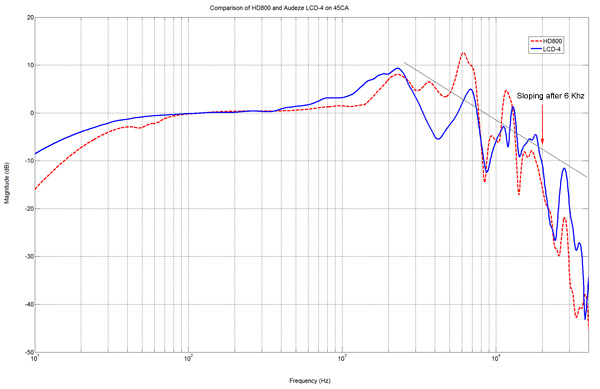
Below we have plotted a graph of LCD-4 vs HD 800 on a GRAS 45CA (control measurement). We did this to make sure our measurement setup yielded similar results to what was published in the paper by Sean Olive et al.
 As another comparison, we have measured LCD-4 using in-ear probes at DRP and also measured HD800 at DRP (as control, red dotted line) and we have plotted the average of 5 measurements each made on the left ear. Note that we have included only the range 250Hz to 10kHz as per the probe specification.
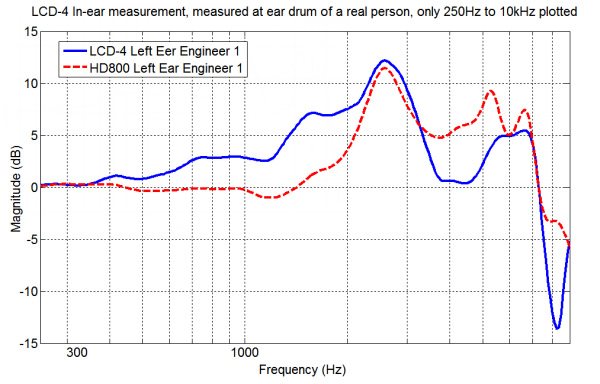 Sometimes removing the ear canal resonance gives a different perspective on the measurements. Below we have plotted the in-ear measurements we made at the ear canal entrance of one of our engineers for the LCD-4 and another planar headphone. Compared to the other headphone we do not see significant deficiencies in the treble region here either.
 The Audeze Sound
 - Unparalleled low-frequency extension due to our large planar drivers and the good seal established by our headband and earpads.
- Smooth through the midrange due to excellent control we have on our diaphragm.
- Close to ideal mid and upper-treble extension starting at 6kHz, slanting downwards from there to 40kHz.
Measurements across multiple systems are significantly different due to the differences in the pinna, concha geometry, inner ear model and how the earpads and headphone interact.















