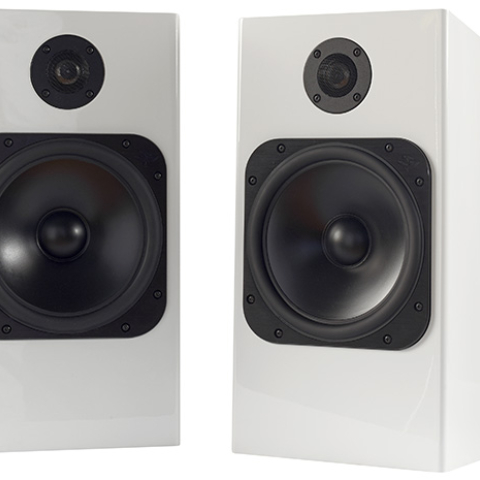
The two-way, biwirable, rear-ported Dreamcatcher is designed and manufactured in Canada; its drive-units are designed by Totem, but made and assembled in Europe. The 1" titanium-dome tweeter, manufactured by German Acoustik, is mated to a 4" Scan-Speak woofer. Totem founder Vince Bruzzese feels very strongly about sourcing his drivers in the West. In the past, he got his small woofers from Peerless in Denmark, but switched to Scan-Speak when Peerless started manufacturing in China. Bruzzese also pointed out that the tweeter used in the Dreamcatcher costs him 16, more than 15 times as much as most similar Asian-made tweeters.
The Dreamcatcher is built using lock-mitered construction, a technique derived from the construction of heirloom furniture, which Totem claims contributes to a speaker cabinet's rigidity, longevity, and visual beauty. The speakers are available finished in Black Ash or genuine Mahogany ($575/pair), Cherry ($625), or White ($650). My white samples were quite attractive, blending with my room's décor without calling attention to themselves.
When I knocked on a Dreamcatcher's cabinet, I could sense no trace of cabinet resonance—something I expect to experience only with much more expensive speakers. Totem strongly recommends that the Dreamcatchers be listened to with their grilles removed. I listened with and without the grilles, and heard a negligible difference; grille-less, there was a touch more transparency. I was further encouraged to leave the grilles off because they made the Dreamcatcher look cheap; naked, the speakers looked like much more expensive speakers. Totem also recommends that the Dreamcatcher be given 40–50 hours of break-in before any serious listening is begun. (My review samples had already had over 100 hours of break-in when I received them.) As usual with bookshelf models, I placed the Dreamcatchers on my steel Celestion Si stands, which I've filled with sand and lead shot.
Sound
The Dreamcatcher has been one of the most difficult speakers I've reviewed, with a sound very different from that of any other affordable speaker I've heard. It took me many hours of listening to get to the bottom of what made this little speaker tick, and to find the appropriate words to describe its performance. It's easiest to describe what the Dreamcatcher doesn't do. The laws of physics dictate that there is a limit to the bass extension possible from a small bookshelf speaker. Although the Dreamcatcher didn't sound bass-shy to me, we'll see where John Atkinson's measurements reveal its lower limit to be. It's also not physically possible for a speaker this small to create the high-level dynamic slam of a larger floorstanding loudspeaker, especially with recordings of dramatic orchestral works. Finally, the Dreamcatcher didn't strike me as being the most well-balanced speaker—its high-frequency reproduction is very extended compared to its limited bottom-end extension. The Paradigm Atom v.5, for example, has a much better-balanced sound in which its subjective HF attenuation seems to match its lack of bass extension. But the Dreamcatcher never sounded bright, and its extended HF performance didn't emphasize the lack of low bass, for example, as did the original ProAc Tablette when I last heard it. Those minor caveats out of the way, I can comfortably say that the Totem Dreamcatcher's performance was just about flawless throughout my listening. From its taut, tuneful, perfectly clean midbass to the highest frequencies, there was no trace of coloration or distortion, and the ability of the pair of them to throw a wide, deep soundstage, even when I sat off axis, was beyond reproach. And for such a tiny bookshelf, the Dreamcatcher was able to reproduce, with dense orchestral fortissimos, a reasonable sense of high-level drama without compression or strain. Even in my large listening room, it behaved like a much larger speaker.
Five attributes of the Dreamcatcher combined to create a breathtaking level of realism that I'd never heard from any other bookshelf speaker. First, the degree of resolution in the midrange let me listen deeply into each recording to uncover an extraordinary amount of detail. This, combined with the best low-level dynamic reproduction I've heard from any speaker—a completely linear integration of loudnesses from pppp to p—made the Dreamcatcher an extremely realistic re-creator of all voices and acoustic instruments. And unlike most bookshelf speakers of this size, which tend to have a subtle thinness in the lower midrange that adds a touch of politeness to tenor saxophones and male voices, the Totem had a rich quality in this region that reminded me of a much larger speaker. Fourth, the integration of this quality of midrange with the Dreamcatcher's detailed, extended, and pristine high frequencies was the best I'd ever heard from a small bookshelf, and more akin to what I'm used to hearing from more expensive electrostatic speakers. And finally, the Totem's perfect reproduction of all transients, with lightning-fast attack and recovery but no trace of sharpness, gave a startling level of realism to all percussion instruments and plucked strings.
The Dreamcatcher has been one of the most difficult speakers I've reviewed, with a sound very different from that of any other affordable speaker I've heard. It took me many hours of listening to get to the bottom of what made this little speaker tick, and to find the appropriate words to describe its performance. It's easiest to describe what the Dreamcatcher doesn't do. The laws of physics dictate that there is a limit to the bass extension possible from a small bookshelf speaker. Although the Dreamcatcher didn't sound bass-shy to me, we'll see where John Atkinson's measurements reveal its lower limit to be. It's also not physically possible for a speaker this small to create the high-level dynamic slam of a larger floorstanding loudspeaker, especially with recordings of dramatic orchestral works. Finally, the Dreamcatcher didn't strike me as being the most well-balanced speaker—its high-frequency reproduction is very extended compared to its limited bottom-end extension. The Paradigm Atom v.5, for example, has a much better-balanced sound in which its subjective HF attenuation seems to match its lack of bass extension. But the Dreamcatcher never sounded bright, and its extended HF performance didn't emphasize the lack of low bass, for example, as did the original ProAc Tablette when I last heard it. Those minor caveats out of the way, I can comfortably say that the Totem Dreamcatcher's performance was just about flawless throughout my listening. From its taut, tuneful, perfectly clean midbass to the highest frequencies, there was no trace of coloration or distortion, and the ability of the pair of them to throw a wide, deep soundstage, even when I sat off axis, was beyond reproach. And for such a tiny bookshelf, the Dreamcatcher was able to reproduce, with dense orchestral fortissimos, a reasonable sense of high-level drama without compression or strain. Even in my large listening room, it behaved like a much larger speaker.